The quick read
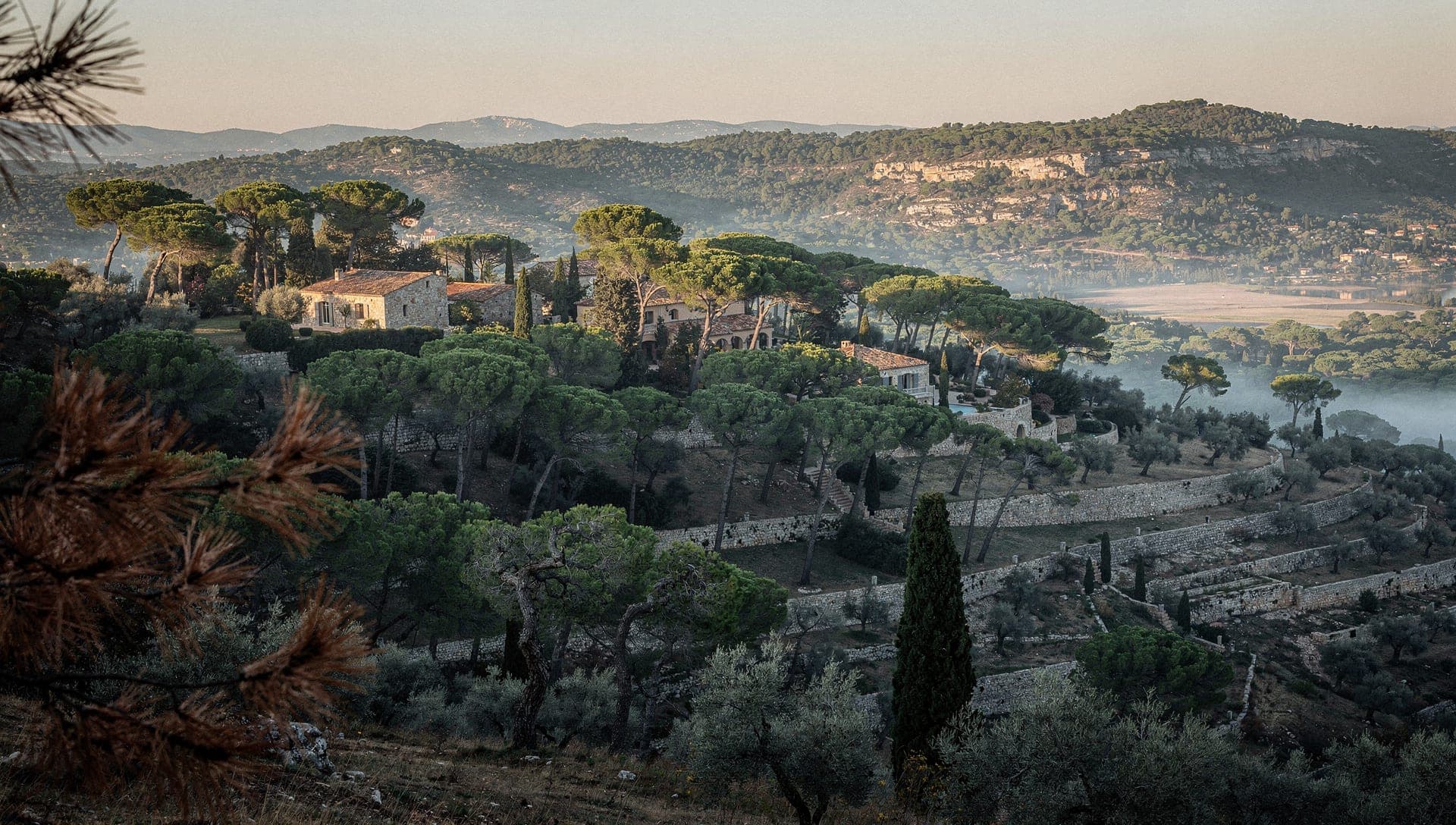
Roquefort-les-Pins houses of 100 m² or more sold for €1M or more had a 2025 DVF median of 7,440 euros a square metre, with a median sale price of 1,261,025 euros. MeilleursAgents’ July 2026 estimate, which covers houses at every price, is lower at 5,851 euros. That makes it one of the more reasonable serious addresses across the eight-village hinterland: on the €1M floor it is cheaper per metre than Mougins, Biot, Valbonne, Châteauneuf-de-Grasse and Opio, and dearer only than Grasse. The DVF median fell 12 per cent between 2024 and 2025 after three years of gains, a reminder that a market of 30 such sales a year moves in steps. The commune runs across 21.5 square kilometres of pine woods and large gardens, and that space is the whole point of buying here. You pay for room and quiet, not for a walkable old village, because Roquefort does not have one. If you want a big plot within fifteen minutes of Sophia Antipolis and twenty of the sea, this is the value end of that trade. The rest of this piece takes the price apart sector by sector, sets it against the neighbours, and gives our view on where the room to negotiate sits.
What a square metre costs now
There is no single true number for Roquefort-les-Pins, and anyone who quotes you one is rounding. The public price indices disagree because the commune is spread out and every sale carries a different plot size, view and condition. Here is where the main sources landed for mid-2026.
| Source | Date | Houses (euro/m²) | Note |
|---|---|---|---|
| MeilleursAgents | Jul 2026 | 5,851 | apartments 5,487 |
| SeLoger | Jan 2026 | 5,722 | range 2,700 to 9,700 |
| efficity | Apr 2026 | 6,220 | all types |
| PAP | Jul 2026 | 6,391 | all types |
| Trackstone | 2026 | about 6,459 | up 2.3% year on year |
Read the spread rather than the midpoint. The bottom of the range, near 2,700 euros a metre, is a tired apartment or an old villa on a small plot beside the RD2085. The top, close to 9,700, is a renovated single-storey villa on a flat plot with a view and a pool. Most family houses that change hands sit between 5,500 and 7,000 euros a metre once you weight for condition. Apartments are thin on the ground because Roquefort was built as a house commune, so the apartment figure moves a lot on a handful of sales. The base price for those numbers is the DVF file, the record of registered sale prices published by the tax authority, layered over current asking prices. Treat every online estimate as a starting point and price the plot, not the postcode.
Sector by sector
Roquefort has no dense medieval core to anchor prices, so the sector map here is a map of plot size, road noise and how far you sit from the RD2085 that cuts the commune in two. The village centre gathers around Place Bermond, with the church, the mairie, a handful of shops and the weekly market. Property right on the centre is the exception rather than the rule: you gain walkability but lose the big garden that most buyers come for.
- Les Plans and La Colle. The established villa sectors north and east of the centre, flatter ground and larger gardens, often 1,500 square metres or more. Neither is one of the sectors we map, so we publish no DVF figure for them.
- Fromentiere and Font-Vive. Quiet residential pockets with a mix of 1980s and 1990s villas. Not mapped sectors either, so no DVF figure. There is room to negotiate on anything that needs a kitchen and bathrooms.
- Les Terres Blanches and Le Camouyer. Larger, more wooded plots on the Villeneuve-Loubet side, popular with buyers who want privacy and a short run to the A8. DVF records no house sale of €1M or more in the Les Terres Blanches lieu-dit over 2021–2025: too few to publish a figure. Across Roquefort-les-Pins, the median for the same years is €7,364/m². Some plots are steep or partly unbuildable, so read the terrain.
- Notre-Dame and La Bergerie. Older, leafier lanes closer to the Le Rouret boundary. This is where the horse country feel is strongest, with paddocks behind the hedges and the occasional equestrian property. DVF records 9 house sales of €1M or more in the Notre Dame lieu-dit over 2021–2025, at a median of €7,493/m², close to Roquefort-les-Pins’s €7,364/m² for the same years.
Our shorthand for the commune is simple. The further you get from the RD2085 and the flatter the ground, the more you pay and the easier the resale. A steep plot or a house that fronts the road is where the discounts live. Our sector pages cover Le Colombier and Les Terres Blanches.
How Roquefort compares
Roquefort sits towards the value end of the hinterland table. Among the seven towns measured on houses sold for €1M or more, only Grasse is cheaper per square metre. Here is the house price per square metre across the neighbours on the 2025 DVF medians for houses of 100 m² or more sold for €1M or more. Le Rouret is shown on its own €700,000 floor, so do not read it against the others.
| Commune | Houses sold for €1M or more (euro/m², DVF 2025) | Read |
|---|---|---|
| Mougins | 10,073 | reputation, but a wide internal range |
| Valbonne | 8,986 | the anchor village, Sophia on the doorstep |
| Châteauneuf-de-Grasse | 8,705 | hilltop views carry a premium |
| Opio | 8,593 | the plot premium, olive and golf |
| Roquefort-les-Pins | 7,440 | space and quiet for less |
| Le Rouret | 6,349 (houses sold for €700,000 or more) | the quiet value pick, on a lower floor |
The gap that matters most is with Valbonne. A buyer choosing Roquefort over Valbonne is trading the walkable Place des Arcades and the Sophia commute measured in single-digit minutes for a bigger garden and a slightly longer drive. On a 200 square metre villa that difference is about 309,000 euros at the €1M+ median rate, and often more once you factor in that Roquefort plots tend to be larger. Against Opio the saving is smaller, about 230,000 euros, and Opio buyers are usually paying for a specific olive-grove or golf setting that Roquefort does not try to match.
What is firming, what has stalled
The 12 per cent fall in the 2025 DVF median for houses sold for €1M or more hides a two-speed market. What is firming is the well-presented single-storey villa on a flat, usable plot of 1,500 to 3,000 square metres, ideally with a pool, a good energy rating and nothing obvious to spend on. These sell inside three months and rarely move far off asking, because the buyers are cash-rich relocators and second-home owners who will not take on a building site. Supply of that exact house is thin, and scarcity is doing most of the work behind the headline figure.
What has stalled is everything with a caveat. A villa on a steep plot, a house that fronts the RD2085, a dated property carrying an E or F energy label, or anything priced as though the 2021 to 2022 peak never ended. Those sit for six months and more, and the eventual sale often lands 8 to 12 per cent below the first asking price. The pattern is familiar across the hinterland in 2026. Good stock holds firm and thin, weaker stock drifts, and the average masks both. For a buyer that split is useful, because the negotiating power is entirely on the second group. For a seller it is a warning to price honestly from day one, since a stale listing on the portals loses more than it would have conceded up front.
Step back from the mid-2026 figure and the longer picture is one of a steady, unspectacular climb. The DVF median for houses sold for €1M or more in Roquefort-les-Pins rose 16 per cent since 2021, about 4 per cent a year, climbing every year from 2021 to 2024 before the 2025 dip. That dip is not the sharp correction that hit some coastal apartment markets, because the buyer here is rarely an investor chasing yield with borrowed money. Most purchases are equity-rich, either a family relocating for Sophia or a second home, and that base of buyer holds prices steady when credit tightens. The practical read is that you are not catching a falling knife here, nor buying into a bubble. You are buying a slow-moving, supply-starved market where the discipline sits in the individual negotiation rather than in timing the cycle.
Schools, roads and the Sophia commute
Roquefort works for families who want space without giving up a short run to work and school. The commune has four primary schools and its own college, all public, spread so that most sectors have a school within a few minutes. What it does not have is a lycée, so older teenagers travel out. The obvious destination is Valbonne, home of the Campus International de Valbonne, the CIV, whose international sections draw families from across the hinterland. The CIV is about fifteen minutes by car in normal traffic. Families on the English-language route tend to look at Mougins British International School, roughly twenty to twenty-five minutes on the far side of the Valmasque.
On roads, the spine is the RD2085, which links Grasse through Le Rouret and Roquefort down towards Villeneuve-Loubet and the coast. The RD7 and RD98 carry you towards Valbonne and Sophia Antipolis, which sits ten to fifteen minutes away depending on your sector and the hour. The A8 motorway is reached at Villeneuve-Loubet or Antibes in about fifteen to twenty minutes, which puts Nice airport around thirty. The sea at Villeneuve-Loubet is a twenty-minute drive. Public transport is the Envibus network run by the Sophia Antipolis agglomeration, useful for the school run and the Sophia corridor but no substitute for a car in a commune this spread out. The honest summary is that Roquefort is a two-car commune, and buyers who need to be at a Sophia desk by nine should test their exact route at rush hour before they commit. The local collège is on our Collège César page.
The Alpes-Maritimes tax angle
One number that quietly favours a Roquefort buyer in 2026 has nothing to do with the town itself. When the 2025 finance law let departments raise their share of transfer duty from 4.5 to 5.0 per cent for purchases between April 2025 and March 2028, about 83 departments took the money (DGFiP table of rates at 1 February 2026). The Alpes-Maritimes did not. The department held its rate at 4.5 per cent, which keeps total transfer duties on an older property at about 5.81 per cent rather than the roughly 6.32 per cent now charged in departments that raised the rate, the neighbouring Var among them.
On a one million euro purchase that decision is worth around 5,000 euros kept in your pocket, and more on larger deals. It is a small edge, but it is real, and it reinforces a wider point about buying in this department rather than immediately west of it. Beyond the transfer duty, budget for the annual taxe foncière, which in a commune of large plots like Roquefort often runs to several thousand euros a year on a family villa, and check whether the purchase pushes your net French property assets over the 1.3 million euro threshold where the wealth tax on real estate, the IFI, begins to apply. None of this is a reason to buy or not buy, but it belongs in the true cost of the house, and we would rather a client saw the full figure before an offer than after the notaire’s statement.
Energy labels and renovation maths
A lot of Roquefort stock dates from the 1970s to the 1990s, single-storey villas built when energy performance was an afterthought, so the energy label matters here more than in a village of thick-walled stone. The rules moved in 2026. A recalculation of the DPE, the energy performance diagnostic, took effect on the first of January and lifted around 700,000 principal residences nationwide out of the worst brackets without any work, on the official SDES simulation, mostly F properties shifting to E and a share of G properties to F. If you are looking at a villa that was marketed as an F last year, ask for the current certificate, because it might now read better on paper.
The label still carries weight for anyone who might let the house. Since January 2025 the law bars offering a property rated G as a long-term let, with F due to follow in 2028 and E in 2034, although the government has softened its tone through 2026 as the rental supply tightened. For an owner-occupier none of that bites directly, but the label is a reliable proxy for the renovation bill. A single-glazed villa with an old oil boiler and no insulation is a real project, and in the hinterland a full renovation runs broadly from 1,500 to 2,500 euros a square metre depending on ambition. Our rule with clients is plain. Price the house you are buying as it stands, get a builder through it before you sign anything, and treat any online estimate of the works as the floor rather than the ceiling.
Who is buying in 2026
Knowing who competes with you for a Roquefort house helps you price an offer. Three groups dominate the market in 2026. The first is the Sophia Antipolis professional, often relocating from northern Europe or Paris for a role in tech, pharma or research, who wants a family villa within a fifteen-minute commute and rates a garden and a pool above a village address. This buyer is the reason a clean, move-in villa in Les Plans sells in weeks.
The second is the second-home owner, frequently British, Scandinavian, Belgian or Swiss, who wants space and quiet for the summer and the flexibility to let or lend the house the rest of the year. This group watches running costs and the energy label closely, and it drives the premium on a low-maintenance, well-rated house. The third is the local move-up buyer, a French family trading a smaller home in Valbonne, Biot or on the coast for more ground at a lower price per metre, who knows the market cold and negotiates hard on anything overpriced.
What none of these three wants is a project. The renovation buyer exists, but they are a minority and they expect the discount to match the work. That imbalance is the single most useful fact for pricing in Roquefort. A finished house meets three sources of demand and a tired one meets a fraction of that, which is why the gap between the two, in both time on market and final price, runs as wide as it does. Price your offer against the buyer pool the house faces, not against the seller’s asking price. For the estate end, read horse country and family estates.
Our view
Roquefort-les-Pins is the hinterland commune you buy for the plot, not the postcode, and on that basis it earns its place on a value-driven shortlist. You get more garden, more quiet and more house per euro than in Valbonne, Opio or Châteauneuf, and you keep a Sophia commute that holds around fifteen minutes and a coast run of twenty. The price of that trade is honest to state. There is no walkable old village to fall back on, the commune needs two cars, and daily life leans on the market at Place Bermond and the shops rather than a dense centre. Buyers who want to stroll to a café every morning are better served in Valbonne or Mougins Village and should pay for it.
For everyone else the 2026 setup is favourable. The two-speed market means the negotiating power sits with the buyer on anything that is steep, dated, road-facing or wrongly priced, and there is plenty of that stock sitting on the portals. The department has held transfer duties down while its neighbour raised them. The DPE reset has quietly improved the paper on a slice of the older villas. Our advice to a client this year is to be patient and specific. Wait for the flat, usable plot in Les Plans or La Colle, price it on condition rather than the seller’s hope, and use a builder and a certificat d’urbanisme to turn a large garden from a story into a fact. Bought that way, Roquefort is one of the better-value serious addresses on the Riviera hinterland in 2026.