The quick read: what Valbonne costs in 2026
A house in Valbonne costs €6,453 per square metre on average in mid-2026, with the market spanning roughly €2,816 to €11,055 depending on sector and condition, per MeilleursAgents estimates dated 1 June 2026. Apartments average €4,545 per square metre. Efficity, which weights recent listings more heavily, puts houses at €7,280. The realistic range for a well-kept villa within ten minutes of the old village runs from about €6,500 to €8,500 per square metre. On DVF, houses sold for €1M or more had a 2025 median of €8,986 per square metre, up 6% on 2024 and 44% on 2021 (25 sales in 2025), which makes Valbonne one of the firmest markets among the eight hinterland villages we cover.
Three things explain the premium. Sophia Antipolis, with about 2,500 companies and more than 40,000 jobs, sits inside the commune and supplies a steady stream of well-paid buyers and tenants. The Campus International de Valbonne gives families a state school with international sections that would cost €25,000 a year in the private sector elsewhere. And the village itself, planned on a grid in 1519 around what is now the Place des Arcades, is a complete village core you live in on foot. Budget at least €850,000 for a small family house with a garden, and 1.5 million euros upwards for the classic four-bedroom villa with a pool that most international buyers picture.
Why Valbonne holds the centre of the hinterland market
Valbonne is an odd commune on paper. It has 11,939 residents and a high share of tenants for the hinterland: 55.3 per cent of households own their main home, so close to half rent or are housed by an employer (INSEE, 2023). Mougins and Opio skew older and more heavily owner occupied. The explanation is Sophia Antipolis. Around two thirds of the technology park sits on Valbonne land, and the engineers, researchers and students it brings in rent first and buy later, often within the commune.
That structure helps property values in two ways. It keeps rental demand deep all year, with apartments letting at around €20.1 per square metre per month and houses at €23.3. And it creates a conveyor belt of future buyers who already know the roads, the schools and the microclimates before they sign anything. When a family outgrows a Garbejaire apartment, the next step is a house in Peyniblou or towards the village, and they rarely look outside the commune.
The second-home share reads differently from what buyers expect. INSEE counts 16.6 per cent of Valbonne’s homes as second homes or occasional dwellings in 2023, close to Opio’s 17.1 per cent and below Châteauneuf-de-Grasse’s 21.3 per cent, yet the Sophia households keep the village lived in all year. Valbonne is a working village with a functioning weekly economy, a Friday market under the arcades, and shops that stay open in November. Buyers pay for that continuity, and in our experience they are right to.
The market in numbers: prices, trends and how Valbonne compares
The two main price references disagree, and the gap tells you something. MeilleursAgents, whose model leans on notarial DVF transactions and partner agency data, put the average Valbonne house at €6,453 per square metre on 1 June 2026. Efficity, working from current asking prices, showed €7,280 in June 2026. The gap between the two is roughly the gap between what sellers ask and what buyers pay. Our own reading of recent DVF releases for the commune sits closer to the MeilleursAgents figure for ordinary stock, with renovated village houses and estate villas trading above it. For houses sold for €1M or more, the 2025 DVF median is €8,986 per square metre, across 25 sales.
| Measure (June 2026) | Apartments | Houses |
|---|---|---|
| Average price per m² (MeilleursAgents) | €4,545 | €6,453 |
| Typical range per m² | €2,545 to €6,804 | €2,816 to €11,055 |
| DVF median per m², houses sold for €1M or more (2025) | - | €8,986 |
| DVF change, houses sold for €1M or more (2024→2025 / 2021→2025) | - | +6% / +44% |
| Average monthly rent per m² | €20.1 | €23.3 |
Against its neighbours, Valbonne sits in the upper middle of the hinterland table. MeilleursAgents all-property averages in June 2026: Antibes €6,702, Opio €6,368, Châteauneuf-de-Grasse €6,216, Mougins €6,122, Roquefort-les-Pins €5,845, Biot €5,602, Mouans-Sartoux €5,416, and Valbonne itself at €5,317 all types combined, a figure pulled down by the large stock of Sophia-side apartments. Compare houses sold for €1M or more on DVF and Valbonne (€8,986 in 2025) sits behind Mougins (€10,073) and Biot (€9,654), and ahead of Châteauneuf-de-Grasse, Opio and Roquefort-les-Pins. The MeilleursAgents three month trend for houses, at plus 3.5 per cent, is the strongest short-run signal we have seen in the commune since 2022.
A note on sources, since we lean on them throughout. DVF, the Demandes de Valeurs Foncières base published by the Direction Générale des Finances Publiques, records actual notarised sale prices with a lag of around six months, so the most recent releases describe transactions agreed in late 2025. MeilleursAgents and Efficity model current values on top of that record plus live agency data. When the two diverge, as they do in Valbonne now, the market is moving and sellers moved first. Volume matters too. Valbonne recorded 25 sales of houses at €1M or more in 2025, so a handful of estate sales is enough to bend an average. Treat any single figure as a bearing, not a verdict.
The old village: arcades, lanes and the price of walkability
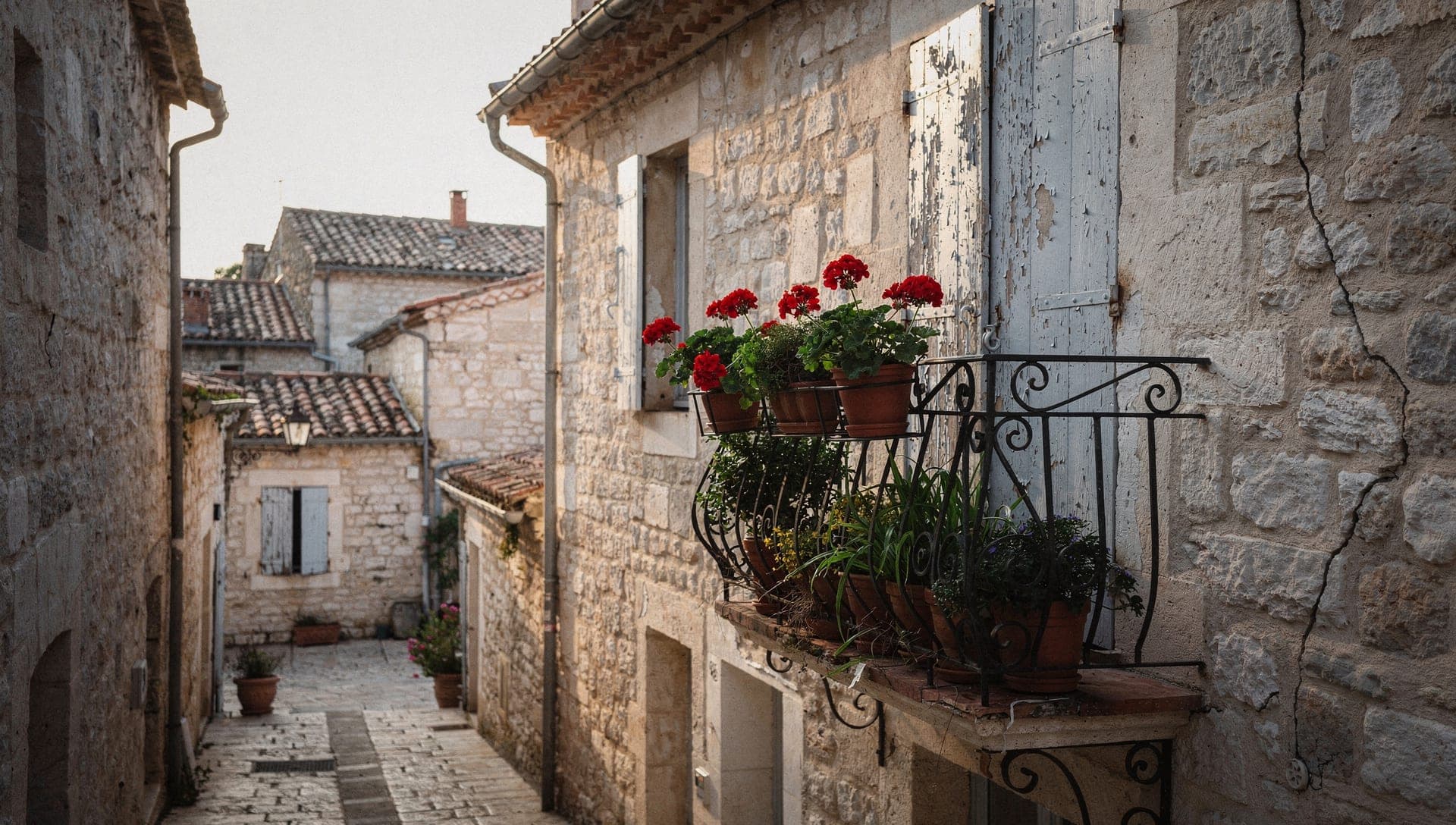
Valbonne village is not perched. It was laid out on a grid in 1519, when Augustin Grimaldi, abbot of Lérins, repopulated the site, flat and rational, which is why it works so well on foot. The Place des Arcades sits at its centre, ringed by restaurant terraces, with the Friday morning market filling the square and the surrounding lanes. Rue de la Fontaine, rue Gambetta and rue Alexis Julien carry most of the commerce. A village house here typically offers 80 to 140 square metres over three narrow floors, a roof terrace if you are lucky, and no parking.
Pricing in the village core is driven by condition and outdoor space rather than size. DVF records only one house sale of €1M or more in the village lieu-dit over 2021–2025: too few to publish a figure. Across Valbonne, the median for the same years is €7,707/m². A renovated three-bedroom house on a quiet lane with a terrace sits at the top of village asking prices. Unrenovated stock still comes up, and it is nearly always worth a look, because the structural fundamentals of these houses are usually sound and the renovation market in the commune is mature. The apartments above the shops, many in the 40 to 80 square metre bracket, let quickly to Sophia professionals.
Our practical caveats. Parking is the permanent negotiation of village life, and a house with a garage or a deeded space commands a real premium at resale. August is lively and long, and the terraces under your window are part of the deal. And the flat grid that makes the village walkable also means few village houses have views. You buy the life of the square, not the panorama.
The village calendar carries value too, in the plain commercial sense that it keeps the address alive. The Friday market has run under and around the arcades for generations, the Saint-Blaise festival each late January turns the grid over to grapes, local produce and two days of crowds, and summer brings open-air concerts on the square. Estate agents talk about walkability, but the calendar is what they are pricing. A house two lanes from the Place des Arcades participates in it every week of the year, and buyers pay for that privilege.
Val de Cuberte and the western villa sectors
West and south of the village, between the chemin Font de Cuberte and the road towards Opio and Châteauneuf, lies the quietest villa country in the commune. Val de Cuberte is the reference address. Plots run from 1,500 to 4,000 square metres, houses are mostly stone-faced Provençal builds from the 1970s through the 1990s, many since rebuilt to a high standard, and the lanes are private, wooded and silent. DVF records 11 house sales of €1M or more in the two Font Cuberte lieux-dits over 2021–2025, at a median of €6,524/m², well below Valbonne’s €7,707/m² for the same years. The houses here are larger than the Valbonne norm, so the price per square metre reads lower even where the price does not.
What you pay for is discretion and land, and the arithmetic is simple. A 220 square metre villa on 2,500 square metres with a pool, in walking or cycling distance of the village on the chemin de Peidessalle side, will ask between 1.8 and 2.4 million euros. Prices hold at resale because the supply of flat, wooded, village-adjacent land stopped growing decades ago, and the ZAN framework on land take makes new subdivision harder every year.
Check the servitudes carefully in this sector. Many lanes are private with shared maintenance agreements, and access rights across neighbouring plots are common in acts dating from the original subdivisions. None of this should stop a purchase, but give your notaire time to trace them properly.
Peyniblou and the east side: the family belt
East of the village, along the chemin de Peyniblou and towards the Sophia boundary, sits the sector we recommend most often to families. The houses are a notch more modest than Val de Cuberte, typically 140 to 200 square metres on plots of 1,000 to 2,000 square metres, built from the 1980s onward. Children cycle to the village on back lanes, the drive to the school cluster at Sophia takes six to eight minutes, and the A8 at Antibes is reachable in a quarter of an hour outside rush hour.
Prices in Peyniblou and the adjacent lanes off the route de Biot are family houses in good order. DVF records only one house sale of €1M or more in the Peyniblou lieu-dit over 2021–2025: too few to publish a figure. Across Valbonne, the median for the same years is €7,707/m². Many working families find the location more useful than the western sectors. Well priced houses regularly go under offer within three weeks. If you are buying from abroad, have your financing agreed in principle before you fly, because the local buyer you are competing against will.
The east side also holds the Île Verte quarter, immediately beside the village across the Brague, where townhouses and small residences from the 1990s offer a compromise between village life and parking. It is not one of the sectors we map, so we publish no DVF figure for it.
Garbejaire and Haut-Sartoux: the apartment quarters
The planned quarters of Garbejaire and Haut-Sartoux, built from the late 1970s to house Sophia Antipolis, are where most of Valbonne’s apartments sit. This is apartment country, three and four storey residences among umbrella pines along the route des Dolines and around the SKEMA and Polytech campuses, with the CIV a walk away. Two-bedroom apartments of 55 to 70 square metres make up much of the stock. They are not covered by our DVF sector figures, which count houses only.
The rental maths are the strongest in the hinterland. At an average of €20.1 per square metre per month, a 65 square metre apartment bought at €273,000 returns a gross yield close to 5.7 per cent, before the letting even touches the deep student and young-engineer market that Sophia guarantees. Vacancy is close to zero in September. For a first investment in the area, this is where the numbers work.
Two caveats from experience. Check the copropriété accounts before anything else, because several of the 1980s residences are mid-way through heavy facade and roof programmes, and a €15,000 call for funds changes the yield picture fast. And check the DPE, since the G-class letting ban already bites and the older Garbejaire stock includes energy-hungry buildings that will need work to stay lettable as the E-class deadline approaches in 2034.
Schools: the CIV and why it moves the market
No institution moves hinterland property demand like the Campus International de Valbonne. The CIV is a state campus at Sophia Antipolis teaching around 2,300 pupils from collège through lycée, with international sections in American English, German, Spanish, Italian, Chinese and Russian. For families relocating with school-age children, it offers a bilingual education of private-school quality at state-school cost, and it is the reason many of them draw their search circle around Valbonne in the first place.
Entry is selective, not postal. Admission to the international sections runs on written and oral tests, held in the spring, with results issued to families in early summer. Living in Valbonne does not guarantee a place, a point worth repeating to anyone who has been told otherwise by a listing description. What proximity buys is a shorter commute for a child who does get in, access to the ordinary Valbonne primary schools which feed the system well, and a resale market of future parents with exactly the same plan.
The practical school map for buyers looks like this. Village and east-side families use the Campouns and Île Verte primary schools, then the college at the CIV or Niki de Saint Phalle in Garbejaire. The private international alternatives, Mougins British International School on the Avenue Maurice Donat and ICS Côte d’Azur (formerly EBICA) at Sophia, are both within twenty minutes of any Valbonne address. Between the CIV tests in the spring and results in early summer, we see a reliable bump in family viewing demand, and sellers of four-bedroom houses price accordingly.
Access: the A8, the RD roads and the real commute
Valbonne has no motorway junction and no train station, and that matters less than you would expect. The commune is stitched to the coast by three departmental roads. The RD35 runs south through Sophia towards Antibes and the A8 exit 44, the RD103 skirts the technology park to join the same interchange, and the RD3 climbs from Antibes through the village and on towards Châteauneuf and Grasse. In free traffic the A8 is 15 minutes from the village, Nice airport 30 to 35 minutes via the A8, and Cannes about 30 minutes.
Then there is rush hour. Between 8 and 9.30 on a term-time morning, the RD35 and RD103 both load up with Sophia traffic, and the village-to-airport run stretches past 50 minutes. Locals learn the back roads through Biot quickly. The Envibus network runs regular lines from the village and Garbejaire into the Sophia campuses and down to Antibes station, and the express coach links from Sophia to Nice airport take a useful share of commuters out of their cars.
For buyers weighing sectors, the access rule of thumb is simple. East of the village shortens every commute that matters, west of the village buys quiet at the cost of ten daily minutes, and the village itself lets one adult in the household live largely without a car. We advise clients to drive their expected commute at 8.15 on a Tuesday before making any offer. We are serious about this.
What to check before you buy in Valbonne
Four checks earn their place in every Valbonne purchase. First, the DPE. The 2026 recalculation softened results for many small apartments, but G-class homes are already barred from the rental market and F follows in 2028. On a villa with 1990s glazing and electric heating, budget the audit and the likely €40,000 to €80,000 of works into your offer rather than finding them after.
Second, the PLU. Valbonne’s local plan protects wooded zones aggressively, and many large plots carry espaces boisés classés where cutting, building and even paving or terracing are forbidden. If your plan involves a pool house, an extension or a second dwelling, have the notaire or a géomètre confirm buildable rights before the compromis, not after. The ZAN trajectory means these rules tighten rather than loosen.
Third, water and fire. Parts of the commune sit in wildfire risk zones with legal brush-clearing obligations, the obligations légales de débroussaillement, that apply within 50 metres of any structure. The work costs real money on a wooded hectare and is checked. Insurers increasingly ask.
Fourth, the tax position. Valbonne applies the maximum 60 per cent majoration on taxe d’habitation for second homes (DGFiP local tax data, 2025), and non-resident owners should model IFI exposure once net French property assets pass 1.3 million euros. None of these are reasons to hesitate. They are the difference between the asking price and the true cost of ownership, and a buyer who prices them calmly negotiates better than one who meets them late. For the full sequence, read buying in Valbonne, step by step.
Our view: who Valbonne fits and where the value sits
Valbonne fits the working international family well. If your life includes a Sophia office, school-age children and a preference for walking to coffee, the commune answers all three without compromise, and the depth of the anglophone and northern European community means arriving is easy. It also fits the investor, since the Sophia rental base gives Garbejaire apartments a steady tenant market.
It fits less well in three cases. Buyers chasing sea views should look to Châteauneuf-de-Grasse or the heights of Biot, because Valbonne’s wooded plateau rarely offers them, and the few view properties price accordingly. Buyers who want silence and land above all will find more of both for less money in Roquefort-les-Pins or Opio, ten minutes away. And buyers with a strict budget below €600,000 who need a house should face facts, because that budget in Valbonne buys a small townhouse or a renovation project, while in Grasse it buys about 130 square metres of finished home.
The second-home buyer sits in the middle. Valbonne works well for long stays, and the year-round village means a February visit feels nothing like a ghost town. But pure lock-up-and-leave holiday use pays the second-home tax surcharge for services it does not consume, and quieter villages will suit better. We say this while noting that second-home owners who fall for Valbonne tend to become residents within five years, a pattern we have watched many times.
Valbonne is not cheap. The question is where the commune still pays you for looking carefully, and in mid-2026 we see three answers. Île Verte townhouses give you village life with parking. Unrenovated village houses still leave room for a quality renovation, provided the buyer prices works realistically. And Garbejaire apartments with a compliant DPE offer the clearest income case in the commune, with a tenant market that Sophia refills every September.
Where we urge caution is the top of the villa market. Sellers in the western sectors have read the rising figures and priced ahead of them, and we see asking prices well above what the recorded sales support. DVF puts houses sold for €1M or more in Val de Cuberte at a median of €6,524/m² (11 sales) over 2021–2025, and the whole commune at €8,986 in 2025. The three month momentum is real, but it does not justify paying 2027 prices in 2026. Negotiate from the transaction data, not the listing.
Taken whole, Valbonne remains what it has been for two decades, a deep market with a steady pool of future buyers. Pay a fair price rather than a hopeful one.