Town Guide
Biot in 2026: A Property Guide to the Village Between Sophia and the Sea
Prices by sector, the school question, commute times and what to check before you buy in the glass village above Antibes.
In This Guide
Biot in 2026: A Property Guide to the Village Between Sophia and the Sea
The quick read
Buying in Biot in 2026 means paying roughly 5,850 to 6,200 euros per square metre for a house and around 4,700 to 5,460 for an apartment, in a commune that sits minutes from the Sophia Antipolis technology park on one side and the Antibes coast on the other. That double address is the reason people choose Biot over its better-known neighbours. You get a working medieval village, a train station with a direct line to Nice and Cannes, and villa sectors that back onto a 630-hectare departmental park, all without the price ceiling of Mougins or Valbonne.
The commune splits into a few distinct worlds. The hilltop village is walkable, full of glassblowing studios and restaurant terraces, and short on parking. The plateau around Saint-Philippe holds the villas closest to Sophia. The western edge near Les Clausonnes is where the jobs and the new retail are. The lower commune, along the Route de la Mer near the Biot train station and the former Marineland, trades village charm for coastal access and the cheapest entry prices.
Two changes are worth watching this year. The Marineland marine park closed in January 2025, and its large coastal site near the Biot station is now waiting on a redevelopment decision that will shape the lower commune. The long-running Open Sky retail project at Les Clausonnes is still moving through revisions tied to France's soil-artificialisation rules. Our honest read: Biot offers better value than the headline hinterland names for buyers who actually work at or near Sophia, but the sectors vary so much that the commune average tells you almost nothing. Read by sector, not by postcode.
Where Biot sits, and why that matters
Biot is one of the few hinterland communes that touches both the coast and Sophia Antipolis. The territory runs from the Brague river valley near the Mediterranean up to a plateau that borders the technology park. Antibes is about eight kilometres south. Nice airport is roughly twenty-five minutes by car on a clear run. Valbonne and the Sophia campus sit immediately to the west.
That geography produces two Biots that feel like different towns. The first is the perched village, a tight cluster of stone houses, arcaded squares and glass workshops on a hill above the valley. The second is the spread of residential sectors below and around it, where most of the villas, the schools and the daily traffic actually live. Buyers who visit only the village often misjudge the commune, because the village holds a small share of the housing stock and almost none of the family villas.
The practical effect is that Biot lets a household split the difference between coast and country. A family can put children in a school with international sections, keep one parent on a ten-minute commute to a Sophia office, and still reach an Antibes beach in a quarter of an hour. Few communes in the area offer that combination at Biot's prices, which is the case for paying attention to it. The trade-off is that the commune carries real through-traffic on its main roads at rush hour, and the quietest villa sectors are not the ones nearest the village or the station.
The population sits around ten thousand, which keeps Biot small enough to feel like a community and large enough to hold proper schools, shops and a station. That scale matters at resale. Communes this size with a working centre and a coastal link tend to hold buyers through soft patches in the wider market, because the people who want Biot want it for reasons that do not vanish when prices wobble. We see steadier interest here than in the smaller villages that lean almost entirely on the second-home crowd.
Prices in 2026: Biot in context
Mid-2026 figures from MeilleursAgents, Orpi and SeLoger put Biot houses in a band of about 5,843 to 6,214 euros per square metre, with apartments around 4,710 to 5,463. The full spread of recorded sales runs much wider, from roughly 2,790 to over 10,000 euros per square metre, because a renovated village terrace and a hillside villa with a Brague-valley view are not the same product. Price growth has cooled. The commune added about 35 percent over seven years, but only around 4 percent between 2023 and 2025, so the steep period is behind us for now.
Set against its neighbours, Biot reads as mid-table. It costs less than Opio, Valbonne, Roquefort-les-Pins and Mougins, more than Le Rouret and well above Grasse. Here is how mid-2026 averages compare across the hinterland communes, using mixed and house figures from MeilleursAgents, efficity and DVF data. Treat these as orientation, not as a valuation of any single property.
| Commune | Average EUR/m2 (mixed) | House EUR/m2 | Read |
|---|---|---|---|
| Grasse | 3,430 | 4,132 | The value entry to the area |
| Le Rouret | 5,490 | 5,096 | Quiet, family, still climbing |
| Biot | 5,900 | 5,850 to 6,214 | Coast plus Sophia in one commune |
| Mougins | 5,970 | 6,633 (villas higher) | Prestige and schools |
| Roquefort-les-Pins | 6,000 | 5,444 | Larger plots, horse country |
| Valbonne | 6,200 | 5,441 | The hinterland benchmark |
| Opio | 6,750 | 5,836 | Olive and golf country |
The number that matters in Biot is not the commune average but the sector average, and those move by thousands of euros per square metre across a few kilometres. The next section breaks them down.
Sector by sector: where to buy in Biot
Biot rewards buyers who learn its sectors. The village, the plateau, the western edge and the lower commune each attract a different household and carry a different price. Our desk estimates below combine DVF transaction records with current agent asking prices. They are indicative bands, not guarantees, and the right figure for any house depends on its plot, view and renovation state.
| Sector | Indicative EUR/m2 | Character |
|---|---|---|
| Biot village (medieval centre) | 5,500 to 7,500 | Walkable, glass studios, restaurant terraces, little or no parking |
| Saint-Philippe and the plateau | 5,800 to 7,000 | Villas closest to Sophia, residential, short commute |
| Les Clausonnes (western edge) | 5,500 to 6,500 | By the Sophia entrance, near jobs and new retail, busier |
| La Brague and Vallon des Vignes | 6,000 to 8,000 | Green, park frontage, quiet, the premium villa addresses |
| Lower Biot, Route de la Mer, near the station | 4,500 to 5,800 | Coastal access, train, mixed housing, the value entry |
The village suits buyers who want to walk to dinner and do not mind carrying shopping up a lane. Expect renovated stone apartments and small townhouses rather than family villas, and check parking arrangements before you fall for a terrace. Saint-Philippe and the plateau are the practical family choice for Sophia workers, with detached villas, garages and a drive to the office measured in single-digit minutes.
La Brague and the Vallon des Vignes are the quiet end, where larger plots back onto the departmental park and the views open up. They carry the commune's highest house prices and the slowest resale, because the buyer pool is narrower. The lower commune around the Route de la Mer and the station is where the budget goes furthest, with the trade-off of more traffic, a less village feel and the open question of what replaces Marineland. Les Clausonnes is the work-led edge, sensible for someone who wants to be next to a Sophia desk and accepts the noise that comes with the busiest entrance to the park.
The Sophia Antipolis factor
Sophia Antipolis is the reason a large share of Biot buyers are here. Europe's first dedicated technology park spreads across Valbonne, Biot, Antibes and neighbouring communes, with tens of thousands of jobs in software, telecoms, life sciences and research. For a household with one or two earners on that campus, Biot offers something rare: a real village and a short, reliable commute in the same purchase.
From the plateau and Les Clausonnes, a drive to a Sophia office runs five to ten minutes outside peak hours. That number holds better in Biot than in towns that sit one valley further out, because much of the park is on Biot's own doorstep. Rush hour still bites on the approach roads, and anyone counting on an exact arrival time should test the actual route at 8.30 on a weekday before committing. The Envibus network links the commune and the station to the park for those who would rather not drive.
The Sophia effect also steadies the resale market. Demand from incoming professionals, often on company relocation packages, keeps family villas near the park moving even when the wider luxury market slows. That is a point in Biot's favour for a buyer who may sell in five to ten years. The flip side is that the most Sophia-convenient sectors trade at a premium to the village and the coast, and a buyer who does not need the commute can find better value and more quiet a little further down the hill.
Schools: the question that decides the postcode
For most international families, the school choice comes before the house choice, and Biot does well here. The College de l'Eganaude, on the commune's plateau near Sophia, carries international sections, which is the main draw for English-speaking and bilingual families who want a state-sector option close to home. Biot also runs public primary schools in the village and the lower sectors, served by the Envibus school lines.
The larger magnet sits next door. The Centre International de Valbonne, the public international school complex, teaches around 2,245 students across its college, lycee and preparatory classes, with several recognised language sections. Admission is selective and tied to specific catchment and language criteria, so a Biot address does not guarantee a place. Families targeting the CIV should confirm the current admission rules directly with the school before they assume a given sector qualifies. School bus lines, including services that reach the Biot SNCF station, connect the commune to the CIV and to other international sections at colleges in Valbonne and Roquefort-les-Pins.
Private and international options widen the field further out. Mougins School and other English-language schools sit within a reasonable drive, which is part of why families weigh Biot against Mougins and Valbonne rather than against the coast. Our advice is plain: pick the school first, confirm in writing that your shortlisted sectors feed or qualify for it, and only then start viewing houses. Buying for a school you later cannot access is the most expensive mistake families make in this area.
Getting around: roads, train and airport
Biot is better connected than most hinterland villages because it keeps a foot on the coast. The A8 motorway runs just south of the commune, with the Antibes and Villeneuve-Loubet junctions both within easy reach, so Cannes, Nice and the Italian border are all straightforward drives. The RD6007 coastal road, the old Route de la Mer, carries the lower commune toward Antibes and Villeneuve-Loubet. The RD4 climbs from the coast through the village toward Valbonne and the Sophia plateau, and the smaller departmental roads feed the residential sectors.
The standout is the train. Biot has its own SNCF station on the Marseille to Ventimiglia line, down by the coast near the former Marineland, with regional TER services to Antibes, Cannes, Nice and the towns along the shore. For a hinterland buyer, a walk-or-short-drive to a real station is unusual and useful, both for car-free commuting and for resale appeal to younger buyers. Nice Cote d'Azur airport sits about twenty to twenty-five minutes away by car outside peak times, which keeps Biot practical for owners who travel or who run a second home.
The honest caveat is traffic. The coastal corridor and the Sophia approaches clog at rush hour and through the summer, and the lower commune feels that more than the plateau. If a quiet morning matters to you, weight the sectors set back from the RD6007 and the park-side addresses over anything fronting a through-road. Test your specific route at the time you would actually use it, not at midday on a viewing trip.
Life in Biot: glass, markets and the Brague
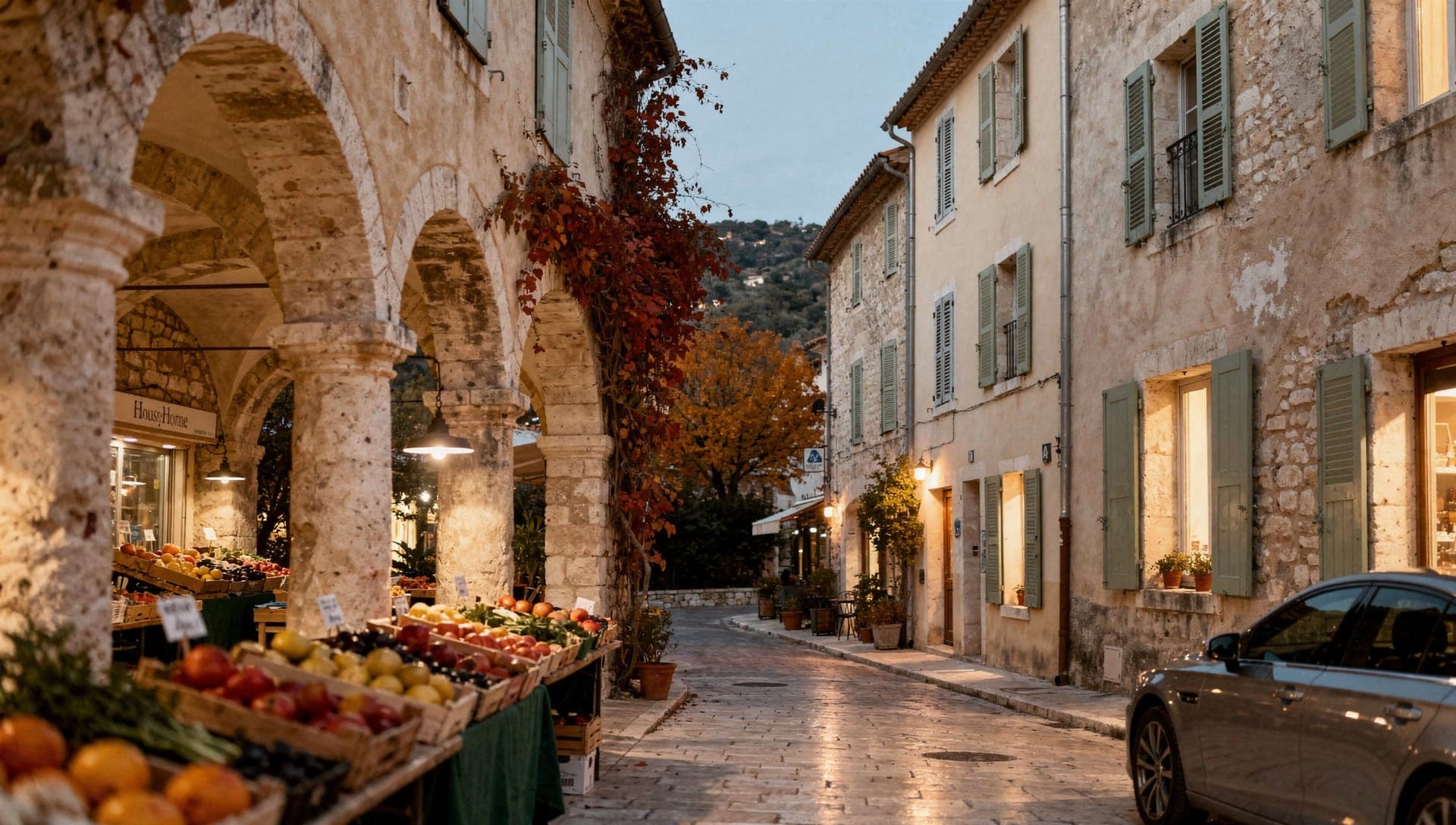
Biot earns its character from craft. The Verrerie de Biot and the studios around it made the village a centre for bubbled glass, and the workshops still draw visitors and keep the lanes alive year-round rather than only in August. The medieval centre, with its arcaded Place des Arcades and stepped streets, holds a real working population of artisans, restaurants and small shops, which is what separates a living village from a postcard.
The weekly market and the village fetes set the social calendar, and the food scene punches above the commune's size, from village bistros to terraces that fill on summer evenings. For families, the draw is partly the green setting. The departmental park of the Brague spreads across some 630 hectares north and west of the commune and the Sophia park, with marked trails along the Brague and Valmasque streams and a Roman aqueduct that once fed ancient Antipolis. It gives villa sectors on that side a permanent green border and weekend walking from the door.
The pace suits people who want a Provencal village rhythm without cutting themselves off. You can walk to a glassblower, take the train to an Antibes beach, and be at a Sophia desk inside ten minutes, all in the same week. That mix is the reason Biot holds its value with international buyers who could afford the coast but want a community their children can grow up in. The summer brings crowds to the village and the coast road, which is the price of the setting, and locals plan around it rather than fight it.
Two changes to watch: Marineland and Les Clausonnes
Two large sites are in flux, and both touch property decisions in Biot. The first is the former Marineland marine park, by the coast near the Biot train station. France's 2021 law against using dolphins and whales for entertainment forced the park to close in January 2025, and the remaining animals are due to leave the site by the end of 2026. That leaves a major coastal parcel whose future is still being decided. Whatever replaces it, residential, leisure or mixed use, will shape the feel and value of the lower commune for years. A buyer looking at the Route de la Mer sectors should treat the Marineland question as a live unknown rather than ignore it.
The second is Les Clausonnes, on the western edge by the Sophia entrance, where the Open Sky retail and leisure project has been in planning and dispute for around fifteen years. The scheme, planned at close to 100,000 square metres of shops, leisure, offices and hospitality, has drawn repeated legal challenges over its environmental impact and its fit with France's tightening rules on soil artificialisation. For buyers, a finished centre would add convenience and traffic to the western sectors, while further delay keeps the area as it is. Either way, anyone buying near Les Clausonnes should read the current planning status before assuming the project will or will not land.
Our take is that neither story should scare a buyer off Biot, but both should sharpen which sector you choose. If you want certainty and quiet, the plateau and the park-side villas are insulated from both. If you are drawn to the lower commune for its prices, go in with eyes open about what the coast strip may become.
Buying costs in 2026 and our honest read
Budget beyond the asking price. On a resale property in 2026, total acquisition costs run to roughly 7 to 8 percent on top of the price once notaire fees, registration duties and disbursements are counted. The reason the figure crept up is the transfer tax. The 2025 finance law let departments raise their share of the droits de mutation from 4.5 to 5 percent of the price, a temporary measure running from April 2025 to April 2028, and most departments adopted it. First-time buyers of a main residence are spared the extra half-point under the stated conditions. Confirm the current Alpes-Maritimes rate with your notaire before you model the cost, because that 0.5 point moves the bill on a Biot-sized purchase.
Beyond fees, do the usual hinterland checks. Read the energy rating, since older stone villas can score poorly and France keeps tightening rules on the least efficient homes. Confirm the legal status of any pool, extension or guest annexe against the permits on file, because informal additions are common and expensive to regularise. Check the connection to mains drainage, the flood and wildfire risk maps, and the exact commute by testing it at rush hour. For village apartments, get parking in writing.
Our honest read on Biot: it is one of the better-judged buys in the hinterland for anyone tied to Sophia Antipolis or who values a train station and coastal access alongside a real village. It costs less than Valbonne, Opio and Mougins while offering a lot of what those names sell. The catch is variance. A great Biot purchase and a mediocre one can sit a kilometre apart at the same price per square metre, so the work is in the sector and the specific property, not in the commune name. Buy the plateau or the park side for quiet, the village for walkability, and the lower commune for value with your eyes open. We are happy to pressure-test a shortlist before you commit.
Frequently Asked Questions
Frequently Asked Questions
In mid-2026, houses in Biot average roughly 5,850 to 6,214 euros per square metre and apartments around 4,710 to 5,463, according to MeilleursAgents, Orpi and SeLoger. Recorded sales span a much wider band, from about 2,790 to over 10,000 euros per square metre, because village apartments and hillside villas are different products. Price growth has slowed to around 4 percent across 2023 to 2025 after about 35 percent over seven years.
Yes, Biot is one of the strongest hinterland choices for Sophia workers. Part of the technology park sits on Biot's own territory, so a drive from the plateau or Les Clausonnes to a Sophia office runs five to ten minutes outside peak hours. The Envibus network links the commune and the train station to the park. Rush-hour traffic still builds on the approach roads, so test your route on a weekday morning before you buy.
It depends on your priority. The plateau around Saint-Philippe suits Sophia families wanting villas and a short commute, roughly 5,800 to 7,000 euros per square metre. La Brague and the Vallon des Vignes are the quiet, green premium addresses at 6,000 to 8,000. The medieval village, 5,500 to 7,500, is for walkability and character but offers little parking. The lower commune near the Route de la Mer and the station, 4,500 to 5,800, is the value entry. These are indicative bands from DVF and agent data.
Biot hosts the College de l'Eganaude on its plateau, which carries international sections, plus public primary schools served by Envibus lines. Next door in Valbonne, the Centre International de Valbonne teaches around 2,245 students with several language sections, though admission is selective and tied to catchment and language criteria. School buses, including a service to the Biot SNCF station, connect the commune to the CIV and to international sections in Valbonne and Roquefort-les-Pins. Confirm admission rules with each school before buying for a place.
Yes. Biot has its own SNCF station by the coast, near the former Marineland, on the Marseille to Ventimiglia line. Regional TER services link it to Antibes, Cannes, Nice and the coastal towns. A station within walking or short driving distance is unusual for a hinterland village and helps both with car-free commuting and resale appeal. Nice airport is about twenty to twenty-five minutes away by car outside peak times.
Marineland, the marine park by the Biot train station, closed in January 2025 after France's 2021 law banned the use of dolphins and whales for entertainment. The remaining animals are due to leave by the end of 2026. The future of the large coastal site is still being decided, and whatever replaces it will affect the lower commune. Buyers looking at the Route de la Mer sectors should treat the site's redevelopment as a live unknown.
On a resale property, budget roughly 7 to 8 percent on top of the price for notaire fees, registration duties and disbursements. The 2025 finance law let departments raise the transfer tax from 4.5 to 5 percent of the price, a temporary measure to April 2028 that most departments adopted, with first-time buyers of a main residence exempt under set conditions. Confirm the current Alpes-Maritimes rate with your notaire, and factor in checks on energy rating, permits and pool legality.
Need personalised guidance?
Our team knows every street and every sector across the hinterland.