Town Guide
Biot in 2026: A Glass Village, a Slice of Sophia, and Two Very Different Markets
A sector-by-sector guide to buying in Biot, from the medieval village four kilometres from the sea to the Saint-Philippe side of Sophia Antipolis, with 2026 prices, schools and access.
In This Guide
Biot in 2026: A Glass Village, a Slice of Sophia, and Two Very Different Markets
The quick read: who Biot is for
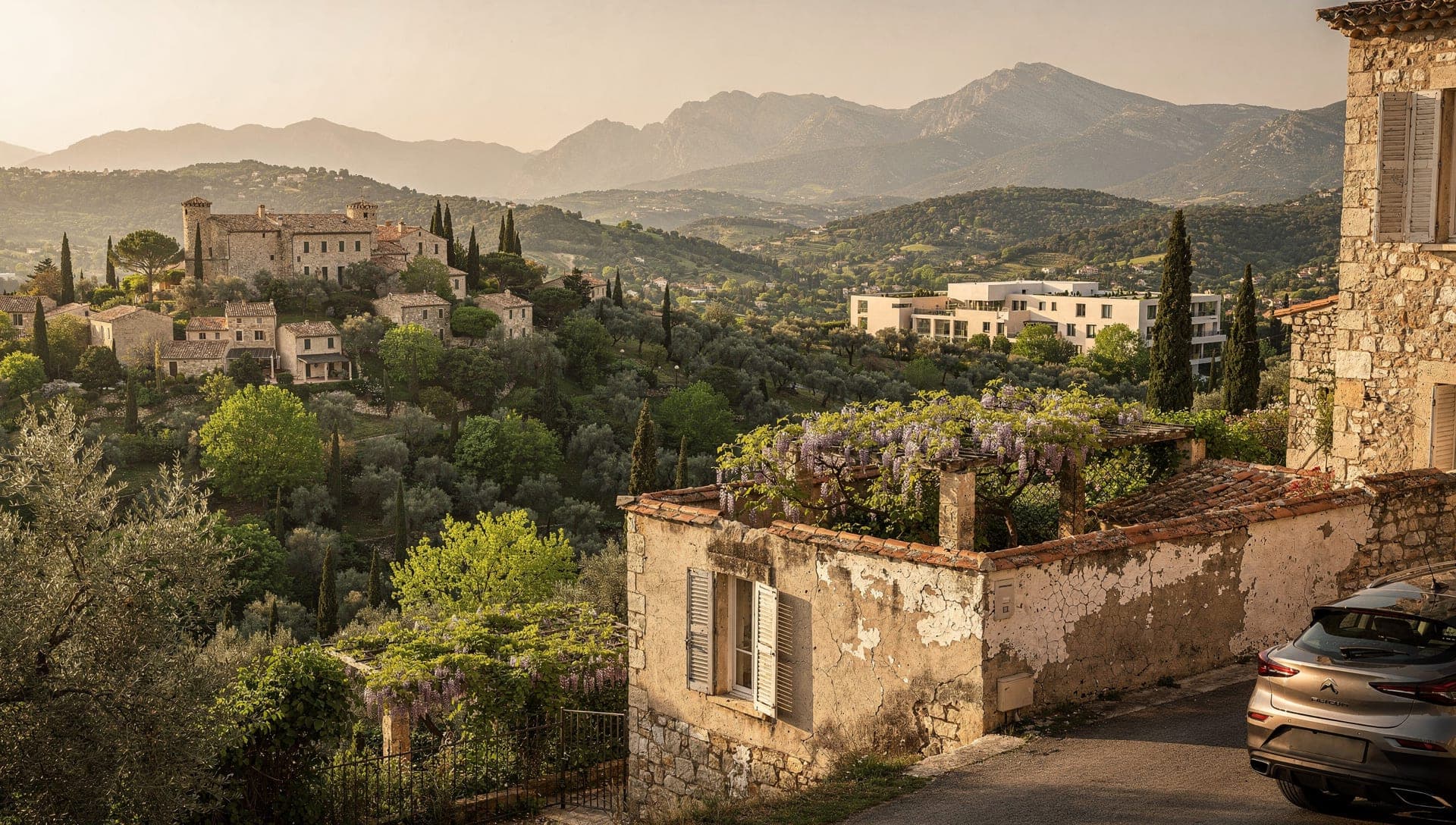
Biot suits the buyer who wants a real working village four kilometres from the sea, with Europe's largest technology park inside its own commune boundary. That combination is rare in the eight hinterland villages, and it sets the tone for everything here. The medieval centre on its hill is famous for bubble glass and the Fernand Leger museum, while the Saint-Philippe plateau on the Valbonne side is full-blown Sophia Antipolis, with offices, apartments and a steady tenant pool. House prices across the commune sit around 5,983 euros per square metre in mid-2026 on MeilleursAgents data, but that single figure hides a very wide spread, from under 3,000 euros on the plain near the coast road to above 10,000 on the best village slopes.
So the honest answer to who should buy in Biot is two different people. One wants the stone, the views and the walk to the Place des Arcades. The other wants a low-friction base for a job in Sophia, with a short commute and easy resale to the next tech family. Both can be served here, but they buy in different sectors at different prices, and confusing the two is the most common mistake we see. The sections below map the village against the Sophia side, give the price bands by sector, and set out schools, access and what each budget actually buys.
The shape of the commune
Biot is a commune of roughly 9,800 people that does an unusual amount of work for its size. The historic village sits on a hill about four kilometres inland, looking down the Brague valley toward the Mediterranean. Below and to the east, the land falls toward the coast at the boundary with Antibes and Villeneuve-Loubet, which is why Biot is the closest of the eight hinterland communes to a beach. To the west and north, on the plateau shared with Valbonne, lies the Sophia Antipolis side, including the Saint-Philippe quarter, where a slice of the technology park sits on Biot soil rather than Valbonne's.
That geography produces three very different living experiences inside one postcode. The village is stone, narrow lanes and tourism. The Brague valley and the plain are greener, more spread out, and a touch warmer because they are lower. The Sophia side is modern, planned and built around work. When agents quote a Biot price they are averaging across all three, so always ask which part of the commune a figure refers to before you read anything into it.
Sectors and prices, mid-2026
The table below maps the main sectors against indicative house price-per-square-metre bands for mid-2026. The figures come from MeilleursAgents and efficity portal medians at commune and street level, and they should be read as a starting frame, not a valuation. Biot's street-level range is one of the widest in the hinterland, running from about 2,871 to about 10,246 euros per square metre depending on exactly where you stand.
| Sector | Character | Indicative house price/m² (mid-2026) |
|---|---|---|
| Historic village and upper slopes | Medieval stone, views, walkable, tourist footfall | ~6,500 to 7,500 EUR |
| Bois Fleuri and Les Combes | Detached villas, gardens, quiet residential | ~6,000 to 6,600 EUR |
| Saint-Philippe (Sophia side) | Modern flats and offices, rental demand | ~4,500 to 5,500 EUR (flats) |
| La Brague and route de la Mer | Plain, greener, closer to coast and station | ~4,900 to 5,500 EUR |
| Commune house median | ~5,983 EUR (range ~2,871 to ~10,246) | |
Two patterns hold across the data. The village and the villa pockets just below it command the premium, because stone, views and walkability are scarce and do not get built any more. The Sophia side and the plain are cheaper per square metre, and they are where apartments dominate, so a buyer chasing yield or a low-maintenance lock-up-and-leave will look there first. The street examples behind these bands are telling: Allee des Colibris sits near 7,130 euros, Chemin des Vignasses near 6,580, and Route de la Mer near 4,940, all on mid-2026 portal data.
A word on what moves a price inside a band. In the village, a renovated house with parking and a terrace with a view can sit a full third above a similar floor area buried in the lanes with no outside space and a poor energy label. On the Sophia side, a flat with a garage and a real terrace lets and resells far better than a dated studio, and the gap shows up in the per-metre figure. So treat the bands as the frame and the property's own condition, parking, outdoor space and DPE as the swing factors. The widest part of Biot's range, that jump from under 3,000 to above 10,000 euros, is mostly the difference between a tired flat on the plain and a renovated stone house with a view on the upper village, and very little of it is noise.
Living in the village: glass, art and narrow lanes
The village is the reason most people fall for Biot. It is a compact medieval grid of honey-coloured stone wrapped around the Place des Arcades, with the kind of arcaded square that the hinterland does better than anywhere on the coast. Two things give it a character no other hinterland village has. The first is glass. The Verrerie de Biot, founded in 1956, made bubble glass world-famous, and the craft still anchors the village economy and its weekend visitors. The second is the Musee national Fernand Leger, opened in 1960 below the village, which holds the largest collection of the artist's work anywhere, mosaics and ceramics included.
For a resident, the village delivers walkability, restaurants, a real calendar of fetes and a strong rental story for short stays. The trade-offs are the ones every hilltop village carries. Parking is tight and largely outside the walls, the lanes are too narrow for easy deliveries or large cars, and summer tourism brings footfall right past your door. Stone houses here also tend to be older and harder to heat, which matters under the current energy rules if you ever intend to let long term. Buy in the village for the life and the look, not for convenience, and view several properties before you decide how much old-village texture you actually want to live inside.
Daily life: market, makers and the coast nearby
Day to day, Biot runs on a rhythm that mixes a working village with a tourist one. A weekly market brings producers into the centre, the glassmakers keep open workshops along the lanes so you can watch the bubble glass being blown, and the restaurants around the Place des Arcades fill on summer evenings. The Musee national Fernand Leger and its gardens give the commune a cultural anchor that pulls visitors year-round, not only in July and August, and the church of Sainte-Marie-Madeleine and the old chapels give the centre its quiet corners away from the footfall.
What rounds out the picture is how close the coast is. Biot is the only one of the eight hinterland communes where you can be on a beach in well under fifteen minutes, with the sands at the Antibes and Villeneuve-Loubet boundary and the marinas of the Baie des Anges within easy reach. The Brague river and its valley give walkers and runners green space on the doorstep, and the wider Sophia area adds sports clubs, supermarkets and services that a pure hilltop village like Gourdon could never carry. For a buyer weighing village charm against practical living, Biot is the rare address that does not force a hard choice between the two.
The Sophia side: Saint-Philippe and the working commune
Cross to the plateau and Biot becomes a different place. The Saint-Philippe quarter holds around 2,300 residents and sits squarely inside Sophia Antipolis, with offices along Avenue Roumanille and the route des Colles, apartment blocks, a commercial annexe and a municipal police post. This is where Biot's share of the technology park lives. A buyer here is usually buying for work, not for the postcard, and the maths reflect that. Apartments dominate, prices per square metre run below the village, and rental demand from engineers and researchers is reliable through the year rather than seasonal.
The appeal of Saint-Philippe is friction removed. You can walk or cycle to an office, reach the wider park in minutes, and resell to the next arrival without the renovation questions that hang over old stone. The cost is atmosphere. It reads as a planned business district rather than a Provencal village, and the people who love the Biot of the glassmakers often bounce off it. Our view is that Saint-Philippe is the smart buy for a working couple or a buy-to-let investor focused on the Sophia tenant base, and the wrong buy for someone whose whole reason for choosing Biot was the village on the hill.
Practical life on the plateau is easy in a way the village is not. Saint-Philippe has its own commercial annexe with everyday shops and services, parking is plentiful, and the supermarkets and retail of the wider Sophia area are minutes away rather than a drive down the hill. For a household that wants to drop the car at home and walk to work, or to park without circling a medieval lane, this side of Biot simply works better. The honest summary is that Saint-Philippe trades charm for convenience, and a clear-eyed buyer who knows which they are paying for rarely regrets the choice.
Schools: the local collège and the CIV next door
For families, Biot's school position is one of its quiet strengths. The commune has its own state primary schools, and the public Collège de l'Eganaude sits on the Sophia side serving Biot and the surrounding park, with school bus lines linking it to the village and the plateau. That means a Biot family can keep a child in state education from primary through the early secondary years without leaving the commune, which is not true of every hinterland village.
For international and bilingual schooling, Biot's real advantage is what sits next door. The Centre International de Valbonne, the CIV, is a few minutes away in Valbonne, a large state-funded international school with sections in many languages and preparatory classes after the baccalaureate. Several private and bilingual options, including schools on the Route de Biot in Valbonne and the international and English-language schools around Sophia and Mougins, are within an easy drive. The Envibus network, including the cross-commune line 10 between Antibes, the Biot train station, the village, Valbonne and Sophia, plus dedicated school services, ties the whole cluster together. Families relocating for Sophia tend to choose the school first and the sector second, and Biot scores well precisely because it gives access to both the state collège and the CIV without a long commute.
Getting around: motorway, coast train and the airport
Biot's access is better than most hinterland villages because the commune touches both the plateau and the coast. By car, the A8 motorway is reached at exit 44, signed Antibes and Sophia Antipolis, which feeds the plateau directly. The RD4, the old CD4, links the village down to Antibes and across to Valbonne, passing the coastal flats on the way to the sea. Nice Cote d'Azur airport is roughly a 25 to 30 minute drive in normal traffic, which is among the shortest of the eight communes.
What sets Biot apart is the train. The Biot SNCF station sits on the coast about four kilometres below the village, on the main line between Cannes, Antibes, Nice and the Italian border, with regional TER services calling through the day. No other hinterland village has its own mainline station, even a detached one, and for a commuter to Nice or Cannes who would rather not drive, that is a real asset. The catch is that the station is down by the sea, not in the village, so you either drive the four kilometres or take the Envibus line 10, which runs on average every half hour between Antibes, the station, the village, Valbonne and Sophia. Plan around that gap before you assume car-free living from the hilltop.
For work and weekends the wider picture is good. Antibes and its old town are about ten minutes down the RD4, Cannes is around twenty-five minutes by road or a short train hop, and Nice is roughly half an hour outside the worst rush hours. The one honest caveat is traffic on the plateau. The roads into Sophia Antipolis clog at the start and end of the working day, so a commute that takes twelve minutes at ten in the morning can take half an hour at eight. If your daily run is into the park, test it at the real hour you would drive it, not at a quiet midday viewing, because that single variable changes how Biot feels to live in more than any other.
What your budget buys in Biot
Because the sectors diverge so sharply, the same budget buys very different homes depending on where you point it. The table below gives a realistic mid-2026 picture across three common budgets, using the sector price bands above. Treat the surface areas as typical rather than guaranteed, since condition, garden, view and parking move the figure on any given property.
| Budget | Sophia side / plain | Village and villa pockets |
|---|---|---|
| 500,000 EUR | A two or three room apartment in Saint-Philippe, often with terrace and parking, lettable to Sophia | A small village house or a flat to renovate, compact and characterful |
| 800,000 EUR | A larger flat or a modest villa on the plain near the Brague | A renovated village house, or a dated villa in Bois Fleuri to update |
| 1,500,000 EUR | A comfortable detached villa with pool, garden and easy Sophia access | A characterful stone house with views, or a renovated villa on the upper slopes |
The pattern to take away is that your money goes furthest, in pure floor area, on the Sophia side and the plain, while the village and the slopes above it ask you to pay for scarcity and charm rather than space. A buyer who needs four bedrooms and a garden for a family will usually get there sooner on the plateau or in Bois Fleuri. A buyer who wants stone walls and a five-minute walk to the Place des Arcades should expect to spend more per square metre and accept less of it.
One more option is worth naming for the higher budgets. Because part of Biot is modern Sophia-era development, the commune has more recent and new-build housing than the older villages, and a new build carries a far lower transfer tax than an old stone house, roughly 2 to 3 percent against the 7 to 8 percent on a resale. For a buyer who values low maintenance and a clean energy label over period character, a recent villa or apartment on the plateau can be the quietly sensible buy, both at purchase and through the energy rules that now weigh on older stock. We would not push anyone away from the village for it, but the option deserves a place on the shortlist rather than being dismissed out of hand.
The rental question, and the rules that now shape it
Biot has two rental markets running side by side. Long-term demand comes from Sophia Antipolis, where engineers, researchers and visiting staff need year-round homes near the park, and Saint-Philippe and the plain serve that pool well. Short-term and seasonal demand comes from the village and the coast, where glass-trail tourism and the nearby beaches fill summer weeks. A buyer can target either, but the rules changed enough in 2025 and 2026 that the old assumptions no longer hold.
Three points matter before you count on rental income. First, the energy rules now ban new long-term lettings of the worst-rated homes, with G-rated properties off the market since January 2025 and F-rated ones following in 2028, which catches a share of older village stone. Second, the Loi Le Meur cut the tax allowances on furnished holiday lets and handed communes more power to register and cap them, so seasonal letting in the village needs checking against the local rules rather than assumed. Third, the Alpes-Maritimes held its property transfer tax at the lower 4.50% departmental rate when most of France raised it, which keeps your entry costs down whichever market you target. We cover all three in detail in our guide to the 2026 rule changes, and the short version for Biot is simple. The Sophia long-let case is the steadier one, and the village short-let case still works but now rewards a classified, energy-respectable property run as a real business.
Our honest read on Biot
Biot is the hinterland village we recommend most often to buyers who cannot decide between work and life, because it genuinely offers both. The combination of a stone village four kilometres from a beach, its own mainline station, a slice of Sophia inside the commune and a state collège plus the CIV next door is not matched anywhere else in the eight. For a Sophia couple with school-age children it is close to an ideal fit, and the price per square metre on the plateau and the plain is sensible for what you get.
The honest caution is about the village itself. It is beautiful and it is busy, and the older stone carries the heating and energy questions that now shape what you can let and what a renovation will cost. If you want the postcard, buy it with open eyes, read the DPE before you offer, and price the works rather than hope. If you want the practical Riviera life with a short commute and an easy resale, look at Saint-Philippe, Bois Fleuri and the Brague plain first. Either way, decide which of the two Biots you are buying before you start viewing, because the commune rewards a clear brief and punishes a vague one. If you want a second read on a specific property or sector, our team works these files daily and is glad to walk the numbers through with you.
Frequently Asked Questions
Frequently Asked Questions
Yes, in part. Sophia Antipolis spans several communes, including Antibes, Biot, Mougins, Valbonne and Vallauris, and a slice of the technology park sits on Biot soil. The Saint-Philippe quarter, with around 2,300 residents, is the Biot section of the park, with offices along Avenue Roumanille and the route des Colles. The medieval village, by contrast, is a separate world four kilometres away on its hill.
The house median across Biot is around 5,983 euros per square metre in mid-2026 on MeilleursAgents data, but the street-level range is very wide, from roughly 2,871 to 10,246 euros. The village and the villa slopes above it sit at the top, around 6,500 to 7,500 euros, while apartments on the Sophia side and homes on the plain near the coast run lower, often 4,500 to 5,500 euros. Always check which sector a quoted price refers to.
Biot has its own state primary schools and the public Collège de l'Eganaude on the Sophia side for the early secondary years, linked by school buses. For international and bilingual education, the Centre International de Valbonne, the CIV, is a few minutes away in Valbonne, alongside private and bilingual schools on the Route de Biot and around Sophia and Mougins. The Envibus network, including line 10 and dedicated school services, connects the cluster.
Yes. The Biot SNCF station sits on the coast about four kilometres below the village, on the main line between Cannes, Antibes, Nice and the Italian border, with regional TER services through the day. No other hinterland village has its own mainline station. The catch is the distance: the station is down by the sea, so you drive the four kilometres or take Envibus line 10, which runs on average every half hour between Antibes, the station, the village, Valbonne and Sophia.
For Sophia families it is one of the strongest fits in the hinterland. You get a state primary and the Collège de l'Eganaude inside the commune, the CIV and bilingual options a few minutes away, a short Sophia commute, and a beach within reach on the coast. Families tend to favour the plateau and the Brague plain for space and easy parking rather than the medieval village, where lanes are narrow and parking is tight.
Yes, but check the energy label and the local rules first. Long-term lettings of G-rated homes have been banned since January 2025, with F-rated homes following in 2028, which catches some older village stone. For furnished holiday lets the Loi Le Meur cut the tax allowances and lets communes require registration and caps. Sophia long-term demand on the plateau is the steadier market. Seasonal letting in the village still works for a classified, energy-respectable property.
Decide what you are buying for. The village gives you stone, views, walkability and short-stay rental appeal, at a higher price per square metre and with parking, heating and tourism trade-offs. The Sophia side and the Brague plain give you space, a short commute, modern low-maintenance homes and a steady long-term tenant pool, at a lower price per square metre but with less charm. Both are Biot. They suit different buyers, so pick before you start viewing.
Need personalised guidance?
Our team knows every street and every sector across the hinterland.