The quick read
A building plot in the Riviera hinterland costs between about 175 and 600 euros per square metre in 2026. Roquefort-les-Pins sits near the floor of that range and Valbonne near the ceiling, with Mougins, Biot and Châteauneuf-de-Grasse in the middle. Those are land-only numbers. They come before you connect the parcel to water, power and drains, and before any building work starts.
For a typical plot of 1,000 square metres, that spread means a raw cost of roughly 175,000 euros in Roquefort-les-Pins against around 600,000 euros for the same surface in central Valbonne. The gap is wide because two things move at once. Finished property prices are higher near Sophia Antipolis and the prettiest villages, and buildable land near those same places has run short. Add connection costs of 5,000 to 15,000 euros, a development tax that changes from commune to commune, and construction at 2,500 to 4,000 euros per square metre for a good villa, and the finished number climbs fast.
Our short answer for 2026 buyers is that plots are getting rarer, not cheaper. The national push to slow soil artificialisation, known as ZAN, is reaching local planning documents across the Alpes-Maritimes. Communes are tightening the rules on what gets built and where. If you want land, the search is harder than it was three years ago, and the parcels that clear every check command a premium. The rest of this report breaks the figures down town by town, walks through the costs between a plot and a permit, and shows where we think the real value sits.
Why land costs less than the house on it
Buyers new to the hinterland often expect land to track the headline price per square metre they see for houses. It does not. Houses sold for €1M or more in Valbonne had a 2025 DVF median of 8,986 euros per square metre of built space. A building plot in the same commune averages closer to 600 euros per square metre of ground. Those two numbers measure different things. One is finished living space with walls, a roof, a pool and a garden already in place. The other is bare ground that still needs a permit, services and a build.
The link between the two runs through what agents call the residual land value. A private buyer or a developer works backwards. They take the likely sale price of the finished villa, subtract the cost to build it, subtract fees, taxes and a margin, and what is left is what the land is worth to them. In a commune where finished villas sell well, the residual value is high, so land is dear. In a commune where resale is softer, the same surface of ground is worth less because the house it will carry sells for less.
This is why Opio is worth a second look. Finished houses sold there for €1M or more reach a 2025 DVF median of 8,593 euros per square metre, close to Valbonne, yet land averages near 222 euros per square metre. The reason is supply. Opio still has parcels with slope, olive terraces and room to build, while Valbonne has little flat, serviced, central ground left. Scarcity, not desirability alone, sets the land figure. The lesson for buyers is that a high house price does not always mean expensive land, and a low land price does not always mean a cheap commune. You have to read the two figures together, and then read the supply behind them.
Land prices by town in 2026
The table below gives our working figures for buildable land across the eight communes, drawn from aggregated agency and notaire data for the first half of 2026. Treat them as a midpoint. A flat, serviced plot with a view near a village runs well above these averages, and a sloped or poorly placed parcel runs below. Across the Alpes-Maritimes as a whole, buildable land averages around 349 euros per square metre, with recorded sales ranging from about 129 to more than 1,287 euros per square metre.
| Commune | Land approx. €/m² (2026) | Finished house sold for €1M or more, €/m² (DVF 2025) | What sets the figure |
|---|---|---|---|
| Valbonne | ~600 | ~8,986 | Tightest supply, Sophia premium |
| Mougins | ~485 | ~10,073 | Golf sectors and village both short |
| Biot | ~417 | ~9,654 | Village and Sophia side differ widely |
| Châteauneuf-de-Grasse | ~323 | view-led | Open southern view plots cost more |
| Grasse | ~267 | ~6,212 | Most land choice, lowest built prices |
| Opio | ~222 | ~8,593 | High resale, land still available |
| Le Rouret | ~209 | family-led | Larger plots, quiet demand |
| Roquefort-les-Pins | ~175 | space-led | Big plots, low density, equestrian zoning |
Two patterns stand out. Land is dearest where serviced, central plots have run out, which is the Valbonne and Mougins story. And the towns with the cheapest land per square metre, Roquefort-les-Pins and Le Rouret, are the ones that sell space rather than postcode, with larger plots and lower density. A low land price per square metre does not always mean a cheaper project, because those parcels tend to be bigger and need more groundwork. Read the price next to the plot size and the zoning, never on its own. Built-house medians for comparison are in the Hinterland Price Index.
The ZAN squeeze on buildable land
The single biggest change to the land market in the hinterland is not a price move. It is a planning one. France has set a goal known as zero net artificialisation, or ZAN, which aims to balance newly built-on ground against renatured ground by 2050. The 2021 Climate and Resilience law set an intermediate target: halving the consumption of natural, agricultural and forest land over 2021–2031 compared with the previous ten years. A Senate bill, the proposition de loi TRACE, adopted by the Senate in March 2025, would soften the timeline, but as of spring 2026 it had not completed its passage through the National Assembly. The direction has not changed. Communes must consume less new land over time.
For the Alpes-Maritimes, this reaches the local planning documents, the PLU and PLUi, which are being revised through 2025 and 2026 to fit the new ceilings. In practice some parcels once marked for future urbanisation, the AU zones, are being returned to agricultural or natural status. Ground that a seller assumed was buildable five years ago does not always carry a permit today. That is the squeeze. Supply of genuinely constructible land is falling while demand from international and Sophia-linked buyers holds firm.
The effect on price runs one way. When buildable land becomes scarcer and demand stays steady, the parcels that remain constructible get dearer. We already see it in the gap between the asking price for a serviced plot with a clean certificat d’urbanisme and the much lower figure for ground whose status is uncertain. Our advice is plain. Never assume a plot is buildable because it is empty and for sale. The planning status is the asset, and in 2026 that status is harder to get and worth more than it was. We expect this to keep a floor under serviced, permitted plots even if the wider market cools, because no amount of softening demand creates new constructible ground.
What moves one plot above another
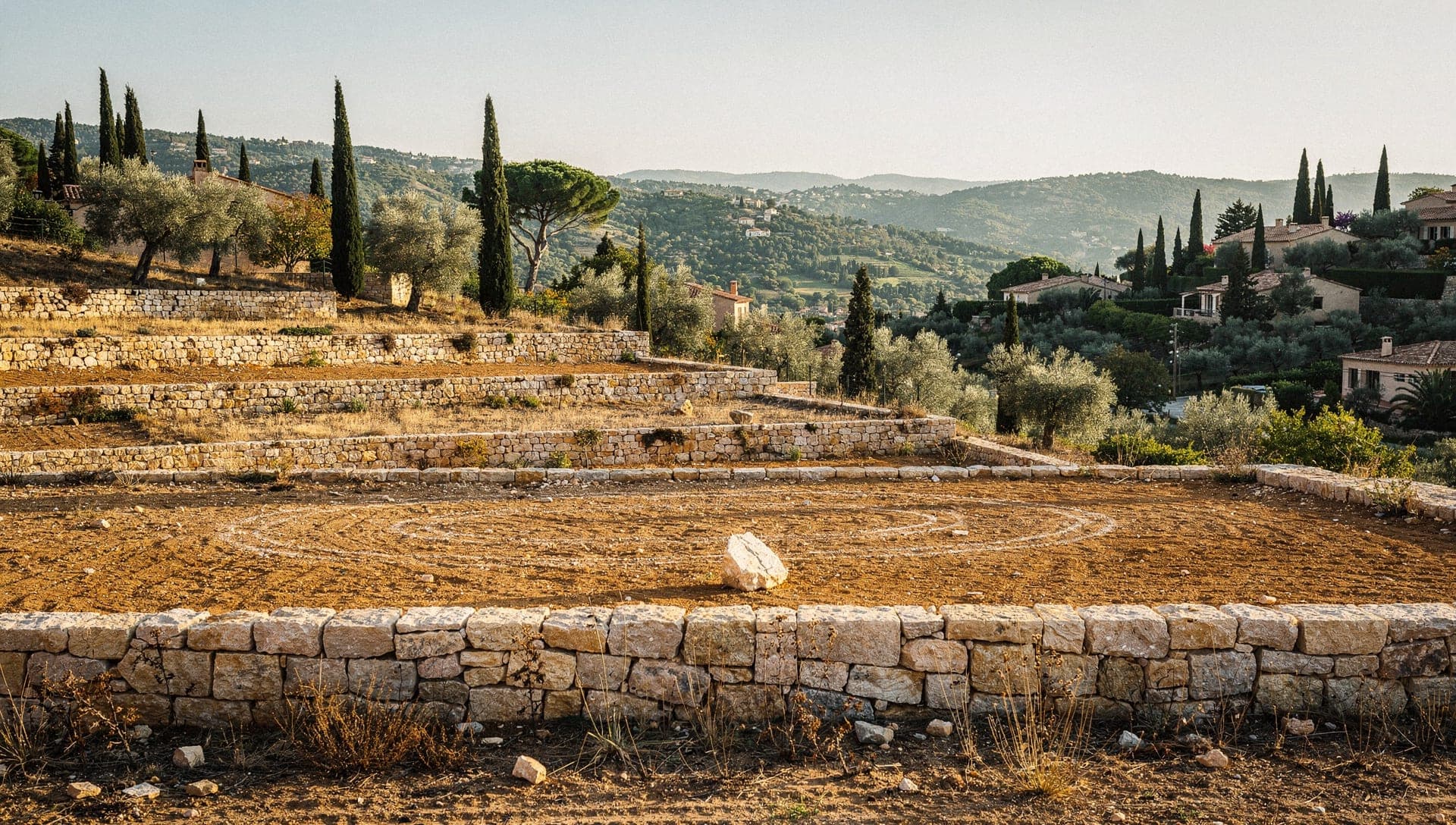
Two plots in the same commune at the same surface sometimes differ in price by half. Here is what does the moving. Slope comes first. A flat or gently graded plot is far cheaper to build on than a steep one, where retaining walls, deep foundations and access ramps add tens of thousands of euros before the house begins. Many hinterland parcels sit on restanques, the old olive terraces held by dry-stone walls. They look lovely and they complicate the groundwork.
Constructibility is the second driver. The PLU sets how much of a plot you are allowed to cover, the emprise au sol, and how much floor area you are allowed to build. A 1,500 square metre plot zoned for light density sometimes allows only a 200 square metre house, while a smaller plot in a denser zone allows more. Buyers who look only at total surface miss this. The number that matters is the buildable floor area, not the size of the garden.
Then come exposure, view and services. South-facing ground with an open view towards the sea or the hills carries a clear premium, and a north-facing plot in a dip does not. A parcel already connected to water, power, drains and a made road saves both money and months. An unserviced plot far from the network costs 15,000 to 30,000 euros to connect. Access matters too. A plot reached by a shared private lane with unclear rights of way is worth less than one with its own frontage on a public road.
None of this shows in the price per square metre headline, which is why the headline alone is a poor guide. We have seen two parcels on the same hillside in Châteauneuf-de-Grasse, a few hundred metres apart, trade at prices that differ by 40 per cent because one was flat, serviced and south-facing and the other was steep, raw and shaded. The square metre price told you almost nothing. The plan, the slope and the certificat told you everything.
Town by town: where the land is
Valbonne carries the highest land price in our eight villages, near 600 euros per square metre, because central, serviced plots have all but run out and Sophia Antipolis sits on its doorstep. Most of what trades now is either a tear-down sold for its land value or a rare division of a larger garden. Mougins follows at around 485 euros per square metre, with the golf sectors and the village both short of supply and the same tear-down pattern in the older quarters.
Biot averages about 417 euros per square metre, but the figure hides two markets. Plots near the medieval village and the Sophia-Saint-Philippe side carry a premium, while ground further out is cheaper. Châteauneuf-de-Grasse, near 323 euros per square metre, is a view market. A plot with an open southern view towards the Bay of Cannes commands far more than a parcel in a dip, so the average understates the good plots and overstates the rest.
Grasse offers the most land choice and the lowest built prices, with land near 267 euros per square metre, which makes it the value entry for anyone willing to build above the perfume town. Opio sits near 222 euros per square metre despite high resale, because olive country still has parcels to sell. Le Rouret, around 209 euros per square metre, trades on larger family plots and quiet demand. Roquefort-les-Pins has the lowest land price per square metre at about 175 euros, but its plots are large and often zoned for horses and low density, so the low per-metre figure usually buys a big, groundwork-heavy project rather than a small cheap one.
One thread runs through all eight. The closer a plot sits to a working village centre and to Sophia, the dearer and rarer it is. The further out and the steeper, the cheaper per metre and the more you spend turning it into a home. There is no free lunch in the hinterland land market, only a choice about where you carry the cost.
From land to finished villa: the full number
Here is how the parts add up for a realistic project. Take a 1,000 square metre plot in Châteauneuf-de-Grasse at 323 euros per square metre. The land alone is around 323,000 euros. Notaire and registration fees on land run higher in percentage terms than on a built home, near 8 per cent, so add roughly 26,000 euros. Servicing and the development tax might add 20,000 to 35,000 euros depending on the parcel.
Now the house. A good new villa in the hinterland costs between 2,500 and 4,000 euros per square metre to build in 2026, before pool and grounds, with the higher end for architect-led, high-specification work. A 180 square metre villa at 3,000 euros per square metre is 540,000 euros of construction. Architect and engineering fees add roughly 10 to 12 per cent. A pool, terracing and planting add 80,000 to 150,000 euros on a sloped plot.
Run the totals and a self-built 180 square metre villa on a mid-priced plot lands somewhere between 1.0 and 1.3 million euros all in, depending on slope, specification and how much groundwork the parcel demands. Compare that with a finished villa of the same size. At the 2025 DVF median for all house sales, 180 square metres comes to about 0.95 million euros in Le Rouret, 1.2 to 1.3 million in Valbonne, Opio and Châteauneuf-de-Grasse, and 1.33 million in Mougins, and the better-placed villas sold for €1M or more run higher, near 1.6 million at the Châteauneuf median of €8,705 per square metre. The finished house often costs a similar number or more, so the maths of building yourself only works if you want a specific house, you are able to carry the time and risk, or you find land below the going rate.
For most buyers, building is a choice about control, not a clear discount. The people for whom it pays are those with a precise brief the resale market does not offer, those buying in a commune where finished villas sell at a strong premium so a new build holds its value, and those who turn up a plot that is mispriced against its constructibility. Everyone else should weigh the eighteen to twenty-four months of project time against the simpler path of buying a house that already stands. Renovation costs per m² are in our guide to renovating a Provençal villa.
Our view
Our view in mid-2026 is that land is the tightest part of the hinterland market and the part most exposed to planning risk. If your goal is simply to own a villa near Sophia or in one of the prettier villages, buying a finished house is usually the calmer route, and not much dearer. Building makes sense when you have a clear brief the resale market does not offer, or when you find a plot whose price has not caught up with its constructibility.
On where to look, we keep coming back to three names. Grasse, for buyers who want the most land for the money and do not need the Valbonne postcode. Opio, where high resale values mean a self-build tends to hold its worth and where land still trades. And Roquefort-les-Pins or Le Rouret for those who want space and accept a bigger groundwork bill in exchange for a low price per square metre. Valbonne and Mougins land is for buyers who must be in those communes and accept they will pay the top of the band, often for a tear-down.
The risk we watch closest is the certificat d’urbanisme. With ZAN reaching local plans, a plot that looks buildable sometimes loses that status in a PLU revision. We would not commit to land without a current, positive certificate and a clear read of where the commune sits in its planning review. Get that right and a plot is a sound asset. Get it wrong and you own a field with a nice view.
If we had to call a direction for the next two years, it is this. Serviced, permitted plots in the good villages hold their value or rise, because there are fewer of them each year. Raw land with an uncertain status sits longer and trades at a discount that reflects the work and the risk the buyer takes on. The middle ground, decent plots with fixable issues, is where a patient buyer with good advice still does well.
Before you buy a plot: a checklist
Run these checks before you sign anything on a building plot in the hinterland. They take a few weeks and save years of regret.
- Pull a current certificat d’urbanisme opérationnel from the mairie. It tells you what you are allowed to build, rather than only confirming the plot exists. A simple information certificate is not enough.
- Read the PLU zoning for the parcel and ask whether the commune is mid-revision under ZAN. Ask directly whether the zone is at risk of reclassification.
- Confirm the buildable floor area and the emprise au sol, not the plot surface. Ask what house size the rules allow.
- Check servicing. Is the plot connected to water, power and drains, or will you pay 15,000 to 30,000 euros to connect it?
- Test the ground. A geotechnical study, the étude de sol G2, is required before building in zones exposed to clay shrink-swell risk and advisable everywhere. It tells you what foundations the slope and soil demand.
- Check access and rights of way. A shared lane with unclear servitudes has stalled builds for months.
- Budget the full stack. Land, fees, servicing, development tax, study costs and construction, before you decide the plot is affordable.
Our last word is the one we give every buyer. The land price per square metre is the least useful number in the deal. What matters is what you are allowed to build, what it will cost to make the plot ready, and whether the planning status will still stand when your permit lands. Check those three and the headline figure falls into place. Skip them and the cheap plot becomes the expensive mistake. The permit rules are in our guide to permits and planning.