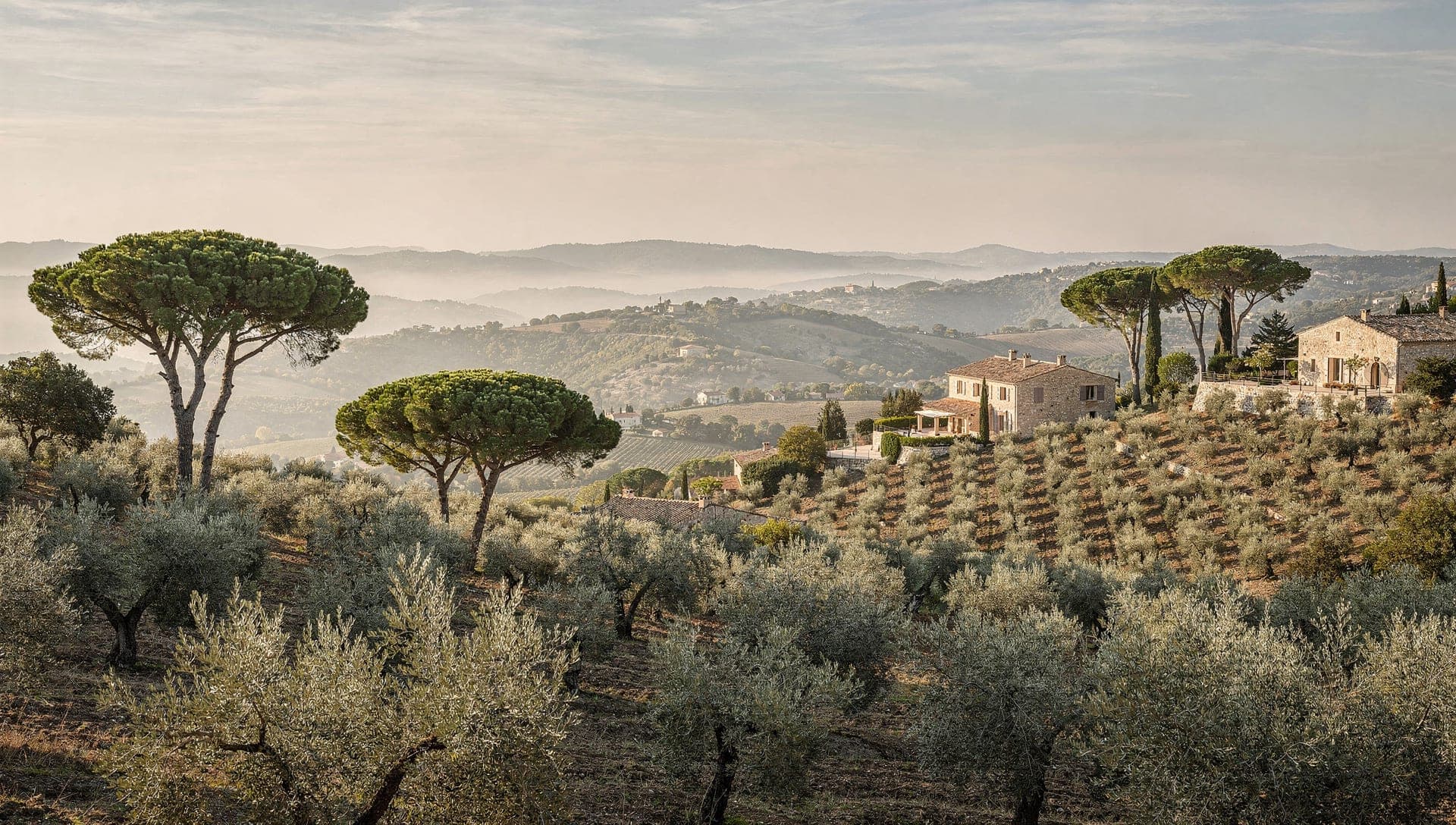
Why the drive up is worth it
Châteauneuf-de-Grasse sits on a long ridge that drops south towards Mougins and west towards Grasse. The climb from the Pré-du-Lac roundabout takes about seven minutes on the D2085, and most buyers who try it once start picturing the view from a terrace. That is the simple thesis of this village: you accept a few extra minutes of driving in exchange for a horizon that runs from the Lérins islands to the foothills of the Mercantour, and after a few months the trade stops feeling like a trade at all.
The commune has around 3,800 residents (3,815 in 2023) spread across about nine square kilometres, which makes it one of the lower-density municipalities in the central hinterland. There is one village core, one main parish, two distinct outlying districts, and a generous amount of olive grove between them. The current municipal team has resisted pressure to densify, which is one reason building permits remain difficult to secure.
This guide covers who Châteauneuf suits and who it does not, where the desirable streets are, what view-facing properties cost in 2026, how daily logistics work, and what we tell our buyers to budget for. Real numbers and real street names. We do not write puff pieces, so if a sector has drawbacks we say so.
The village itself
The historic centre wraps around the Place de l’Église and runs down Rue Saint-Antoine. It is small (twenty minutes covers every street), but the stone houses here are some of the oldest in the commune, several dating to the 17th century. The church of Saint-Martin stands at the highest point of the village and offers the first view that sells most buyers on the area: the Bay of Cannes spreads out below and the Estérel range rises in red silhouette to the west.
The commune’s weekly market is not in the old village but down at Pré-du-Lac: every Monday morning until 1pm, on the Place des Pins car park, a compact food market that residents of Châteauneuf, Opio and Le Rouret treat as their own. It is not Valbonne’s market, and that is the point. There are no tourist stalls. Locals do their weekly shop and stop for coffee afterwards.
The village proper has limited commerce by design: one bakery, one small grocery, a tabac, a hairdresser, and a notary. For supermarkets and pharmacies most residents drive down to the Pré-du-Lac roundabout, where supermarkets, a large pharmacy and a DIY store form the practical commercial centre serving both Châteauneuf and Le Rouret.
What the village lacks in retail it returns in atmosphere. Evening light hits the limestone façades at around seven in summer and stays for nearly an hour. The streets are pedestrianised in the historic core, the parking situation is solved by a small lot below the church (free, never full outside July and August), and almost no through traffic passes the central streets because the D2085 bypasses the old village to the north.
Sectors: the village, Le Brusc, Pré-du-Lac
Châteauneuf-de-Grasse breaks into three property markets. Understanding which one a listing belongs to matters more than the postcode.
The Village. Stone houses inside the historic centre, typically three to five bedrooms, 120 to 220 square metres, with small courtyards or roof terraces rather than gardens. These trade between €580,000 and €1.2 million depending on condition and view. The premium ones face south or southwest from the upper streets. A south terrace and a parking space make the largest difference to the price. Parking is the second largest pricing variable after view, and it is harder to add than buyers expect.
Le Brusc. The hamlet to the south of the village, halfway down the slope towards Mougins. This is where you find detached villas on plots of 1,500 to 4,000 square metres, almost all built between 1975 and 2005, almost all with pools. Le Brusc enjoys the same horizon view as the upper village but adds garden space and privacy. Current asking range: €1.4 million to €3.2 million. The best parcels, those with unobstructed sea sightlines and pool orientation due south, push above €4 million. Architectural style is mixed. Neo-Provençal predominates, but several modernist villas designed in the 1990s also appear on the market, and they tend to sell quickly to international buyers who want clean lines.
Pré-du-Lac. The flat valley district at the base of the village, shared administratively with Le Rouret and Opio. Detached houses on 800 to 1,500 square metre plots are marketed from €750,000 to €1.6 million. DVF records no house sale of €1M or more in the Pré-du-Lac lieu-dit over 2021–2025: too few to publish a figure. No views to speak of, since you are at the bottom of the bowl rather than the top. You do gain proximity to shops, to the school in Opio, and to the D2085 for commuting. Families with school-age children often start here and trade up to Le Brusc or the village once they know the area. Our sector pages cover the historic village and Pré-du-Lac.
Schools and family life
School choice is the single most important factor for international buyers with children, and it shapes where families settle within the commune. The local public primary school sits in the valley district. For secondary school, families look at the public collèges of neighbouring communes, such as Collège César in Roquefort-les-Pins.
The international school cluster is what brings most relocating families to Châteauneuf. The Campus International de Valbonne (CIV) is a 12-minute drive via the D2085 and the D3 (about 8 kilometres) and offers international sections, an American one among them, from collège through baccalaureate. Mougins British International School, the British curriculum option, is 15 minutes south via the D35. Pickup runs from 3pm and the route fills with school traffic between 3.15 and 4pm, which is the only meaningful congestion you will encounter living in the village. The International School of Nice is 35 minutes east, generally not feasible as a daily commute from Châteauneuf.
For preschool (maternelle), the village’s own École Maternelle de Châteauneuf takes children from age three. Demand is moderate. Most years there is room, but families relocating mid-year should contact the mairie before assuming a place. Private daycare options cluster in Le Rouret and Opio.
For teenagers, the village is calmer than Valbonne or Mougins. There is no skatepark, no cinema, no central café scene for teens. Most families with older children find this means weekends are spent driving to Cannes, Antibes, or Sophia Antipolis. This is a positive for some buyers and a negative for others. Be honest about what your household will want.
Eating locally
The village keeps a short list of tables.
Village tables. The village and the road just outside it hold a few restaurants with Provençal menus that follow the season and terraces over the southern slope. Book ahead from Thursday through Sunday.
Winter menus. In the cold months, local kitchens turn to Niçoise dishes and game.
La Bastide Saint-Antoine in Grasse. Not in Châteauneuf, but 15 minutes by car and worth mentioning because most village residents end up there for special occasions. Listed in the Michelin Guide (no star in 2026), with Jacques Chibois in the kitchen and prices in the guide’s top band. The drive home up the village at night is itself part of the experience.
For everyday lunch, the village has a café on the square with a plat du jour and terrace seating, and the bakery does excellent fougasse and pissaladière that work for picnics on the terrace. The Pré-du-Lac district adds a couple of bistros and a pizzeria, useful for school pickups but not destinations in themselves. For groceries beyond the Sunday market, most households use the supermarkets at Pré-du-Lac for weekly shops and drive to the hypermarkets near Antibes for larger runs.
Connections
Châteauneuf’s location is its second-best feature after the view. The village sits at the intersection of three useful axes. The D2085 runs east-west connecting Grasse (12 minutes) to the autoroute access at Villeneuve-Loubet (18 minutes). The D3 drops south to Mougins (10 minutes) and onward to Cannes (22 minutes outside rush hour). The D7 climbs north to the Plateau de Caussols and the hiking country, but more practically connects to Roquefort-les-Pins (8 minutes).
Sophia Antipolis, the technology park that anchors the local employment market, sits 10 kilometres southeast. Door-to-door from a Le Brusc villa to a typical Sophia office runs 18 to 25 minutes depending on whether you go through Mougins or through Valbonne. The Valbonne route is shorter but the Mougins route avoids morning school traffic between 8 and 9am. We recommend buyers test both during the weekday they plan to commute.
Nice Côte d’Azur airport is 28 kilometres east, about 35 minutes by car outside peak times, 50 minutes during the morning rush. The trip is simple: the A8 from the Villeneuve-Loubet entry to the airport exit. The TGV station at Cannes is 25 minutes south. Regional TER trains run from Cannes to Marseille in about two hours, and TGV services from Cannes reach Paris in a little over five hours.
Public transport within the commune is limited. Bus lines link Pré-du-Lac to Grasse and the coast, but services are infrequent. School buses serve the international schools at Valbonne and Mougins. No buyer should expect to live in Châteauneuf without a car. Two cars per household is the norm for families with teenagers, who cannot drive alone before 17 under French law (the minimum age for a car licence fell from 18 to 17 on 1 January 2024).
The 2026 market: prices, stock, buyers
The Châteauneuf market entered 2026 in good health relative to the wider Alpes-Maritimes. DVF records 15 sales of houses of 100 m² or more sold for €1M or more in the commune in 2025, against 16 in 2024. Their median price was €8,705 per square metre, 8% below the 2024 median of €9,449 and 23% above 2021.
Stock is tight, and much of what is openly listed is villas above €1.5 million. Village houses for owner-occupiers in the €600,000 to €900,000 band move faster than the €2 million plus segment, where international buyers spend longer on due diligence and the best properties rarely list publicly.
The buyers are mostly French, many relocating from Paris and Lyon, alongside British, Scandinavian, Belgian, Dutch and Swiss buyers and some Americans, often remote technology workers, who still need a long-stay visa: buying property in France gives no right of residence.
What this means for a 2026 buyer: expect to pay close to asking price for anything well-priced under €1 million, expect to negotiate 4% to 7% on properties above €1.5 million if they have been on the market more than four months, and expect to wait for the right villa rather than the right price. Nothing about the Châteauneuf market in 2026 rewards impatient buyers. For prices by sector, read our article on the Châteauneuf-de-Grasse market in 2026.
Buying notes for international purchasers
The legal process for a property purchase in France is well-established and protective of the buyer, but it moves at a French pace. Plan for three to four months between offer and acte authentique (final deed). The compromis de vente, signed a few weeks after the offer, locks both parties subject to standard conditions (mortgage approval, no liens, no zoning issues). Once signed, the buyer has a 10-day cooling-off period and then risks losing the deposit (usually 5 to 10%) if they withdraw without an approved condition.
Three Châteauneuf-specific points worth flagging. First, septic systems. Roughly half the commune is not connected to mains drainage and uses individual systems (assainissement individuel). Any sale requires a SPANC inspection report, valid for three years. A non-compliant system must be brought up to code within one year of purchase, and a full replacement runs €8,000 to €15,000 depending on terrain.
Second, water sources. Several properties in Le Brusc and on the outer village edge use private wells or rely on rooftop catchment supplemented by mains. This works in practice (water rights are stable and the geology produces good flow), but understand the maintenance commitment before buying. Ask for the previous owner’s water bills and ask the seller’s notary to confirm the legal status of any well.
Third, view easements. Several streets in the upper village have informal arrangements about maintaining sightlines, such as neighbours agreeing not to plant tall trees. These rarely appear in the title documents. If view is your primary reason for buying, walk the neighbouring properties before signing and ask the seller’s notary directly whether any servitudes de vue are registered.
Mortgage availability for non-residents has loosened slightly since 2023. Most French banks lend at 75% to 80% LTV to qualified international buyers, with rates currently around 3.6% to 4.1% on 20-year fixed terms. Lining up a mortgage broker before signing the compromis avoids the most common cause of failed transactions. Our non-resident mortgage guide covers the lenders.
The year in Châteauneuf
Each season offers a different version of the village.
Winter (December–February). Cold mornings, often crisp blue skies, snow visible on the Mercantour peaks. Restaurants serve daube, game and truffles from late November. The village population thins as second-home owners head north, which means parking is easy and the bakery has bread at 11am. This is when local life is most local.
Spring (March–May). The hillsides bloom in stages: almond first in February, then mimosa down towards Mandelieu, then wisteria coating the village walls in April. ExpoRose in Grasse in early May draws daytrippers, and the Cannes Film Festival in mid-May creates a brief traffic spike on the D2085. The village itself stays quiet.
Summer (June–August). Warm but rarely oppressive. Châteauneuf’s altitude keeps nights cool, typically 18 to 20°C even in August. The village fills with second-home families. Restaurants book out by Tuesday for the coming weekend.
Autumn (September–November). Autumn is our favourite season here. The light turns gold, the olive harvest begins in late October, and the village restaurants reopen after their August closures with new menus. Property viewings increase as families who looked over summer return to make decisions before Christmas. October and early November are the months when the best villas come back on the market after summer rentals end.
If you have time for one visit, come in late October or early February. Either trip will show you the village without the seasonal distortions of high summer.
Outdoors and the wider hinterland
The village sits at the edge of one of the best outdoor zones in the central hinterland. The Plateau de Caussols, 25 minutes north on the D7, offers walking and trail running across limestone karst with no traffic and few other people. The Grottes de Saint-Cézaire are 30 minutes west. The Gorges du Loup, one of the better local swimming spots in summer, are 25 minutes north.
For golf, the Golf d’Opio-Valbonne (open to non-members for green fees) is 12 minutes east. Royal Mougins Golf Resort is 15 minutes south. Both are 18-hole courses, and the Golf de la Grande Bastide, an 18-hole Cabell Robinson design from 1990, sits inside the commune.
The cycling is excellent. The D3 north towards Cipières and the climb to Gourdon is one of the classic local routes, roughly 35 kilometres round trip with 800 metres of elevation gain. The Pré-du-Lac flats give beginners a place to learn before tackling the climbs.
Tennis facilities are limited within the commune (two public courts at the village sports area, often busy on weekends), but the Tennis Club de Valbonne (12 minutes) and the Mougins Country Club (10 minutes) both take outside members. Equestrian facilities cluster in Roquefort-les-Pins and Le Rouret, where most properties offer paddocks and several local centres run children’s lessons through the school year.
Is Châteauneuf-de-Grasse right for you?
After years working this market, here is the honest summary.
Châteauneuf-de-Grasse suits buyers who want a horizon, value privacy more than walkable convenience, and have the budget to buy a property with a verified view. It suits families with international school placements at CIV or Mougins British International School and at least one parent who works flexibly or in Sophia Antipolis. It suits second-home buyers who plan to spend three months a year in residence and want the village to feel like home rather than like a hotel district.
It does not suit buyers who need to walk to a café every morning, who do not want to drive, or who place a high value on social density. The village is sociable in a quiet, slow way: neighbours know each other and the bakery owner remembers your order. If you want a busier village, Valbonne or even Mougins suit you better. It does not suit first-time international buyers looking for the cheapest entry point to the Riviera. That is Plan de Grasse or parts of Le Rouret. And it does not suit anyone who looks at a property only once before signing. The view changes by season, by hour, and by year as vegetation grows. Visit at least three times.
For the right buyer, Châteauneuf is the rare commune where price and value still align. The village does not feature in glossy magazine round-ups of the Riviera’s most-wanted towns, which is precisely why it should. Drive up, take a coffee on the square, walk to the church terrace, and look west towards Cannes. If that view still occupies your mind a week later, you have your answer.