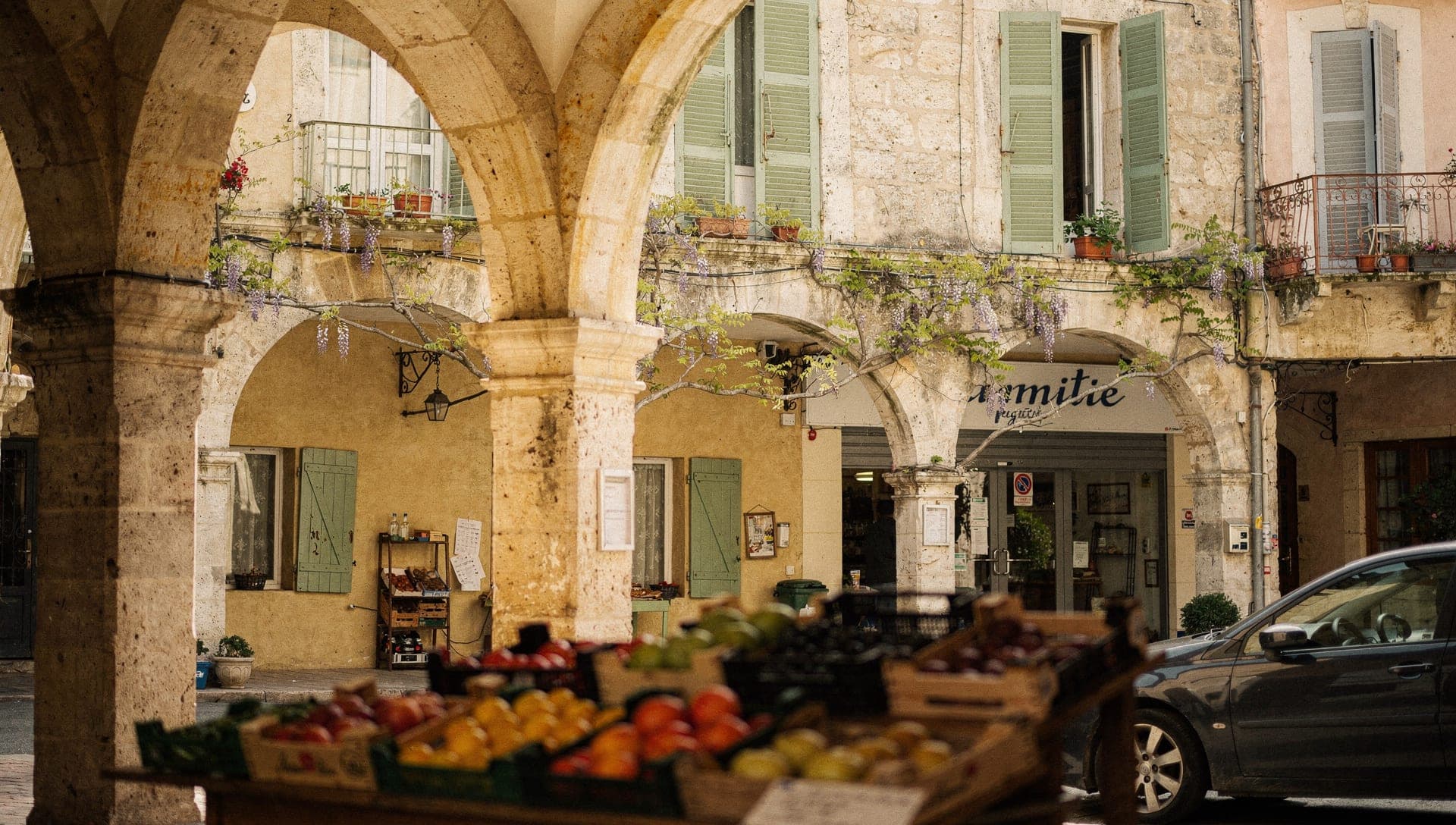
Why the Old Town, and why under €400,000
Quick answer: Yes, a character home in Grasse old town is still possible under €400,000. On 2026 asking prices, that budget buys a renovated apartment of 70 to 90 m² or 100 to 130 m² that need work, and a whole village house to restore starts around €180,000 to €260,000 before works. Exterior changes in the protected centre need the approval of the Architecte des Bâtiments de France, and notaire fees add about 7.3% (around €27,000 on €370,000).
Grasse is the only town in this part of the hinterland where a buyer with a budget of €400,000 still owns a piece of real history rather than a slice of a modern development. While renovated village apartments in Valbonne or Mougins now start well above half a million euros, the historic centre of Grasse, a tall, tightly packed medieval town spilling down a south-facing slope at roughly 350 metres of altitude, still sells renovated apartments for under €400,000. That is the whole story. It is what lets €400,000 buy a renovated home of 70 to 90 square metres, or 100 to 130 square metres that need work, with stone walls, beamed ceilings and, often, a terrace looking out over the rooftops towards the sea.
The reason the price gap exists is not that Grasse is less desirable. The old town spent decades undervalued: too dense, too vertical and too much work for buyers chasing turnkey villas with pools. That is changing. Since the skills of Grasse perfumery were added to UNESCO’s Intangible Cultural Heritage list in 2018, the town has poured money into restoring its streets, its fountains and its facades. The result is a centre that feels cared for again, where artisans and young families are buying the same houses that investors overlooked.
This guide is written for the buyer who wants character without the seven-figure cheque: who would rather walk to the Saturday market than drive to a retail park, and who understands that an old building rewards patience. It covers what your money buys, which lanes to target, the rules that govern renovation in a protected sector, and the honest trade-offs of living inside one of France’s most storied small towns. It also sets out the rental and resale case, and the step-by-step buying process for international purchasers, so that by the end you are able to judge whether an old-town home in Grasse fits your money and your life.
The shape of Vieux Grasse: how the old town is laid out
The historic centre is shaped like an amphitheatre. At the top sits the Cathédrale Notre-Dame-du-Puy, built in the twelfth and thirteenth centuries, which holds three paintings by Rubens and an early religious work by Jean-Honoré Fragonard, the town’s most famous son. From the cathedral terrace the old town drops away in tiers of ochre and pink houses, and on a clear day the view reaches the Lérins islands off Cannes.
Daily life organises itself around two open spaces. The Place aux Aires, ringed by arcades and anchored by a three-tiered fountain, is the market square, the place locals mean when they say they are going "en ville." Below it, the Cours Honoré Cresp is a broad esplanade lined with plane trees and cafés, with the Villa-Musée Fragonard and the Musée International de la Parfumerie within a two-minute walk. Between these two anchors runs the rue Jean Ossola, the main artery, with smaller lanes (rue de l’Oratoire, rue de la Fontette, the Place de la Poissonnerie) branching off in every direction.
What matters for a buyer is that the old town is not uniform. The streets closest to the Cours and the cathedral are the most sought-after: brighter, better restored, with the best views. The deeper, narrower lanes lower down towards Saint-Jacques are darker, and this is where the renovation projects sit. Orientation is everything. A south or west-facing apartment three floors up gets flooded with light. A north-facing ground floor on the same street feels like a cellar. Walk the streets at different times of day before you commit, because the difference of a single floor or a single corner changes both the living experience and the price.
What €400,000 buys in 2026
Let us turn the budget into square metres. Our DVF figures cover houses sold for €1M or more, so they do not price an old-town apartment, and neither the centre historique nor Saint-Jacques has a reliable apartment figure of its own. The guide here is asking prices, and they put €400,000 at 70 to 90 renovated square metres or 100 to 130 square metres that need work.
In practice, the €400,000 ceiling buys three broad types of home. The first is a fully renovated apartment of 70 to 90 square metres, usually on an upper floor, with restored beams, a modern kitchen and bathroom, and often a small terrace or balcony. These are priced from about €350,000 to €420,000 depending on view and condition. The second is a larger property, 100 to 130 square metres, that needs cosmetic or partial work: tired kitchens, dated bathrooms, but sound structure. These appear from €280,000 to €380,000. The third is the project: an entire small village house, three or four narrow floors, gutted or close to it, where the purchase price runs €180,000 to €260,000 and the renovation budget matches it.
Remember the costs on top. Notaire fees on an older property come to about 7.3% of the price in the Alpes-Maritimes (4.50% transfer tax kept), so a €370,000 purchase carries around €27,000 in fees. Agency commission, where it applies, is usually already included in the displayed price. If you are buying within a co-ownership building (most old-town apartments are), ask for the last three years of charges and any planned works (the carnet d’entretien and the procès-verbaux of the syndic meetings), because a facade or roof restoration voted through the co-ownership adds several thousand euros you did not budget for.
Saint-Jacques: the quarter next door
If your priority is space, Saint-Jacques is worth a look. This quarter sits below and to the west of the historic core, an easy walk to the Place aux Aires. Historically a working district, it has the same tall stone houses and shuttered windows as the centre, and younger buyers and first-time owners are moving in. Do not read the figure on our Saint-Jacques page as an apartment price. DVF records 14 house sales of €1M or more in the Saint-Jacques INSEE districts over 2021–2025, at a median of €8,002/m², well above Grasse’s €6,132/m² for the same years. That is the villa market of the wider district, not the old-town flats.
The trade-offs are real and worth naming. Some streets in Saint-Jacques are steep and shaded, parking is street-side and competitive, and a minority of buildings still wait their turn for facade restoration. But the bones are excellent, the same UNESCO-driven public investment is reaching these streets, and the character is all there. A 100 square-metre apartment with two or three bedrooms and original features still sells here for under €380,000, with budget left for cosmetic work.
Saint-Jacques also offers something the densest part of the centre lacks: a little more sky. Because it sits on the slope rather than the saddle, many apartments enjoy open views to the south and southwest, towards the plain of Grasse and the sea beyond. For a buyer who wants the old-town life (the market, the cafés, the walk to the cathedral) and also a terrace where the morning light arrives early and stays, this quarter delivers both. See our Saint-Jacques sector page.
Centre historique: living inside the perfume story
The centre historique is the postcard. You are buying proximity to everything that makes Grasse what it is. The three historic perfume houses are within or beside the old town. Galimard, founded in 1747, is one of France’s oldest fragrance houses. Molinard, established in 1849, is known for natural jasmine extraction. Fragonard, dating from 1926, has its factory-museum at the foot of the centre. Living here means the Musée International de la Parfumerie is part of your daily walk, not a day trip.
The housing in the centre is the most architecturally rewarding in town: tall ceilings, original tomette floors, fireplaces and the occasional vaulted cellar. The best apartments are on the upper floors of the streets ringing the Cours Honoré Cresp and along rue Jean Ossola, where light and views are strongest. A renovated two-bedroom of 80 square metres with a terrace and a sea view reaches the top of the €400,000 band, and on the most coveted corners it occasionally exceeds it.
This is the part of the old town that has benefited most visibly from the post-2018 restoration drive. Streets have been repaved, the cathedral square cleaned, lighting improved, and a steady stream of independent shops, perfumers and small restaurants has filled the ground floors. For a buyer who wants to be at the centre of the town’s cultural life, and who likes stepping out each morning into streets that are centuries old, the centre is, for many, worth what it costs. Our Grasse old town sector page goes further.
Reading a character property: light, stone and the things that cost money
Old-town apartments reward a careful eye. The features that make them special (thick stone walls, beamed ceilings, terracotta floors) become expensive when neglected. Learn to read a property before you fall for the view.
Start with light and orientation, because neither changes after you buy. A bright, south-facing apartment two or three floors up is the benchmark. A dim lower floor on a narrow lane will always feel cramped no matter how well it is finished. Next, look for damp. Grasse old town is built into a hillside, and ground and first floors often suffer from rising moisture. Check the base of walls, smell for mustiness, and ask whether the building has been treated. Then assess the structure: cracks in load-bearing walls, sagging beams, or a roof in poor condition are the items that turn a €50,000 refresh into a €150,000 rebuild.
Practical realities matter as much as romance. Few old-town buildings have a lift, so a top-floor apartment means up to four flights of stairs: fine at forty, a problem at eighty. Parking is almost never included; most owners rely on the municipal car parks (Honoré Cresp, Notre-Dame-des-Fleurs, the Cours) or rent a space nearby. Factor in a monthly cost or a longer walk. Storage is tight, ceilings sometimes too low under the eaves, and windows are often single-glazed and constrained by heritage rules. None of this should put you off, but each item is a number, and the buyers who do well are the ones who price the work honestly before they offer. A simple habit helps here: walk through with a notebook and a torch, photograph the metre cupboard and the ceilings, and ask the agent for the building’s last maintenance records. The romance of a stone terrace is real, but the cost of a new roof is more real still, and the two should be weighed together before any offer goes in.
Renovation reality: costs, permits and the Architecte des Bâtiments de France
Most buyers under €400,000 will do some work, so understand the rules before you sign. The historic centre of Grasse is a protected heritage area (a Site Patrimonial Remarquable), which means exterior changes are overseen by the Architecte des Bâtiments de France, the state heritage architect. Anything visible from the street, from windows, shutters, facade colours and roof tiles to the type of glazing, needs to comply, and you will usually file a déclaration préalable or a permit before work begins. Interior renovation is far freer, but if you touch a load-bearing element or the building’s shared parts you will also need the co-ownership’s agreement.
On budget, plan realistically. A cosmetic refresh (paint, kitchen, bathroom, flooring) runs from roughly €800 to €1,200 per square metre. A full renovation, including new electrics, plumbing, insulation and heritage-compliant windows, typically costs €1,500 to €2,500 per square metre, and a complete house restoration with structural work often exceeds that. So a 90 square-metre apartment bought at €300,000 and fully renovated at €2,000 per square metre lands near €480,000 all in. That is still competitive against a turnkey villa, but only if you have planned for it.
Two pieces of advice save buyers the most grief. First, get a builder’s estimate before you commit, ideally during the offer period, so the renovation number is real rather than hopeful. Second, use local artisans who already work inside the protected sector. They know what the heritage architect will accept and how to source the right materials, which avoids the costly false starts that catch newcomers. Done well, an old-town renovation is one of the few projects on the Riviera where the finished value comfortably exceeds the total spent. The permits in full are in our guide to renovation permits.
Daily life: markets, cafés and the Saturday rhythm
The argument for living in the old town is the day, more than the price. Saturday mornings begin on the Place aux Aires, where the market sets up under the arcades with produce from the plain below, olives, cheeses and flowers. The square fills and the café terraces overflow, and on Wednesdays a second market sets up on the Cours Honoré Cresp. You buy your vegetables from the same growers each week, the baker knows your order, and the whole rhythm of the place runs on foot.
Eating well costs less here than in the smarter villages. Local tables and the cafés around the Cours and the Place aux Aires serve honest Provençal cooking at honest prices. For an occasion, La Bastide Saint-Antoine, chef Jacques Chibois’s restaurant and hotel on avenue Henri Dunant, listed in the Michelin Guide, sits a few minutes from the centre and remains one of the most respected kitchens in the hinterland. Culture is part of the street plan: the Musée International de la Parfumerie, the Villa-Musée Fragonard, the cathedral with its Rubens and Fragonard canvases, and a calendar of events that peaks with ExpoRose in May and the Fête du Jasmin at the start of August, when the streets fill with flower floats and the air carries the town’s signature scent.
Everyday life here has real texture. This is a town that works for its living rather than performing for visitors, where the perfume industry still employs thousands and the school run, the market and the evening apero are all local. For buyers coming from busier cities, that sense of belonging to a working place rather than a resort, where neighbours greet you by name within a season, is often the single thing that tips the decision.
Schools, trains and getting around
Grasse is better connected than its hill-town image suggests, and that matters for families and commuters weighing the old town against the coast. The town has its own railway station at the foot of the centre, the terminus of the line to Cannes. Trains reach Cannes in about 25 minutes and continue along the coast towards Antibes and Nice, so a car-free commute works. By road, Cannes is roughly 17 kilometres and 25 minutes, Sophia Antipolis is around 20 minutes, Mougins about 15, Valbonne about 20, and Nice Côte d’Azur airport some 40 kilometres and 40 minutes via the Pénétrante and the A8.
For schooling, Grasse is well served. Public secondary education includes the Lycée Amiral de Grasse and several collèges such as Carnot and Saint-Hilaire, while the private Lycée Fénelon is a long-established alternative. International families typically look a little beyond the commune: the Campus International de Valbonne (CIV) prepares the French baccalauréat with an international option (BFI) around 20 minutes away, Mougins British International School is a similar distance, and the International School of Nice is reachable along the coast. The point for an old-town buyer is that you do not have to choose between character living and good schools. The schools are a short drive away.
Within the town itself, the old centre is built for walking, with the market, shops, schools at primary level, doctors and the train station all within the historic core or a few minutes beyond it. The one practical caveat, parking, has already been flagged: budget for a municipal space or a rented garage, and the rest of daily logistics falls into place on foot.
Who old-town Grasse suits, and who should look elsewhere
Any buying guide should end with a matching exercise. Old-town Grasse suits the buyer who wants character, culture and walkable daily life on a budget that does not stretch that far in Valbonne or Mougins. It suits couples and retirees who enjoy the market, the cafés and the short stroll to a Rubens. It suits first-time owners who want a foothold on the Riviera with room to add value through renovation. And it suits investors drawn by yields that, thanks to lower entry prices, compare well with the pricier villages, supported by year-round rental demand from perfume-industry staff and visitors.
It suits less well the buyer who needs a garden, a pool and a garage at the door. Those things exist in Grasse, but in the residential sectors of Plascassier, Saint-Jean or Magagnosc, not inside the medieval core, and usually above the €400,000 line. Families with young children sometimes prefer those greener sectors too, for the outdoor space and the easier parking. And anyone unwilling to live with stairs, to manage a co-ownership, or to take on any work at all should weight the trade-offs carefully before committing to a historic building.
For the right buyer, though, the proposition is rare on today’s Riviera: a real character home, in a town with UNESCO-recognised heritage and a living culture, within reach of the coast and the tech economy, for a price that still begins with a three. The window exists because the old town spent years out of fashion. With the streets restored and interest rising, that window is unlikely to stay open at these prices for ever.
The investment case: rental yields and resale
For buyers thinking about return as well as lifestyle, the maths in Grasse Old Town are more favourable than the headline glamour of the coast. Lower entry prices are the engine: when a renovated old-town apartment costs a fraction of its Mougins or Valbonne village equivalent, the same rent produces a higher percentage yield. A renovated two-bedroom of 75 square metres bought around €330,000 and let long-term at €1,150 to €1,350 a month gross returns roughly 4.2 to 4.9 per cent before charges and tax. Those are strong numbers for the hinterland, where 3 per cent is more typical in the pricier villages.
Demand underpins those figures. Grasse is a working town of 50,970 people (INSEE, 2023), not a seasonal resort, so long-term tenants are easy to find: perfume-industry employees, hospital and school staff, young professionals priced out of Valbonne. That keeps vacancy low and rent collection steady through the winter, when coastal short-let markets go quiet. For owners who prefer holiday letting, the cultural calendar (ExpoRose, the Fête du Jasmin, the museums and the perfume tours) supports tourist demand from spring to autumn, though short-let rules and any co-ownership restrictions should be checked first.
On resale, the direction of travel matters. The post-2018 UNESCO recognition and the public restoration of streets and facades have started to narrow the historic discount between Grasse and its neighbours. Buyers who renovate to a high standard inside the protected sector are among the few on the Riviera with a reasonable expectation that the finished value will exceed total outlay, because supply of genuine character stock is fixed and slowly improving in perception. None of this is a guarantee, and property never is. Still, the combination of low entry price, real rental demand and a town visibly investing in itself is a sound foundation for value.
The buying process for international buyers
Buying an old-town home in France follows a clear sequence, and knowing it removes most of the anxiety for first-time international buyers. Once your offer is accepted, you sign a compromis de vente, the binding preliminary contract, and pay a deposit, usually 5 to 10 per cent, held by the notaire. From signing, you have a statutory ten-day cooling-off period during which you are free to withdraw without penalty. The full purchase, the acte authentique, completes roughly two to three months later once the notaire has gathered the surveys, the urban planning certificates and the co-ownership documents.
Two technical points deserve attention in the historic centre. First, the diagnostics: French sellers must provide a dossier covering energy performance, lead, asbestos, electrical and gas safety and natural risks. Lead and asbestos come up often in old buildings. A termite report is not compulsory in Grasse, which is outside the prefectural termite order, but ask for one anyway. Read them, don’t skim them. Second, co-ownership paperwork: ask the notaire for the règlement de copropriété, the last three years of accounts, and the minutes of recent general meetings, because votes on facade or roof works carry real cost. For protected exterior changes, also ask for pre-approval guidance from the heritage architect before you complete, not after.
Financing is open to non-residents, though French banks typically lend up to 70 to 80 per cent for non-resident buyers and will want proof of income and a clean debt-to-income ratio. Many international buyers purchase through an SCI, a French property-holding company, for succession and ownership-sharing reasons. Whether it suits you depends on your situation and is worth a short conversation with a notaire or tax adviser. Budget about 7 per cent for notaire and registration fees on an older property, and you have the full picture: a process that is methodical, well-protected by law, and manageable with the right local advisers. The national steps are in our guide to buying in France as a foreigner.
Sources
Official sources this guide draws on: