The village above Cannes
Mougins is one of those addresses people mention with a small smile, as if they have a secret. The village sits on a wooded hill seven kilometres north of Cannes, ringed by stone houses that climb in a slow spiral to the church at the summit. From the top you see the bay of La Napoule on a clear day. On the clearest days the Lérins islands show up in the Mediterranean like two flat green stones.
The commune itself is large, with 19,782 residents (INSEE, 2023) spread across more than 25 square kilometres. When local buyers say "Mougins Village", though, they mean the medieval core: the pedestrian lanes inside the old ramparts, the small ring of properties pressed against the village wall, and the hamlets that begin where the village ends. This guide is about that smaller world. It is the part of Mougins that draws collectors, retired chefs, semi-retired bankers, and a quiet rotation of writers and painters who like the light and the lunch.
What the village offers, in plain terms, is walkability inside a working medieval shell, four serious restaurants within ten minutes on foot, art galleries that change three or four times a year, a school that takes children from age three through A-levels, and a forest that begins at the edge of the village square. What it does not offer is a beach, a supermarket inside the walls, or an easy answer to where you should park. Both lists matter, and we cover both below.
Walking the ramparts: what the old village feels like
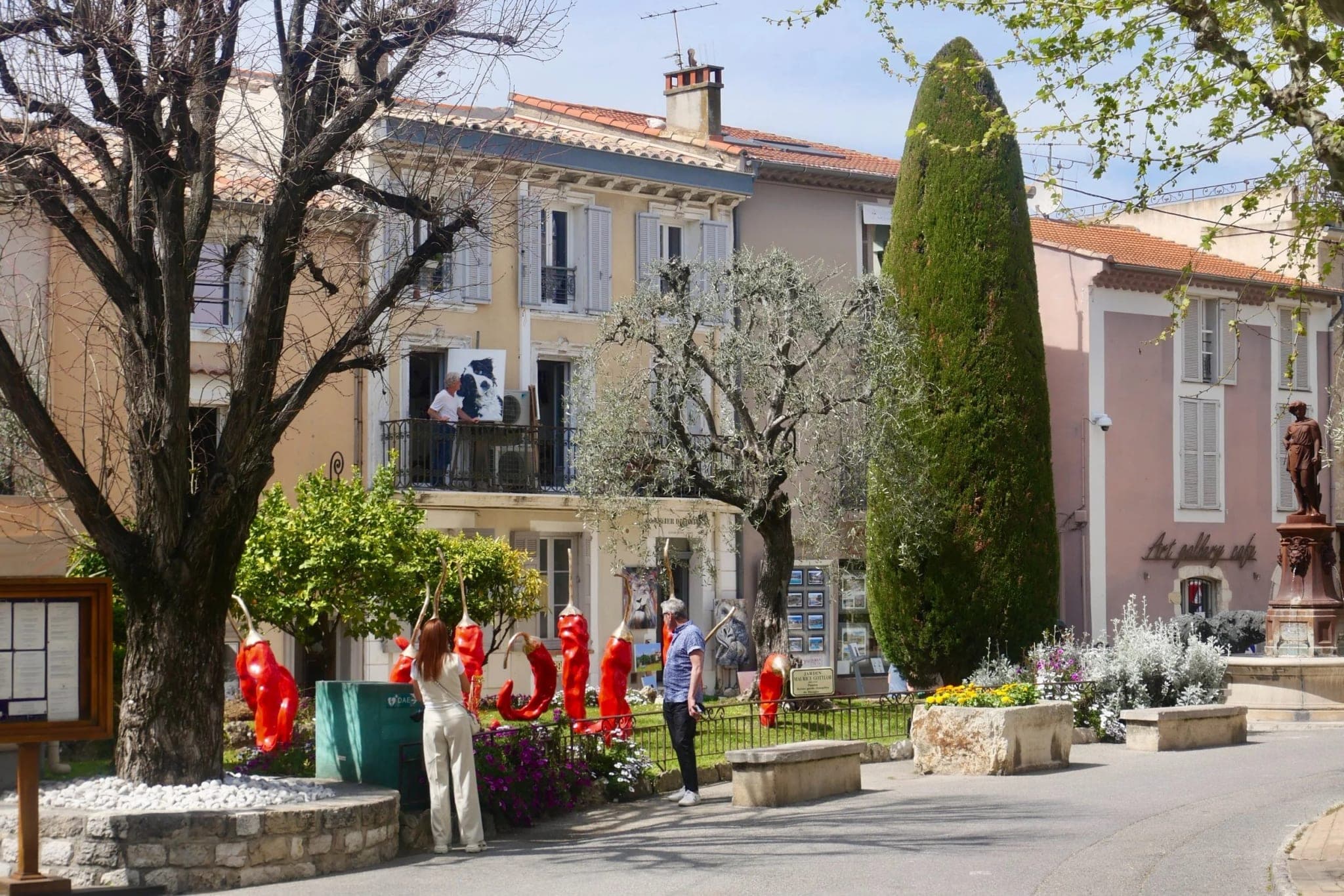
Start with this: cars stay out of the medieval core. The two main car parks sit outside the old gate, and from there you walk. The lanes are narrow enough that two people with shopping bags need to make eye contact to pass. The streets are paved in stone that has been worn into a shallow dish by five centuries of feet.
The architecture is what locals call "Provençal vernacular": three-storey stone houses with painted shutters, terracotta roof tiles, and small balconies overlooking the tiled rooftops below. Most of the village houses inside the ramparts are between 80 and 220 square metres, arranged on three or four floors connected by tight stone staircases. Few have gardens and many have rooftop terraces. Almost all have the small irregular windows that, at four in the afternoon, give the interior light the look of a Vermeer.
The Place du Commandant Lamy at the centre of the village is where the rhythm happens. The cafés and restaurants around it (La Place de Mougins and Le Petit Fouet among them) follow a loose hierarchy that locals understand. Mornings are for pastry and a quick coffee. Lunch sits longer. After 18:00, a glass of rosé in front of the church is a daily ritual rather than an event.
The village ends abruptly. Walk past the school at the eastern gate and within four minutes you are in pine forest. Leave the village and about two kilometres on you reach Notre-Dame-de-Vie, the chapel beside the house where Picasso lived for the last twelve years of his life. Everything is close, and that is why people choose it. People who live here describe the same routine: out for bread at 09:00, lunch at one of three or four places, a walk in the Valmasque in the afternoon, and dinner that you cooked yourself with whatever you bought that morning.
Why cooks came here: the gastronomic inheritance
Mougins is the village where Roger Vergé opened Le Moulin de Mougins in 1969, set in a 16th-century olive mill on the road down to Notre-Dame-de-Vie. Vergé invented what he called la cuisine du soleil, the cooking of the sun, and turned a sleepy hilltop village into one of the early gastronomic addresses in France. He trained Alain Ducasse and David Bouley. The Moulin still runs as a restaurant under different ownership. What he left behind matters more: Mougins is still a village that eats seriously.
The current names are easy to list, and none of them holds a Michelin star in the 2026 guide. Paloma, which once held two stars, has closed. Le Mas Candille, the hotel-restaurant on the Boulevard Clément Rebuffel, lost its star in 2022 and still runs its restaurant. L’Amandier de Mougins sits inside the village walls and is the best-known table in the medieval core itself. Its terrace catches the late sun. La Place de Mougins on the main square is listed in the 2026 Michelin Guide.
Beyond these, the village has eight or nine restaurants that locals use. The everyday staples are Le Resto des Arts, the village bistro near the church that cooks the simple Provençal repertoire properly, Le Bistrot de Mougins for a simple dinner, and Le Petit Fouet for late-afternoon charcuterie boards on the Place. None of these are tourist traps, and prices outside the formal rooms run €30 to €55 for a full lunch with a glass.
What the food economy means for buyers is simple. Mougins Village has a year-round restaurant scene that does not collapse in November the way the coast does. The better-known kitchens drive a steady high-summer rental market, and the village restaurants drive a steady winter one. People who buy here use the village and have no need to drive to Cannes for a decent meal. That changes how a property works day to day. Our guide to dining in Mougins names the tables.
Picasso’s last address and the art habit
In June 1961 Pablo Picasso bought a stone farmhouse called Mas Notre-Dame-de-Vie, on the hillside about two kilometres from Mougins Village. He was 79. He stayed there with Jacqueline Roque until his death in April 1973. The Mas is private and not open to the public, but the chapel of Notre-Dame-de-Vie next to it, a 12th-century chapel rebuilt in 1654 and ringed by cypress trees, opens to visitors at set seasonal hours. The walk from the village square is one of the best around.
Picasso’s twelve years in Mougins gave the village an art habit it has not lost. Throughout the 1970s and 1980s, sculptors and painters bought small village houses because they were affordable and because the mid-afternoon light here is unusually white and clean. Several galleries still trade inside the medieval core, from mid-century Riviera painting to modern and contemporary work, and their shows rotate through the year.
The Musée d’Art Classique de Mougins (MACM), inside the village walls, has closed, and in June 2024 its founder, Christian Levett, reopened the site as FAMM, a museum devoted to women artists. The working artist scene (studios above shop fronts, open weekends in October, the September art fair on the Place) has held up. The Espace de l’Art Concret, twelve minutes’ drive away in Mouans-Sartoux, runs contemporary exhibitions through the year and is the regional anchor most residents use.
Sectors at a glance: where the village ends and the hills begin
"Mougins" on a property listing covers five different places. The price per square metre and the way the property works depend entirely on which one. For buyers focused on the village experience, four sectors matter most.
Inside the ramparts (the old village)
The medieval core itself. Mostly stone village houses on three or four floors, often without dedicated parking, often with rooftop terraces rather than gardens. Surface areas run 80 to 250 square metres. DVF records only three house sales of €1M or more in the village lieu-dit over 2021–2025: too few to publish a figure. Live here for walkability and the morning routine. Look elsewhere if you want a pool.
Les Bréguières
The hamlet immediately west of the village, between the medieval core and the Notre-Dame-de-Vie chapel. The properties here are mostly individual stone mas and small estates, often with mature olive groves and pools. Land sizes start around 1,500 square metres and climb past one hectare. A renovated property of 250 square metres on a hectare is marketed at €4 to €8 million, though DVF records only one house sale of €1M or more in the Les Bréguières lieux-dits over 2021–2025. It is two minutes from the village square and feels rural the moment you turn off the lane.
Tournamy
The flat plain to the south-west of the village, closer to Cannes, with the post office, the supermarket, and most of the everyday infrastructure. Tournamy is functional rather than picturesque, and it matters because most of the village’s daily logistics happen there. A modern villa in Tournamy on 1,000 square metres of land typically prices between €1.4 and €2.2 million in 2026.
Font de Currault
South of the village, sloping down towards Mouans-Sartoux. A residential sector of mostly 1970s–1990s villas on land plots between 1,000 and 3,000 square metres. Currault is the family-buyer favourite: school-run distances are short, properties have pools and gardens, and prices run €1.2 to €2.5 million for a four-bedroom villa in good order. You give up the village experience, and for many buyers with school-age children that is the better fit.
A fifth sector, Val de Mougins, sits between Tournamy and the autoroute and is mostly mid-2000s gated developments. Worth knowing about, and rarely the right answer if you want the village proper. The village proper has its own page: Le Vieux Mougins, sector guide.
The Mougins British International School question
For families relocating from London, Geneva, Singapore, or Dubai, the school question often determines the property search before anything else. Mougins School, now Mougins British International School, on the Avenue Maurice Donat towards Sophia Antipolis, is the largest English-language school in the area. It runs from age three to eighteen, follows the English National Curriculum leading to A-levels, and has around 480 pupils. Annual fees for 2026/27 run from €15,960 to €25,600 depending on year group. That is broadly half what an equivalent school in central London charges, and less than the British schools in Monaco or Geneva.
The other English-language option in the immediate area is the International School of Nice (ISN), which sits in Nice itself and is a 35-minute drive from Mougins Village in light traffic, longer in summer. Many Mougins families also consider the Campus International de Valbonne (CIV), the bilingual French state school in Valbonne that requires entrance testing and is roughly 18 minutes by car from the village. CIV is free for residents and prepares pupils for the French baccalauréat with its international option (BFI), but the admission criteria are demanding.
What this means in practice is a recurring buyer pattern: families with younger children typically prioritise Mougins British International School and look at Font de Currault, Tournamy, or the edge of the old village, where the school run is under ten minutes. Families with older teenagers sometimes put CIV in Valbonne first and look further north, at Châteauneuf-de-Grasse or Opio, to shorten that journey instead.
The school does not run buses through every sector of the village, so where you live affects whether the school run is a five-minute walk, a twelve-minute drive, or something in between. Drive the route at 08:15 on a Tuesday before you make an offer. Here it pays. Fees, curriculum and admissions are on our Mougins British International School page.
Green space: La Valmasque, Fontmerle and the plateau
The Parc naturel départemental de la Valmasque covers 428 hectares across Mougins and Valbonne, running north-east towards Sophia Antipolis. It is one of the largest protected woodlands in the Alpes-Maritimes department and is laced with walking and cycling paths. The best-known walk is the loop around the Étang de Fontmerle, a pond that fills with lotus flowers in summer. The walk takes about 45 minutes and the lotus bloom is a small but real local event each summer.
For families, the forest matters in three practical ways. First, it means that within four minutes of leaving the village square you are on a marked footpath under pine trees. Second, the forest’s protected status keeps the eastern side of the village green for good, so no development will block the view from a property on the eastern wall. Third, the forest connects, via marked paths, to the GR51 long-distance trail, which runs along the entire hinterland from Menton to Marseille. Serious walkers set off from their front door.
South of the village, the Plateau de la Valmasque is a slightly less wooded, more open table of land with running and cycling routes that are flatter and easier than the forest paths. It is also where the local rugby club trains. Riding stables operate within ten minutes, and several Mougins households keep horses on rented stalls there.
One often-overlooked detail: the village itself sits at 260 metres of elevation. That is enough to make summer evenings five or six degrees cooler than Cannes, which sits at sea level. People who buy in the village in March often find, in their first August, that they sleep with the windows open while their friends in Cannes are running air conditioning.
The weekend rhythm: markets, cafés and slow mornings
The farmers’ and artisans’ market on the Cours des Arts anchors the social life of the village. It runs every Sunday morning from 08:30 to 13:00, and since June 2026 on Saturday mornings as well. Growers and local producers make up most of the stalls, with a few craftspeople alongside.
The market is not a tourist market. Locals do their weekly shopping there and stay for coffee afterwards. If you buy a property in the village and you do not become a regular at the weekend market within three months, something is slightly off.
The fuller market, for buyers who want the larger Provençal experience, is the Tuesday and Thursday market at Mouans-Sartoux, ten minutes by car. The Friday market in Valbonne, on the Place des Arcades, is the most famous in the area and is twenty minutes away. People end up valuing the weekend routine: the small market in your own village, then a bigger one somewhere nearby the following week.
Sundays in the village are quiet in a way that surprises some buyers. The boulangerie opens until midday. Two of the cafés stay open until late afternoon. The restaurants serve lunch and then close. By 18:00 in February the village is almost silent. Buyers who want to be in the middle of things on a Sunday evening sometimes find this jarring. Buyers who came here to get away from that find it the best part of the week.
What property costs in 2026
Mougins Village is one of the most stratified property markets in the hinterland. The price-per-square-metre range inside the commune is wider than for any of the surrounding towns. Generalisations mislead. The specifics matter.
Inside the medieval village, stone houses without parking: 80 to 220 square metres, asking prices in 2026 between €700,000 (a small two-bedroom on three floors with no view) and €2.4 million (a four-bedroom with a roof terrace facing south and the bay of Cannes). DVF records only three house sales of €1M or more in the village lieu-dit over 2021–2025: too few to publish a figure. Across Mougins, the median for the same years is €8,636/m². A reliable rule: knock 5 to 8 per cent off asking for a winter sale, slightly less in spring.
Inside the medieval village, properties with a parking spot or garage: add 12 to 18 per cent to the asking prices above. Parking moves the price more than anything else. A garage inside or directly outside the ramparts is scarce and often worth €100,000 to €180,000 on its own.
Les Bréguières (the hamlet west of the village): small mas on 1,500 to 5,000 square metres of land run €2.5 to €5 million. Larger estates on a hectare or more, with mature olive groves and a pool, run €5 to €12 million. These are asking prices. DVF records only one house sale of €1M or more in the Les Bréguières lieux-dits over 2021–2025: too few to publish a figure. Next door, DVF records 17 house sales of €1M or more in the Notre-Dame-de-Vie lieu-dit over 2021–2025, at a median of €7,109/m², well below Mougins’s €8,636/m² for the same years.
Font de Currault: villas of 180 to 320 square metres on 1,000 to 3,000 square metres of land. In 2026 the typical asking price for a four-bedroom villa in good condition with a pool sits between €1.2 and €2.5 million. New-build villas to a high spec push past €3 million. DVF records no house sale of €1M or more in the Font de Currault lieu-dit over 2021–2025: too few to publish a figure.
Tournamy: villas of similar size run €1.1 to €2.2 million. The difference with Currault comes down to the feel of the immediate streets. Tournamy is flatter, more functional and less leafy.
Notaire fees on a resale property add about 7 per cent to the purchase price in the Alpes-Maritimes (4.50 per cent transfer tax kept). New-build properties incur lower fees (around 2.5 per cent) but VAT is included in the headline price. The annual taxe foncière on a 200-square-metre village house typically runs €1,800 to €3,200 per year. The annual taxe d’habitation on second homes, which Mougins charges with a surcharge, adds another 1,500 to 4,000 euros depending on the rateable value. For recorded sales since 2021, see Mougins house prices.
Practical realities: access, parking, renovation, heritage rules
Practical considerations decide whether the village fits a buyer’s life. Five matter most.
Access to Nice Airport. From the village, Nice Côte d’Azur airport is 25 to 40 minutes by car depending on traffic. The A8 entrance at Mougins-Tournamy is six minutes from the village square. Helicopter transfers run from Nice to Cannes Heliport, which is twelve minutes from the village, and some second-home owners use this on summer weekends.
Parking. Parking inside the ramparts is allocated to permanent residents only, and even residents do not always have a guaranteed space. The two main public car parks each hold about 90 cars and fill by 11:00 on summer Saturdays. If you buy a property without a dedicated parking spot, your daily reality is walking from one of these car parks with shopping bags. It is no deal-breaker, and it is the reason the village keeps its character. Price it into your choice, though. A property with a parking space is worth a good deal more.
Renovation rules. The medieval core sits inside a protected heritage perimeter. Any external alteration (shutter colour, window size, roof tiles, terrace railings) requires approval from the Architecte des Bâtiments de France. Approvals take three to six months and the rules are strict. Internal renovations are easier, but anything that affects load-bearing walls in a building over 100 years old will need a structural engineer’s report. Budget €2,500 to €4,500 per square metre for a full renovation in the village, higher if heritage materials are required.
Internet. Fibre is available throughout the medieval village and most of Bréguières and Currault. Speeds of 1 Gbps are standard. The two outliers are some of the higher properties in Bréguières where fibre still has to be pulled the last 200 metres at the owner’s cost.
Healthcare. Mougins has a private hospital at Saint-Basile, Arnault Tzanck Mougins Sophia Antipolis, where many local residents go for non-emergency care. The CHU public hospital in Nice is the regional centre for serious cases.
Who Mougins village suits, and who should look elsewhere
Buyers who do well in Mougins Village tend to share three characteristics. They want walkability inside a working medieval setting. They eat out at least once a week and care about the quality of where they eat. And they are comfortable with the idea that a five-minute walk from a car park is part of daily life rather than an inconvenience.
The village suits retired and semi-retired buyers who travel internationally six or eight times a year and want a base to lock and leave. It suits couples without small children who value a short walk to a good restaurant more than a third bedroom. It suits creative professionals (writers, designers, retired chefs, art dealers) who are happy working from a small studio with a roof terrace and like the rhythm of a place where the same dozen people see each other at the boulangerie every morning.
It suits less well families with three or four young children who need a garden and easy car access at every moment. For those families, Font de Currault, Castellaras in Mougins’s neighbouring commune of Mouans-Sartoux, or the family sectors of Valbonne (Peyniblou, Val de Cuberte) usually fit better. It suits less well buyers whose travel pattern is short notice and frequent: the parking constraint and the narrow lanes make late-night arrivals harder than at a villa with a private gate.
And it suits poorly buyers who underestimate the maintenance load of a stone house in a heritage zone. Roofs, gutters, exterior render and shutters all have to be maintained to the standards of the protected sector. An owner who lets a village house drift for five years faces a bill of €80,000 to €150,000 to bring it back. The appropriate mindset is closer to "stewardship of an old building" than to "ownership of a holiday home." Buyers who think of it that way tend to love living here. Buyers who don’t tend to sell within three years.
Sources
Sources
Market data and demographic claims in this article are anchored to the following primary sources:
- DVF (Demandes de Valeurs Foncières), data.gouv.fr for every price and transaction figure.
- INSEE for demographic, household and employment data.
- Notaires de France for quarterly market commentary and regional commentary.
- service-public.fr for legal and procedural references (Notaire, Compromis, Acte authentique, taxes).
- ADEME for energy-performance (DPE) regulatory context.
Published by La Reserve Research. Editorial governance and correction policy: editorial standards. Corrections: contact@lareserve.co.