The quick read
Buy a hinterland property with an olive grove and you take on a small working corner of Provence. It wants pruning once a year, a few deep waterings through the dry months, and roughly a week of picking in late autumn. After that you load the crates into the car, drive to a village moulin like the one at Opio, and come home with your own oil in five-litre cans.
Most houses around Valbonne, Opio, Châteauneuf-de-Grasse and Le Rouret sit on land with at least a handful of olive trees, and plenty come with thirty or more. The local variety is the Cailletier, the same olive behind the AOP Huile d’olive de Nice. Harvest generally starts in November and runs into the new year. Our view after years of watching these sales: a tidy, mature grove reads as a plus at resale, not the chore many first-time buyers fear.
Prices give you the shape of the market. On 2025 DVF medians for houses of 100 m² or more sold for €1M or more, values run from 6,212 euros per square metre in Grasse to 10,073 in Mougins, with Biot, Valbonne, Châteauneuf-de-Grasse, Opio and Roquefort-les-Pins in between. Le Rouret, measured on houses sold for €700,000 or more, sits at 6,349. The grove rarely sets the price on its own. It sets the mood of the garden, and that is what people remember when they walk the plot.
The olive that built these hills
The tree that covers these hills is the Cailletier, known locally as the olive de Nice or the caillette. It is a small olive, picked when it has turned dark and ripe rather than green, and it gives an oil that is light on the palate with almond notes and almost no bitterness. That gentle profile is the reason the oil from this corner of the Alpes-Maritimes earned its own appellation, the AOP Huile d’olive de Nice, recognised in 2001 and covering a large part of the Alpes-Maritimes, from the Cannes and Grasse area across to Menton.
The numbers put the region in context. France presses only a few thousand tonnes of olive oil a year, Provence-Alpes-Côte d’Azur supplies the largest share, and Nice is one of several protected appellations. This is not Andalusia, where oil is made by the tanker. Production here is small, hillside and hand-worked, and that is why the oil is good and why a private grove of twenty or thirty trees still counts for something.
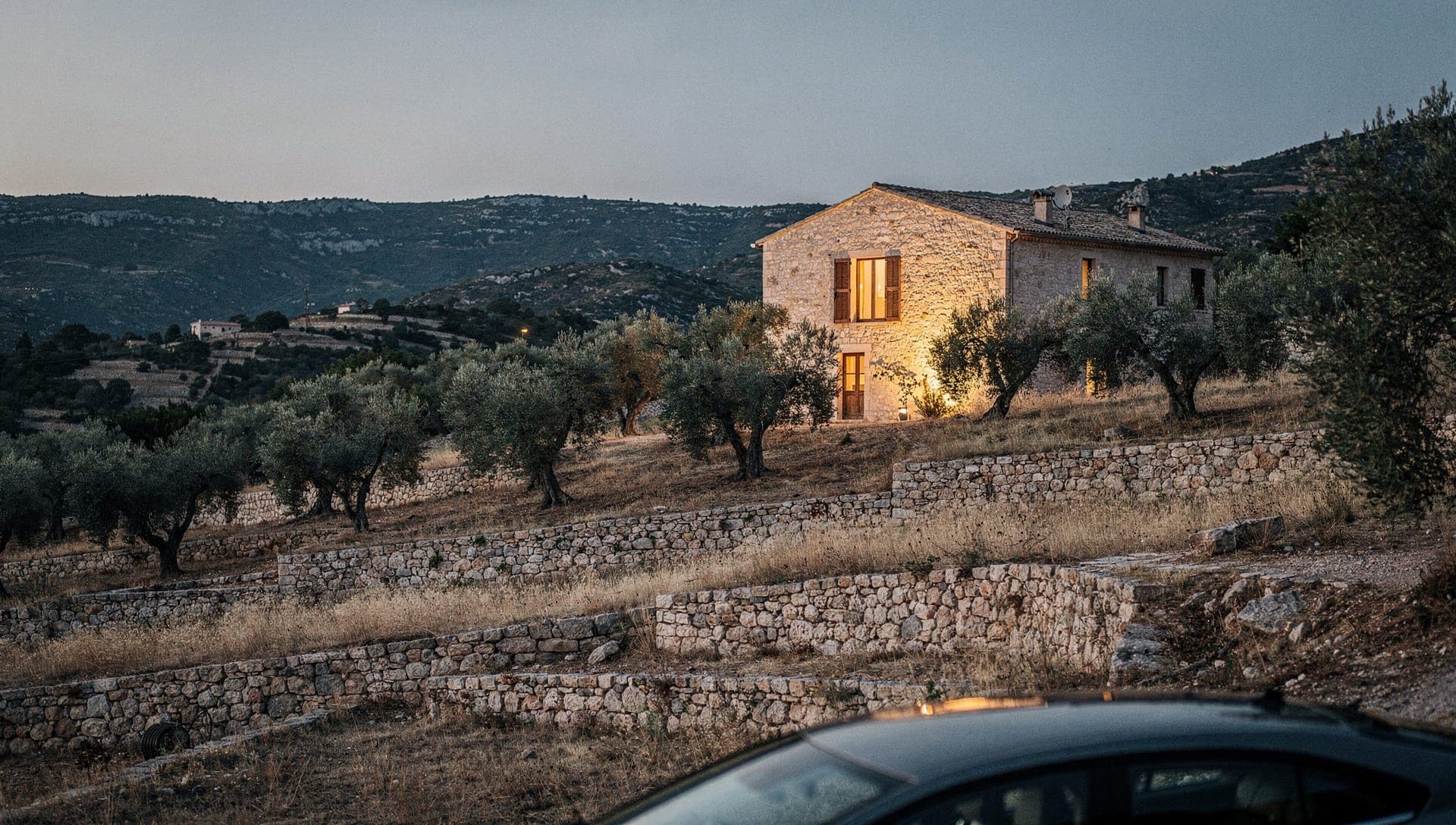
You see the trees everywhere once you start looking. They hold the old terraces, the dry-stone restanques that step down the slopes around Opio and Châteauneuf, walls built by hand over generations to keep soil on a hillside. A century-old Cailletier with a thick, twisted trunk is a fixture of the better gardens here, and locals treat them with the respect you would give an inherited piece of furniture. Buyers from outside the region often arrive thinking of the trees as decoration. Within a year most of them are talking about their oil like a small harvest, because that is what it becomes.
The Cailletier is also a dual-purpose olive. The same fruit, picked a little less ripe and cured in brine, becomes the small wrinkled olive de Nice you find on every market stall and in the tapenade that turns up at every apero. So a grove is not only oil. It is the table olive too, if you have the patience to cure a few jars each winter.
Where the oil is pressed
Everything turns on the moulin, the village mill where olives become oil. The best known around the eight villages is the Moulin d’Opio, at 1 Place de la Font Neuve. Oil has been pressed on the site since 1426, and one family of millers (the Michels in its later generations) ran it from 1848. The Communauté d’agglomération Sophia Antipolis bought it in September 2024, and since 2025 the SCIC Les Ferrages and the association Neede have run it, keeping the part that matters most to residents. You still bring your own olives and walk out with your own oil.
That service has a name, pressing à façon. You drop your crates, the mill weighs and presses them, and you collect oil that is genuinely yours rather than a supermarket blend. There is a practical catch worth knowing before you romanticise it. Rules differ from mill to mill. At Opio there is no minimum quantity for private owners, and from 180 kilos your own olives are pressed separately. Smaller lots go into a shared pressing and you receive a proportional share of the blended oil, which is still your oil in spirit but not from your trees alone. A dozen healthy trees in a good year are usually enough for a dedicated press. A handful will not, and that is fine, because the blend from your own village is excellent.
Opio is not the only option. The Pays de Grasse has several mills within a short drive, and smaller operations near Grasse press by appointment, working through the morning with the olives people bring in. Most mills also sell their own oil, tapenade and olive paste, and run visits out of season, which is the easy way to learn the ropes before you have a crop of your own. The yield rule of thumb that everyone quotes is roughly five kilos of olives for a litre of oil in an average year, more in a poor one. So a tree giving fifteen or twenty kilos is a few bottles, and a real grove is a winter’s supply for the house with some left to give away.
One more thing about the mill run. It is social. You queue with your neighbours, you compare crates, you swap notes on who pruned what and when, and you go home smelling of crushed olive. For a lot of owners this single morning in November or December turns out to be the part of the year they look forward to most, more than they expected when they bought the house for the view.
The olive year, month by month
The olive runs on a calendar you learn quickly once you own a few trees. Flowering comes in late spring, a brief show of tiny cream blossoms that most people never notice. Fruit sets through June, which is when newly planted trees and any grove on thin soil want water. Through summer the olives swell and stay hard and green, and the tree asks almost nothing of you beyond a watchful eye on the weather.
Autumn is when it turns. The colour change, the veraison, moves the fruit from green to purple to black, and the timing shifts year to year. The 2024 to 2025 season ran noticeably late, with the Nice appellation syndicate flagging a delayed veraison across the area. For the Cailletier, picked ripe and dark, the harvest generally starts in November and runs into the new year, according to the appellation’s own specification.
Two rules matter more than any other. Pick when the fruit is ready, not when the calendar says so, because a Cailletier taken too green gives a thin, bitter oil and one left too long loses its freshness. And get the olives to the mill fast, ideally within a day or two, because oil quality falls the longer the fruit sits in the crate. Bruised, warm, waiting olives are the single most common reason a home crop disappoints at the press.
Then winter brings the one real job of the year, the pruning, usually done in February and March once the hard cold has passed and before the sap rises. After that the cycle resets. A grove keeps you in step with the seasons in a way a lawn never will, and for a lot of people that turns out to be the quiet pleasure of the whole thing. You stop checking the calendar and start reading the trees.
What a grove means when you buy
Here is the part that matters when you are signing. An olive grove almost always sits on the garden or agricultural portion of a plot, not under the house, so it rarely complicates the build itself. What it does is shape everything you see from the terrace. Mature trees frame the pool, throw soft shade over the gravel, and give a new garden the look of one that has stood for fifty years. That instant maturity is hard to buy any other way, and it is the reason a villa with an established grove tends to photograph and show better than an identical house on bare land.
Old olive trees also carry a measure of legal protection. Many local plans, the PLU of each commune, treat established trees as features you are not free to remove, and felling or transplanting a mature olive often needs a sign-off from the mairie. Do not assume you are free to clear a grove to extend a lawn or put in a tennis court. Check the PLU and the parcel’s zoning before you picture the garden you want, because the rules vary commune by commune and a refusal after purchase is an expensive surprise.
When you view a property with trees, ask the plain questions. How many trees, and how old. When were they last pruned. Is there any irrigation, or do they run dry through the summer. Who has been maintaining them, the owner or a hired oleiculteur. A grove that has been kept is a gift, ready to crop in your first autumn. A grove that has run wild, full of suckers and three metres too tall, is a season or two of restorative pruning before it produces well again, and that is a real cost in time or money you should price in.
There is a tax footnote worth a word. Land planted and worked as a grove is in some cases classed as agricultural rather than garden, which affects how the parcel is recorded and taxed. It rarely moves the needle on a family home, but on larger estates around Roquefort-les-Pins or Le Rouret, where plots run big and some owners genuinely farm their oil, it is worth asking the notaire how the land is classified before you sign. Our guide to living in Opio covers the grove country around the village.
The real work, honestly
People worry about the work, so here is the honest version. The core job is pruning, once a year or every other year, cutting to the old open-vase shape that lets light and air through the canopy. The local saying is that a swallow should be able to fly clean through the middle of the tree. A dozen trees is a Saturday with a pole saw and a friend who knows what they are doing, and if you do not, an afternoon with a local grower the first year teaches you most of it.
Water is the next thing. Established trees on deep soil cope with the dry summers on their own, but young trees and anything planted in the last few years want a deep soak through July and August, and the recent drought summers have made that less optional than it used to be. A simple drip line solves it. The olive fly is the main pest, the insect that lays in the fruit and ruins the oil, and most owners here manage it with clay or copper-based treatments and by picking before the fruit overripens. None of this is heavy chemistry. A grove is one of the easier things to keep organically, which is how most of the small producers around Opio and Châteauneuf work.
Picking itself is the social part. Some people net the ground and shake the branches, some comb them by hand with a small rake, some still pick into baskets the slow way. For a small grove it is a weekend, usually with help, usually ending with a long lunch. Our view: most owners come to like the rhythm of it, and the ones who do not simply pay a local grower to prune and harvest on shares or by the hour, which is money well spent and easy to arrange in any of the eight villages.
What you should not do is nothing. An olive tree left entirely alone does not die, it sulks. It throws suckers from the base, grows tall and shades itself out, and the crop drops away to almost nothing. The good news is that olives are forgiving and almost impossible to kill outright, so even a badly neglected grove comes back with two or three winters of proper pruning. We have watched buyers turn a sad, overgrown plot into a productive one inside a couple of years, and enjoy the doing of it.
Drought, frost and fire: the real risks
An olive grove is low-maintenance, but it is not risk-free, and a buyer should know what the trees are up against in this part of the Alpes-Maritimes. The first is drought. The summers have run hotter and drier in recent years, and while a mature Cailletier on deep terraced soil is built for it, a young grove or one on a thin, south-facing slope tends to struggle without some water in the worst of August. If you are buying for the trees, look at the soil and the aspect, not only the count.
Frost is the second. The hinterland sits higher and colder than the coast, and the villages above 300 metres around Châteauneuf-de-Grasse and parts of Le Rouret sometimes catch a hard winter frost that the seafront never sees. The olive shrugs off normal cold, but a severe, prolonged freeze damages wood and costs a year of crop. It is rare here, but it is the reason local growers watch the late-winter forecast as closely as the autumn one.
Fire is the risk that carries a legal duty attached. Across the Alpes-Maritimes, properties in or near wooded zones are subject to débroussaillement obligations, the legal requirement to clear brush and maintain defensible space around the house. A well-kept olive grove helps here, because cleared, grazed or mown ground under spaced trees is far less of a fire ladder than dense scrub. When you buy, ask whether the parcel falls under an OLD, the formal clearing obligation, because the work is the owner’s responsibility and the fines for ignoring it are real.
None of this should put anyone off. These are the ordinary facts of owning land in a Mediterranean climate, and the olive is one of the best-adapted trees on the planet for exactly these conditions. The point is to buy with open eyes. Water, aspect and the clearing rules are the three things we would check on any grove property before the survey, not after. The clearing rules are in our fire risk and brush clearing guide.
AOP, and what you are allowed to call your oil
The AOP Huile d’olive de Nice is a protected name with real rules behind it. The oil has to come from the defined area, be built around the Cailletier, and be pressed to the appellation’s standards. That label is what you are paying for when you buy a certified bottle at the Opio mill or on a Saturday market, and it is the reason the local oil sells at a premium to ordinary supermarket oil.
For a private owner the picture is simpler than it looks. Pressing your own olives for your own table sits outside all of that. You are free to press, bottle and give away your oil to family and friends with no certification at all, because it never enters the market. The moment you want to sell it, and especially to sell it as AOP Huile d’olive de Nice, you step into a certified world run through the local syndicate, with checks on your trees, your yields and your mill.
Almost no owner of a garden grove bothers, and there is no reason to. The oil from your own trees is worth more on your own table than it ever would be with a label on it. The handful of hinterland owners who do sell tend to be the larger estates, the ones with several hundred trees and a genuine reason to certify. For everyone else the grove is a private supply, and that is the better deal. You skip the paperwork and keep the best oil for the house.
What grove properties cost, town by town
The grove does not set the price, but the address does. Here is where the eight villages sit on the latest full-year DVF figures (2025, houses of 100 m² or more sold for €1M or more, €700,000 or more in Le Rouret), from the public transaction record kept by the Direction Générale des Finances Publiques. Houses are the figure that matters for the kind of villa-with-garden that comes with olive trees.
| Village | Median €/m², houses sold for €1M or more (2025) | Median sale price |
|---|---|---|
| Mougins | €10,073 | €1,750,400 |
| Biot | €9,654 | €1,920,000 (small sample of 21 sales) |
| Valbonne | €8,986 | €1,566,000 |
| Châteauneuf-de-Grasse | €8,705 | €1,445,000 |
| Opio | €8,593 | €1,550,000 |
| Roquefort-les-Pins | €7,440 | €1,261,025 |
| Grasse | €6,212 | €1,279,750 |
| Le Rouret (sold for €700,000 or more) | €6,349 | €820,000 |
The pattern is steady. Mougins leads, Valbonne, Biot and Opio sit close together below it, and Opio in particular is where the classic olive-grove villa on a generous plot trades, helped by its olive-country identity and the famous mill on its own doorstep. Châteauneuf-de-Grasse, Le Rouret and Roquefort-les-Pins offer more land for the money and the larger groves that come with it, which is why families chasing space and trees keep landing there.
Grasse remains the value play of the group by a wide margin, and the old terraces above the perfume town carry some of the oldest trees in the area, often on steep restanques that have grown olives for centuries. Biot sits near the top and leans towards the coast and Sophia Antipolis. None of these figures move much because of the trees alone, but a property where the grove has been loved tends to sell faster and hold its price better, and that is its own kind of value. For the wider market, see house prices in all eight villages.
Living the olive year
Owning the trees pulls you into a year that the villages have kept for centuries. The oil sits on the table at every meal, poured over warm goat cheese, brushed on grilled bread, stirred into the tapenade that turns up at every apero from Biot to Le Rouret. In December the mills release the huile nouvelle, the new oil, cloudy and green and peppery enough to catch the back of your throat, and people queue for it the way others queue for the first wine of the year.
The mills run open days and visits through the quieter months, and the weekend markets carry local oil, olives in a dozen preparations, and the olive-wood boards and spoons that are a small trade of their own. The weekly market circuit through Valbonne, Mougins and the smaller village squares is where most of this trade happens, and once you have your own trees you start tasting other people’s oil with an eye you did not have before.
If you want the gentle version of all this before you commit to a grove, spend a morning at the Moulin d’Opio in season and watch the crates come in. Buy a tin of the local oil, talk to whoever is pressing, and an hour there teaches you more about life in these villages than any brochure. The olive is the thread that ties the eight villages together, older than the perfume in Grasse and the technology in Sophia Antipolis, and it is still the easiest way into the rhythm of the place.
Our view
Our view, after watching these properties change hands for years: the olive grove is the thing that makes a hinterland house feel rooted, and it is the easiest part of the property to underrate when you are focused on bedroom count and pool size. The trees are not a burden. They are a slow, forgiving hobby that produces something you will use, and they are hard to kill.
If the grove is what you want, we would point you first at Opio, Châteauneuf-de-Grasse and Le Rouret, where the plots run bigger and the old terraces still carry real numbers of trees. Go in with two questions answered before the survey. Is there water for the dry summers, and what does the PLU allow you to do with the trees and the land around them. Get those right and the rest is learning the moulin run.
Do not over-romanticise the picking, and do not neglect the pruning, and you will end up with the best oil you have ever tasted and a garden that looks after its own character year after year. That is the quiet case for buying the trees along with the house. Most owners only understand it after their first harvest, and almost none of them go back.