The quick read
Opio in 2026 is a house market, not an apartment one, and it sits a rung below Valbonne on headline price, with more land and more quiet for the money. Houses change hands at roughly 6,400 euros per square metre on the MeilleursAgents estimate for July 2026, with the working range running from about 2,560 to 12,665 euros depending on plot, view and condition. Apartments, which are scarce here, sit near 5,780 euros per square metre. Across all 35 house and apartment sales recorded in 2025, the DVF median was 7,080 euros per square metre. In our view, Opio is a low-turnover village where the good houses trade privately and slowly, so the average hides a wide spread. If you want a garden, olive terraces and a ten-minute run into Sophia Antipolis without paying the Valbonne premium, this is the sector to study. If you want a walkable village core with a daily market and café life, Opio is thinner than Valbonne or Mougins and you should weigh that before you commit.
What the numbers say in 2026
Start with the sources, because they disagree and the gap tells you something. MeilleursAgents puts Opio houses near 6,400 euros per square metre in July 2026 and apartments near 5,780. Efficity, working the same DVF base slightly differently, lands higher on houses, at about 6,857 euros per square metre in June 2026. Both agree apartments are the smaller, cheaper slice. The reason the estimates diverge is thin volume. Fewer sales means each recorded transaction moves the model, and a single large villa sale or a distressed lot is enough to swing the commune figure for a quarter.
Here is the working grid we use when we advise buyers, rounded and framed as ranges rather than false precision.
| Property type | Opio 2026 (EUR per m²) | Typical range | Source |
|---|---|---|---|
| Houses | ~6,400 | 2,560 to 12,665 | MeilleursAgents, Jul 2026 |
| Apartments | ~5,780 | 2,965 to 8,536 | MeilleursAgents, Jul 2026 |
| All sales, median | 7,080 | - | DVF 2025, 35 sales |
| House rent | ~23.7 per month | 17.9 to 29.9 | MeilleursAgents, Jul 2026 |
| Apartment rent | ~19.7 per month | 14.4 to 27.3 | MeilleursAgents, Jul 2026 |
The number to hold onto is the range, not the midpoint. A tired 1970s villa on a shaded plot near the Châteauneuf road sometimes prints under 5,000 euros per square metre once you account for the renovation it needs. A restored stone mas with olive terraces, a pool and an open view towards the Valbonne plateau will ask well into five figures per square metre and get it from the right buyer. Opio does not have one price. It has a floor set by dated stock and a ceiling set by view and land, and most of the interesting decisions happen in the middle.
Rents tell the same story from the other side. At about 23.7 euros per square metre a month for houses and 19.7 for apartments, an Opio letting sits in line with the plateau villages and reflects the Sophia demand more than any tourist premium. This is a residential rental market of engineers, researchers and relocating families on twelve-month contracts, not a coastal holiday-let market. That matters for the maths, because it means steady occupancy and modest gross yields rather than the higher-risk, higher-headline returns of a seasonal coast let. We size a typical Opio villa yield in the low single digits gross before costs, which is a hold-for-lifestyle number, not a pure investment case.
One more caveat on the data. DVF records the price written into the deed, which does not always separate a large plot, an outbuilding or a pool from the house itself, so a raw per-square-metre figure on a big-land sale often reads artificially low. When we value in Opio we strip the land value out first and price the building second, then add the terraces, the view and the pool back as their own lines. A single blended number misleads you here more than in a flat-plot village.
The village, San Peire and Font Neuve
Opio has a small historic core rather than a full market village. The old part sits above the Brague valley, a cluster of stone houses, the church and the mairie, with the Moulin d’Opio a short way down as the working landmark that gives the commune its identity. Around it, San Peire and Font Neuve are the named sectors most buyers end up circling, both served by the Envibus network that links Opio with Châteauneuf, Valbonne and Antibes. These are residential lanes, not a high street, so read the location for what it is. You buy here for the address, the light and the short hop to Sophia, not for café life on your doorstep.
DVF records only three house sales of €1M or more in the village lieu-dit over 2021–2025: too few to publish a figure. Across Opio, the median for the same years is €7,622/m². A plot that opens south or west towards the plateau adds value. The stone stock is the draw and the risk in equal measure. A pre-1980 village house often carries a weak energy rating, a septic system that needs checking against current norms, and party-wall questions that a good notaire will flag before you sign. We tell buyers to price the diagnostics into the offer rather than treat them as a surprise after the compromis.
For families, the village primary covers the early years, with the collège and lycée choice pulling most international families towards the Campus International de Valbonne, which recruits through its international sections, a short drive away. That school pull is a real part of why Opio houses hold their price. Parents buy the quiet and the land here and accept the daily run to the CIV or the Mougins schools rather than the other way round.
Daily life in the village runs at a slow pace. The mairie, the church square and the olive mill are the fixed points, and the weekly rhythm leans on the markets of the neighbouring villages rather than a big one of its own. Buyers used to Valbonne’s Friday arcades or the Mougins Sunday market should plan to drive for that texture. What Opio gives in return is quiet lanes, low through-traffic and a real sense of countryside within a few minutes of a supermarket run at Châteauneuf or Roquefort. For some buyers that trade is the whole point. For others it is the reason they end up back in Valbonne, and it is worth being honest with yourself about which one you are before you fall for a stone facade. Our sector pages cover Opio village and San Peyre.
The golf belt and the resort side
The single biggest name in Opio is the Opio-Valbonne golf resort, an eighteen-hole course set in a protected estate of around 220 hectares that straddles the commune boundary with Valbonne. Next to it sits the Club Med resort that has long used Opio as its Riviera base. For buyers this belt matters in two ways. It fixes a large share of the commune as green and undeveloped, which protects views and limits new supply, and it creates a small pocket of houses that sell on golf proximity.
DVF records no house sale of €1M or more in the four golf lieux-dits over 2021–2025, so the recorded sales cannot measure a golf premium here. In our experience it is smaller and softer than buyers expect. A quiet setting, mature planting and the sense of protected surroundings add value whether or not you play. Direct course frontage adds a little more, but it also brings the practical trade-offs of stray balls, maintenance traffic and the occasional early mower. Our advice is to pay for the calm and the outlook, which are durable, rather than for the fairway view itself, which a smaller share of future buyers will pay up for.
The protected estate is also the reason Opio feels larger and emptier than its price band suggests. You are buying into a commune where a big block of land will stay as trees and grass for the foreseeable future. That scarcity is built into the house prices and is one of the honest reasons the average holds up despite thin turnover.
The resort itself is a practical amenity as well as a view. It gives the commune a clubhouse, a restaurant and a reason for the roads to stay in good repair, and it draws a steady flow of golfing residents and visitors who keep a small service economy alive. For a second-home owner who wants somewhere to walk, eat and play a round without driving to the coast, that on-site life has real value. For a full-time family it matters less. Read the golf belt as a quiet-and-green anchor first and a sporting amenity second, and price it accordingly. The course itself is on our Opio Valbonne golf page.
The olive terraces and the land buyer
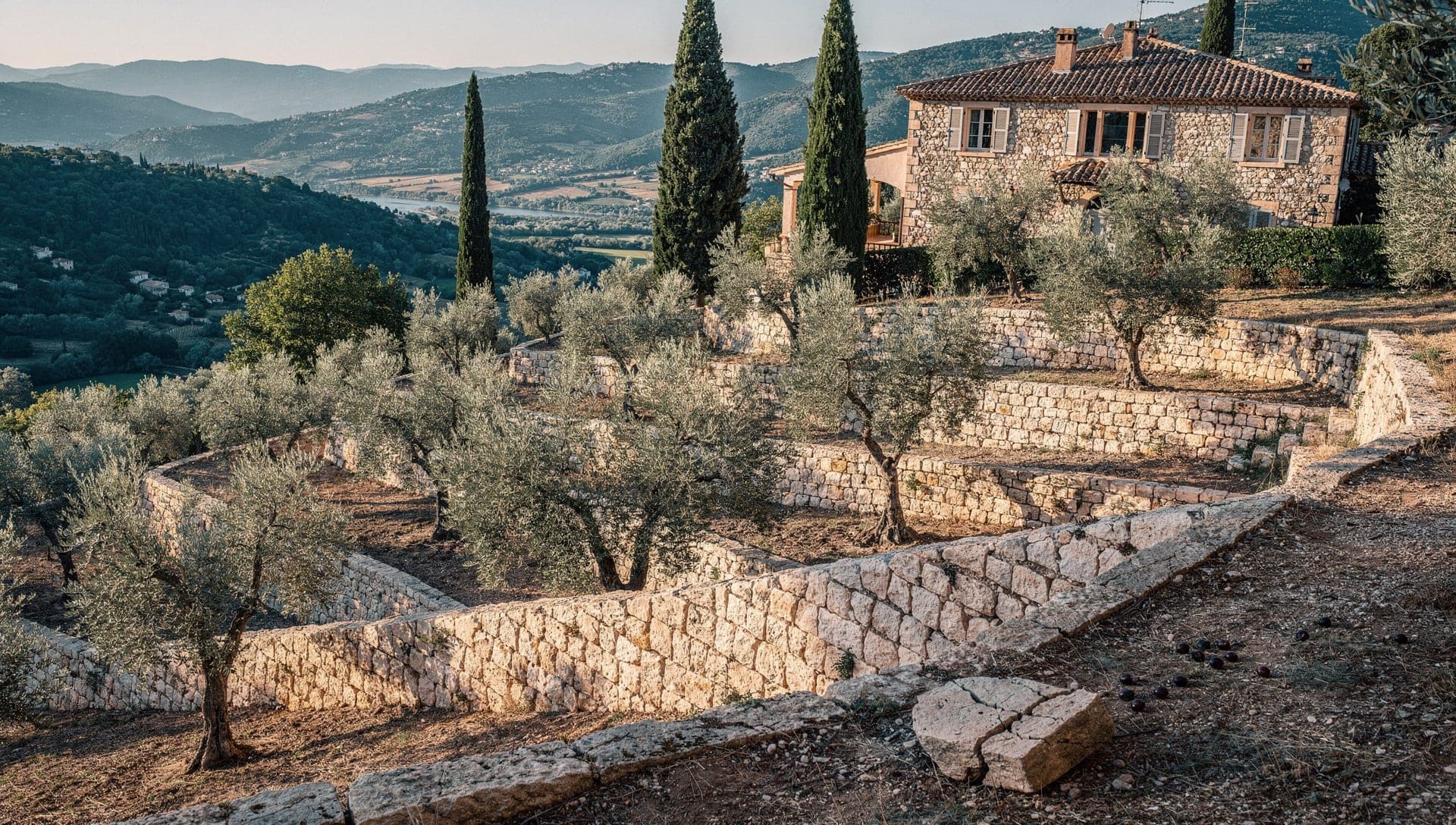
Away from the village and the golf, most of Opio is olive country on restanques, the dry-stone terraces that step down the hillsides. The lanes tell the story in their names. Chemin du Piol, Chemin du Bois d’Opio, Chemin des Restanques, Chemin des Eigages and La Font des Dones are where the larger plots sit, and where a price per square metre misleads, because you are paying for land as much as for building. This is the part of Opio that pulls buyers off the Valbonne shortlist. The same budget buys more ground, more separation from neighbours and a working olive grove whose fruit goes to one of the village mills.
Two cautions apply for land-led buyers. First, the zero net land take rules, known in France as ZAN, are tightening what owners are allowed to build and subdivide across the Alpes-Maritimes, so a large plot does not guarantee a future building right. Check the current PLU and any protected-zone overlay before you assume a second dwelling or a pool house is allowed. Second, terraced ground is beautiful and expensive to maintain. Dry-stone walls fail, access is often single-track, and a pool on a slope costs more to build and insure than the same pool on flat ground.
For the buyer who wants the classic hinterland picture of a stone house among olive trees with the coast twenty minutes below, this is the strongest part of the Opio market and the reason the commune keeps its following. Pay for the survey and the PLU reading before you fall for the view.
The olive trees themselves carry a small cultural premium that is easy to underrate. Opio presses its fruit at the village mill, the same working tradition that gives the commune its Provençal weight, and a mature grove of a few dozen trees produces real oil each winter and a genuine tie to the place. Buyers who want that picture pay for it. What they sometimes miss is the labour. Trees need pruning, nets and a harvest window in November and December, and a neglected grove reads as deferred work to the next buyer rather than romance. If you want the olives without the diary, budget for a local contractor to keep the grove, and treat the oil as a benefit rather than a business.
Transactions and liquidity
Opio is a small market and the numbers say so. The DVF record shows 39 sales of houses of 100 m² or more sold for €1M or more across the commune between 2023 and 2025 (13 in 2025, at a median of €8,593/m²), which is low even by hinterland standards and well below what a village like Valbonne or Mougins turns over. Thin liquidity has two direct effects on a buyer. It makes the published average noisier, because a handful of sales set it, and it lengthens the time between finding the right house and finding the next one if you miss.
Low turnover also changes how the good stock trades. The best houses in Opio, the restored mas with land and view, often move privately through local agents and word of mouth before they ever reach a portal. If you are serious about the commune, register your search with agents who work Opio specifically and be ready to view quickly. We have watched buyers wait a full year for a second chance at a house they hesitated on, because the equivalent never came up.
On the sell side, thin volume rewards patience and punishes a rushed listing. A correctly priced Opio house with clean diagnostics and a real olive terrace finds its buyer, but the pool of buyers for any single property is smaller than in the busier villages, so pricing to the market from day one matters more here than almost anywhere else in the hinterland.
There is a seasonal shape to it too. Opio, like the rest of the plateau, does most of its serious buying between March and June and again in September and October, when relocating Sophia families move on the school calendar and the light shows the terraces at their best. August is quiet for viewings even as the village fills with returning owners. If you are buying, the spring window gives you the widest choice and the strongest competition at once. If you are selling, listing into that window rather than into the August lull is usually worth a few weeks of patience.
What drives Opio prices
Four things set the price of an Opio house, and view sits at the top. A clean southern or western outlook towards the plateau or the distant coast is the biggest single premium in the commune, larger than pool, larger than golf frontage, larger than a fashionable kitchen. Buyers pay for what they see from the terrace at apéro hour, and Opio has more of that than its price band suggests.
Second is the Sophia Antipolis commute. Opio sits about ten minutes from the technology park, with its 2,500 or so companies, by the plateau roads, which puts a steady floor under demand from engineers, researchers and their families who want land without a long drive to work. Access runs off the A8 at the Villeneuve-Loubet exit, then up the D2085 and the local departmental roads through Roquefort-les-Pins and Le Rouret. It is a drive, not a walk, but it holds at rush hour better than the coast roads do, and that reliability is worth real money to a working family.
Third is land and protection. The golf estate, the olive zoning and the ZAN squeeze on new building all keep supply tight and views open, which supports price even when volume is thin. Fourth is condition and energy. Since the market started pricing the energy label seriously, a strong DPE and a recent renovation now command a clear premium, and a weak label is a measurable discount. We come back to that rule change next, because in a village of older stone houses it is the swing factor of the moment.
The DPE and regulation effect
The energy rules have changed the maths on exactly the kind of house Opio sells most of. Since the first of January 2025, homes rated G on the DPE are barred from new leases, with F-rated homes due to follow in 2028 and E-rated homes in 2034 under the Climate and Resilience law. For a village full of pre-1980 stone houses with thick walls and thin insulation, that timetable is not abstract. It decides whether a house is a rentable asset today or a renovation project first.
There is a live twist for 2026. Parliament has debated softening the calendar for owners who commit to a renovation programme, so check the rules in force on the day you sign. Any softening would ease the cliff edge for owners of older stock, but it would not change the direction of travel. The label still sets the rent and increasingly the sale price, and a buyer should read any Opio purchase through that lens.
Practically, this splits the Opio market into two. A renovated house with a strong label and modern systems sells at a clear premium and lets without friction. An unrenovated stone house at F or G sells at a discount that reflects the work, and the honest buyers treat that discount as a budget line rather than a bargain. Our advice has not changed. Get the DPE and a builder’s estimate before you offer, price the label into the deal, and do not assume a coat of paint fixes an energy problem.
How Opio compares with its neighbours
Opio only makes sense next to the villages a buyer weighs it against. On the latest MeilleursAgents estimates (September and October 2026), Opio houses read near 6,464 euros per square metre, Châteauneuf-de-Grasse houses near 6,679, Valbonne houses near 6,549 and Le Rouret near 5,348. Read those figures with the liquidity warning in mind. Opio and Châteauneuf both run thin volume, so their averages jump around more than Valbonne’s, and the ranking sometimes flips from one quarter to the next.
| Commune | Houses (EUR per m²) | Apartments (EUR per m²) | Read |
|---|---|---|---|
| Opio | ~6,464 | ~5,858 | Land and quiet, thin volume |
| Châteauneuf-de-Grasse | ~6,679 | ~4,519 | View premium, hilltop |
| Valbonne | ~6,549 | ~4,613 | Walkable village, deep demand |
| Le Rouret | ~5,348 | ~4,809 | Value entry, family sectors |
The euro figure sits within a tight band across all four. The honest comparison is what the money buys. Valbonne buys you the walkable medieval village and the deepest resale demand in the hinterland, at the cost of less land per euro. Opio buys you more ground, olive terraces and the golf-belt calm, at the cost of a car-first daily life and a thinner village core. Châteauneuf trades on its hilltop view. Le Rouret is the value entry that serious buyers reach on the second pass. If your priority is land and quiet within ten minutes of Sophia, Opio wins the head-to-head. If it is village life and easy resale, Valbonne still leads. For daily life rather than prices, read living in Opio.
Our view for 2026
Opio is a buy for the land-led family and a pass for the buyer who wants village life at the door. Our read for the second half of 2026 is a market that is stable rather than moving, with prices held up by scarcity and protection rather than pushed by demand. We do not expect a jump. We expect the good houses to hold their value, the tired stock to sell at a real energy discount, and the gap between the two to widen as the DPE rules bite.
If you are buying, the plays are clear. Target a renovated house with a strong label and a genuine view, and do not overpay for golf frontage you will struggle to resell the premium on. Or buy the tired stone house with land at the energy discount, budget the renovation properly, and come out with the best kind of Opio asset, a warm modern home inside old walls with olive terraces around it. Either way, register with agents who work the commune directly, because the best of Opio does not wait on a portal.
If you are selling, price to the market on day one, get your diagnostics clean and current, and lead with the view and the land, which are what Opio buyers pay for. The village will not carry a wishful price for you the way a busier market might. Priced right, an Opio house still sells to a buyer who has been waiting for exactly it.
For the investor rather than the resident, our read is more cautious. The gross yields are modest, the market is illiquid, and the energy rules add a renovation risk to older stock, so Opio does not make the case as a pure rental play the way a smaller apartment in a busier town might. Where it does work is as a long-hold family asset that earns a steady residential rent between owner uses and appreciates slowly on scarcity. Buy it because you want to be there, size the rent as a contribution rather than a return, and you will have read Opio correctly.