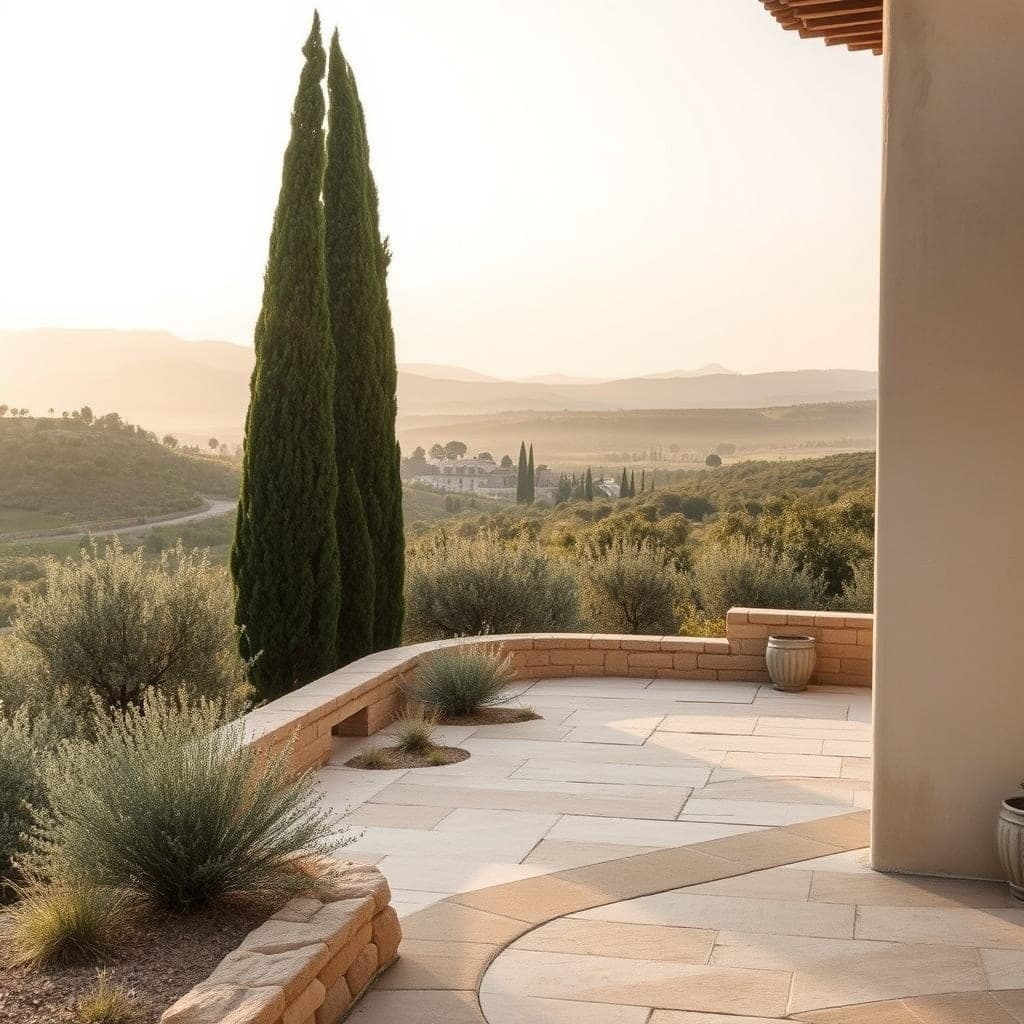
The village the coast forgot to inflate
Quick answer: Opio is a farming commune of about 2,500 people (2,527 in 2023, INSEE) between Grasse and Sophia Antipolis, with olive terraces, a working olive mill and the Golf d’Opio-Valbonne. It sits below Valbonne village on price per square metre, so buyers usually get more garden and more privacy for the money, in a more rural, car-dependent setting. Sophia Antipolis is often ten to fifteen minutes away by car and Nice airport about forty.
Drive ten minutes north-west of Valbonne and the road narrows, the traffic thins, and olive terraces begin to step down the hillsides. This is Opio: a working farming commune of about 2,500 people (2,527 in 2023, INSEE) that sits between the perfume city of Grasse and the tech park of Sophia Antipolis, yet behaves as though neither were close enough to matter. There are no boutiques selling soap to coach parties, no queue for parking on a Saturday morning. There is a mill that has pressed local olives for centuries, a golf course cut into the hills with a second over the boundary, and a quiet that buyers from Mougins and Cap d’Antibes increasingly drive out to find.
For house-hunters, the appeal is practical as much as romantic. Opio offers the green setting, the privacy, and the wide plots that have grown scarce in Valbonne village, but at a price per square metre that still sits below its more famous neighbour. You are buying space, light and farmland on the doorstep of one of Europe’s largest technology employers. This guide walks through where Opio sits, what it costs in 2026, which sectors reward the search, and the everyday rhythm of olive harvests, golf and short school runs that defines living here.
Where Opio sits, and why that matters
Opio perches at around 300 metres on the gentle plateau between the Loup and Brague valleys. Grasse is eight kilometres west, Cannes seventeen kilometres south, and Nice airport a forty-minute drive when the autoroute behaves. What makes the position unusual is its borders: the commune shares boundaries with Valbonne, Châteauneuf-de-Grasse, Le Rouret and Roquefort-les-Pins, which means four of the hinterland’s most sought villages are within a short drive, each with its own market day, restaurant scene and school.
That clustering pays off in daily life. A resident does the Friday morning shopping in Valbonne’s arcaded square, takes a child to the doctor in Châteauneuf, and tee off below their own house, all inside a fifteen-minute radius. Opio is also a full member of the Communauté d’Agglomération Sophia Antipolis, the inter-communal body that runs the Envibus network and ties the village into the technology park’s transport and services. The practical upshot for buyers is that Opio feels rural without being remote. You get olive groves and birdsong, but the supermarket, the international school and a salaried job at a software company are all minutes away rather than a planning exercise.
The terrain itself shapes the property stock. Slopes face south and south-east, capturing winter light that the deeper Grasse valleys lose by mid-afternoon. Older farmhouses sit among working olive terraces, while newer villas occupy the gentler ground near the golf course. The result is a commune with genuine variety in a small area, from restored bergeries to 1990s family villas with pools.
What property costs in Opio in 2026
Opio is a house market, not an apartment market. Roughly nine in ten transactions are villas and farmhouses, and the price reflects scarcity rather than volume: only a few dozen homes change hands in a typical year. In early 2026 the average asking price for houses sits in the region of 6,000 to 6,150 euros per square metre, with the spread running from about 3,800 euros for properties needing work or on awkward plots, up to 8,600 euros and beyond for turnkey villas with views, a pool and flat garden. Once the value of land and outdoor space is weighted in, the effective average lands closer to 5,400 euros per square metre.
To translate that into budgets: entry to the commune in habitable condition generally starts around 650,000 to 750,000 euros for a compact villa of 110 to 130 square metres on a modest plot. The core of the family market runs from 950,000 to roughly 1.6 million euros, which buys a 180 to 220 square metre villa with four bedrooms, a pool and half a hectare. Above two million you move into the estate bracket: gated grounds near the golf course, restored mas with olive terraces, and the occasional property with a guest cottage.
The 2025 market was steady rather than rising. Transaction numbers were modest and sellers who priced realistically sold, and those who chased 2022 peaks waited. For a buyer this is a constructive backdrop. Stock is limited, but there is room to negotiate on homes that have sat unsold for a season, and you are not bidding against a frenzy. Compared with Valbonne village, where equivalent space routinely commands a premium, Opio still offers a meaningful discount for what is, in practice, the same school catchment and the same commute to Sophia Antipolis. The sector figures are in our article on the Opio market by sector.
Reading the sectors: where to buy in Opio
Opio is small enough to walk in an afternoon but varied enough that the sector matters. The old Village core, gathered around the church and the former wash-house, is the most characterful address: stone houses, narrow lanes, and a handful of homes with terraces that open onto olive terraces below. Buyers who want walkable mornings and the feel of a real village concentrate here, accepting smaller plots in exchange for atmosphere.
The Valbonne side of the commune is the practical family choice. Roads are wider, plots are flatter, and you are minutes from the Sophia Antipolis park and the supermarkets at the edge of Valbonne. Much of the 1980s and 1990s villa stock sits here, the kind of four-bedroom house with a pool and a level garden that relocating families consistently search for.
Around the golf course and on the ground that slopes towards it, you find the larger estates: gated entrances, mature grounds, and properties that trade privacy for a short drive to the village. This is where the commune’s two-million-plus homes cluster, often with established gardens and the best of the southern light. Wherever you look, the questions that move price in Opio are consistent: how flat is the garden, how open is the view, how much of the plot is usable, and whether the olive trees come with a maintenance habit or a maintenance bill.
Olive oil, vineyards and the working countryside
Opio’s identity is pressed, in the plainest sense, at the Moulin d’Opio, 1 Place de la Font Neuve, one of the oldest oil mills in Provence. Oil has been pressed on the site since 1426, and one family of millers (the Michels in its later generations) ran it from 1848. The Communauté d’agglomération Sophia Antipolis bought it in September 2024, and since 2025 the SCIC Les Ferrages and the association Neede have run it. It is half shop and half village institution. Through the winter pressing season, owners of even a handful of olive trees bring in their own harvest and leave with their own oil, a custom that keeps the terraces above the village in cultivation rather than ornamental decline.
For a buyer this is more than colour. A property in Opio frequently comes with olive trees, and those trees carry a calendar: netting and harvest from late autumn, pruning in spring, and a relationship with the mill that long-standing neighbours will happily explain. Tapenade, olive paste and the new season’s oil are sold at the mill and at the village’s small producers, and the November harvest is a community event rather than a marketing one.
The same soils and exposure that suit olives suit vines, and the wider hinterland around Opio, Châteauneuf and Le Bar-sur-Loup carries small wine producers working the Alpes-Maritimes hills. Buyers drawn to Opio tend to be the sort who want a few rows of their own, a productive garden, and a fig or two, rather than a lawn that demands watering through August. The commune rewards that instinct: this is countryside that still earns its keep, and the property that comes with it asks to be used. Our olive grove guide covers the harvest and the mills.
A championship course on your doorstep, a second next door
Golf is a large part of Opio’s appeal, with one eighteen-hole course in the commune and a second over the boundary. The Golf d’Opio-Valbonne, set in the grounds of the Château de la Bégude, runs through a wooded valley of oak and olive and is among the most established clubs in the area. A short drive away, the Golf de la Grande Bastide, designed in 1990 by Cabell Robinson, lies in neighbouring Châteauneuf-de-Grasse, with wide fairways, water hazards and views back towards Grasse and the perched villages.
Alongside the championship golf sits the Club Med Opio en Provence, the all-inclusive resort below the old village, with tennis and padel courts, and the unexpected addition of circus and flying-trapeze instruction. For residents the resort is less a place to stay than a reassuring presence: it underpins the local economy, keeps the surrounding roads and amenities maintained, and supplies seasonal employment.
For property values, the golf is a quiet anchor. Homes within an easy approach of the courses hold their appeal to a specific and reliable buyer, particularly international purchasers and second-home owners who want sport, security and greenery in one address. It also shapes the rhythm of the week: an early nine holes before a video call to head office is a realistic routine here, and one that a certain kind of buyer crosses borders to secure. See our Opio Valbonne golf page.
Schools, families and the short school run
Families are the engine of Opio’s market, and the school question usually decides the purchase. Within the commune, the youngest children attend the village school group opened in 2022, with the La Tour d’Opio elementary school on the Route de Cannes, with a further elementary option in Châteauneuf-de-Grasse barely a kilometre away. These are small, well-regarded village schools where teachers know the families, and the short, low-traffic run is one of the small pleasures parents mention most.
For older pupils, the decisive draw is the Campus International de Valbonne (CIV) in the middle of Sophia Antipolis, a public international middle and high school with sections in numerous languages and a path through to preparatory classes. Its presence is one of the main reasons relocating professionals look at this corner of the hinterland at all, and Opio offers a calmer, greener base within easy reach of it than living in the park itself. The Envibus network, run by the Sophia Antipolis agglomeration, operates the school services that connect Opio to Valbonne and the CIV, so older children gain independence without a parent at the wheel.
Beyond the international route, the surrounding communes add private and bilingual options, and the area’s deep pool of academic and technical employment means classmates’ families come from across Europe and beyond. For a buyer weighing Opio against a busier address, the calculation is straightforward: the same schools, the same employers, more garden, less noise, and a school run measured in minutes rather than queues.
Daily life: markets, tables and provisions
Opio keeps its everyday shopping deliberately modest. There is a small supermarket and a clutch of village producers, and most residents fold their bigger errands into the surrounding villages. The La Paoute commercial area on the Grasse side covers the weekly trolley of groceries and household goods, while Valbonne’s Friday morning market under the seventeenth-century arcades of the Place des Arcades supplies the cheese, the fish and the social hour that a village shop lacks. Between the two, a household rarely needs the coast for anything practical.
For the table, Opio rewards those who like to eat where the producers do. The old village holds a well-regarded restaurant or two, the golf clubhouses serve lunch with a view, and the village mill anchors a small economy of oil, tapenade and seasonal produce. Within a ten-minute radius the choice widens sharply: Valbonne village alone offers everything from a corner bistro to a serious dining room, and the gastronomic addresses of Mougins are a short drive beyond.
What residents tend to value is not abundance but proximity. The bakery, the doctor, the pharmacy, the school and the golf are all close, and the things that justify a special trip, a Michelin dinner, a coastal beach, the airport, are close enough to be spontaneous rather than planned. Opio’s bargain is a life where the ordinary is on the doorstep and the exceptional is half an hour away.
The seasons set the social calendar more than any high street does. Spring brings the first markets and the reopening of the golf terraces. In summer the village empties into shaded gardens and pools while the coast fills. Autumn returns the village to itself, and the November olive harvest draws neighbours to the mill in a way no shop opening ever has. For buyers used to a town centre supplying entertainment, this takes a small adjustment. Those who make it tend to describe the trade the same way: less to do on the doorstep, far more reason to stay home.
Getting around: Sophia Antipolis, the coast and the airport
Opio’s strongest practical card is its commute. The southern and eastern edges of the commune sit minutes from Sophia Antipolis, the technology park of about 2,500 companies and more than 40,000 jobs across software, biotech, telecoms and research. For a resident working in the park, the morning journey is often ten to fifteen minutes by car, and the Envibus network links the village into the park’s bus system for those who prefer not to drive. Few places combine farmland and a salaried technology job at quite this range.
The wider connections are easy too. Grasse and its station, the terminus of the branch line to Cannes, are about eight kilometres west, with the Mouans-Sartoux station on the same line a similar distance, giving rail access towards Cannes and the coastal network. Cannes itself is around seventeen kilometres, Antibes and the beaches a little further, and Nice Côte d’Azur airport is roughly forty minutes by car via the A8, putting London, Geneva or Paris within a half-day’s reach for the weekly commuter or the second-home owner.
The trade-off to be honest about is that Opio, like most of the hinterland, assumes a car. Public transport serves the village but does not replace private transport for the rhythms of family life, and the lanes are quiet rather than served by frequent buses. For most buyers this is a feature rather than a fault: the quiet roads are precisely the point, and the proximity of the park, the coast and the airport means the car spends less time in use than an address closer to the sea would demand.
Who buys in Opio, and the outlook for value
Three buyer profiles dominate Opio. The first is the relocating professional, often international, drawn by a job in Sophia Antipolis and a place at the CIV, who wants a family villa with a garden and a short commute. The second is the lifestyle buyer trading down from a larger coastal property or up from an apartment, who wants olive trees, golf and quiet without surrendering access to Cannes and the airport. The third is the second-home owner who values the security, the resort infrastructure and the greenery, and who treats Opio as a calm base for the season.
For value, the case rests on relative pricing and durable demand. Opio sits below Valbonne village on a per-square-metre basis while sharing its schools, its employer and much of its setting, and buyers priced out of Valbonne often look here next. Rental yields are modest, as they are across the reputation hinterland, so the investment logic is preservation of capital and lifestyle return rather than income.
The risks are the ones that apply to the whole region: a dependence on the car, a market thin enough that the right house often takes patience to appear, and prices that already reflect the area’s appeal. But for a buyer who wants space, light, a working garden and a serious employer within fifteen minutes, Opio remains one of the hinterland’s more rational propositions, offering much of what Valbonne and Mougins sell, at a price that still acknowledges its quieter profile.
Practical notes for buyers
A few specifics reward attention before you commit in Opio. Confirm the zoning of any plot with agricultural land or olive terraces: the protected farming character that keeps the commune green also limits what you are allowed to build or extend, and a notaire should clarify the local plan before you fall for a view. Water for irrigation, access easements on shared lanes, and the condition of older septic systems on rural properties are the practical checks that matter more here than in a serviced village centre.
Budget beyond the headline price for the things that make a rural villa work: pool maintenance, garden and olive-tree upkeep, and the running costs of a larger plot. Factor French purchase costs of roughly seven to eight per cent in notaire fees and taxes on an existing home, and speak early to a broker if you need French mortgage finance, as conditions for non-resident buyers move with the market. Many international purchasers hold through an SCI for succession reasons. Whether that suits you depends on your circumstances and deserves professional advice rather than a rule of thumb.
Finally, time your search to the village’s calendar. The best rural stock often appears in spring, ahead of the summer season, and again in early autumn. The olive harvest in November is a fine moment to see the commune as residents live it. Opio rewards the patient, specific buyer who knows which sector, which exposure and which plot shape they want, and who is ready to move when the right house, which does not come often, finally reaches the market. A good local agent who hears of properties before they are advertised is worth more here than anywhere, so make those introductions early in your search.