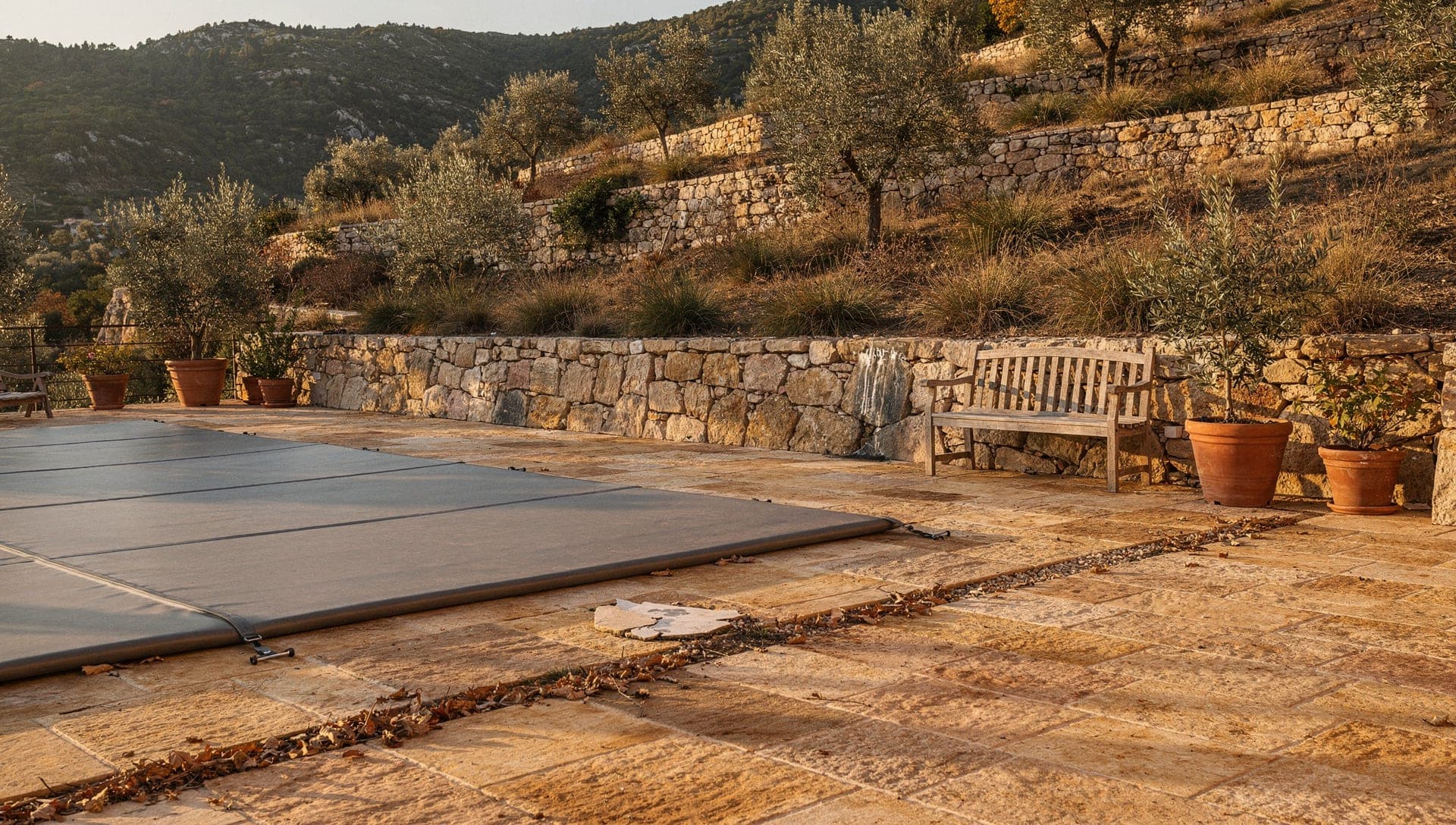
Lifestyle
Autumn in the Riviera Hinterland: September to November in the Eight Villages
The rentrée, the October rain, the olive mills and the hunting calendar, and why autumn is the season a hinterland house finally tells you the truth.
In This Guide
Autumn in the Riviera Hinterland: September to November in the Eight Villages
Autumn in the hinterland: the quick read
Autumn in the Riviera hinterland runs from the rentrée on Tuesday 1 September 2026 to the first hard cold at the end of November, and it is the quietest and most revealing stretch of the year across the eight villages between Valbonne and Grasse. The summer crowd goes home in the last days of August. The roads empty. The markets stay exactly where they were. Midday temperatures hold in the low twenties through September and settle near 15C in Grasse by November, while the rain arrives in short violent bursts rather than in drizzle.
The dates that shape the season this year:
- Tuesday 1 September 2026: rentrée for the académie de Nice, Zone B. Every school gate from the Centre International de Valbonne to Mougins reopens on the same morning.
- 13 September 2026: general opening of the boar season on ordinary communal ground, running to 10 January 2027, on Wednesdays, Saturdays, Sundays and public holidays.
- 19 and 20 September 2026: the 43rd Journées européennes du patrimoine, with chapels, mills and private courtyards opening across the Alpes-Maritimes.
- 17 October to 2 November 2026: Toussaint school holidays, the second emptying of the year.
- 15 October by post, 20 October online: the taxe foncière deadlines for 2026.
- Mid-October to January: the olive presses run. November is the month the mills are busiest.
- 15 December, or 20 December online: the taxe d'habitation deadline on second homes.
For anyone thinking about buying here, the practical point is simple. A hinterland house in August photographs beautifully and tells you nothing. The same house in late October, after a night of real rain, tells you everything: where the water goes, whether the terrace drains, how the boiler sounds, how dark the north side gets once the sun drops behind the ridge. We push almost every client we work with to do at least one autumn visit before signing.
September: the villages get their roads back
September is the month the hinterland becomes a working place again. The rentrée falls on Tuesday 1 September 2026 for the académie de Nice, and within forty-eight hours the rhythm of the week changes completely. The RD 3 between Valbonne and Biot fills between 07:45 and 08:30 and then goes quiet. The RD 2085 through Le Rouret and Pré-du-Lac carries the Grasse-to-Sophia flow. Junction 42 of the A8 at Antibes backs up for twenty-five minutes in the morning and behaves for the rest of the day.
The single biggest change is that the tourist traffic stops. Through July and August, coast traffic pushes inland and the village car parks in Valbonne, Mougins and Biot are unusable from ten in the morning. From the first week of September, you can park under the plane trees again. Restaurants that queued for two months take their congés annuels, so a run of village places in Mougins and Valbonne closes for two or three weeks around mid-September. Check before you drive over for dinner.
Meanwhile the pools stay warm. Water temperature in an unheated hinterland pool holds swimmable into the first week of October in a normal year, and the sea off Antibes and Villeneuve-Loubet stays warmer than the air well into the month. Locals treat September as the best swimming month of the year, and they are right.
For property, September is when the market restarts. Listings that sat unsold through the summer come back with new photographs or a new price. Agents who took August off start calling. The pattern we see every year in the eight villages is a burst of price adjustments in the first two weeks of September, then a run of serious viewings through to the Toussaint break. Owners who tested the market in June at an optimistic number usually make their first real cut now.
The Journées européennes du patrimoine on Saturday 19 and Sunday 20 September 2026 are worth planning around if you are house-hunting. The themes this year cover photography and heritage at risk, and in the hinterland the practical value is access: chapels, old mills, bastide courtyards and communal buildings that are shut the other 363 days. It is also the cheapest way to understand how these villages are actually built, which matters when you are later asked to approve a renovation quote for a stone wall.
October: the month the sky opens
October is the month that decides whether you understand this region or not. The mechanism is well documented. The Mediterranean is still holding summer heat while the air above starts to cool, and the result is the épisode méditerranéen: enormous quantities of rain dropped in a few hours over a narrow corridor, usually where the hills force the air upward. The hinterland sits directly in that corridor.
The numbers are not abstract. On 3 October 2015 the Alpes-Maritimes took close to 200 mm in two hours, with Cannes recording 109 mm in a single hour, and the Brague burst its banks through Biot and down to the coast. On 2 October 2020, storm Alex put 500 mm in twenty-four hours into the back country, a departmental record. Between 24 and 27 October 2024 a slower episode piled up 175.2 mm at Andon and 166.7 mm at Saint-Cézaire-sur-Siagne, both a short drive west of Grasse. Across September to November, the regional average sits around 103 mm of rain per month, but that average hides the shape of it. You can take a third of the autumn total in one night.
What this means for a house is specific and checkable. Look at the vallon behind the plot and work out where the water goes when the ground is saturated. Look at the restanques: dry-stone retaining walls that have not been repointed for thirty years fail in exactly these conditions, and a collapsed restanque above a pool is a five-figure repair. Look at the gutters and downpipes, and at whether those downpipes discharge into a drain or simply onto the garden above the terrace. Ask for the PPRI zoning on the commune and read it rather than accepting a verbal summary from the seller.
The roads tell you the rest. The RD 2210 toward Pré-du-Lac and the lanes along the Brague and the Loup close or flood in the worst episodes, and the mairie communications from October 2024 are a better guide to real risk than any brochure. None of this should scare a buyer off. Most of the hinterland handles rain well because it is built on slopes and has been doing this for centuries. It should simply change what you inspect.
The compensation is that the weather between episodes is excellent. October days in Valbonne and Le Rouret run clear and mild, the light goes low and gold in the afternoon, the trails dry within a day or two, and the villages are empty. It is, for our money, the best month of the year to be here.
November: the olive harvest and the mills
The olive year ends in November. Under the cahier des charges of the Huile d'olive de Nice AOP, which covers Valbonne, Opio, Le Rouret, Châteauneuf-de-Grasse and their neighbours, the fruit is picked at full maturity through November, December and January, when the cailletier olives start to turn from green to red-black. Mills in the area typically open around the middle of October, and November is when the queue outside the press is longest.
If you buy a property here with mature trees, you inherit a small agricultural obligation whether you want it or not. A rough working figure is five to six kilos of olives for one litre of oil, so thirty productive trees is a real day of work with nets, rakes and crates, plus a slot booked at the mill. Most owners we know either do it as a family weekend with neighbours or hand the grove to someone who picks on shares. Both are normal. What is not normal is leaving the fruit on the tree, which invites olive fly and makes the following year worse.
Yields swing hard. Olive trees alternate, and 2025 was close to a write-off across the Alpes-Maritimes, with very little fruit and a matching rise in the price of local oil. Anyone quoting you a reliable annual income from a hinterland grove is selling a story. Treat the trees as scenery and food, not as revenue.
For value, the grove matters in a different way. A well-kept terraced olive grove with maintained restanques is the most reliable signal we know that a property has been looked after, because it is slow, unglamorous work that cannot be faked in the month before a sale. A grove with suckers to waist height and collapsed walls tells you exactly how the roof and the drains have been treated. When we walk a property in November, the state of the olives is the first thing we read.
Practically: the mills around Opio on the Brague and the presses west of Grasse take small private quantities, usually by appointment and with a minimum load. Ask at the mairie or at the market in the first week of October, because slots go quickly and the rules on minimum weights change from one mill to the next.
The season nobody mentions at the viewing: la chasse
Hunting is part of autumn here and almost no seller raises it. The prefectoral order for the 2026-2027 campaign in the Alpes-Maritimes, arrêté DDTM-SEAFEN-AP 2026-064 of 18 May 2026 with its modification 2026-105, sets wild boar as huntable from 1 June 2026 to 28 February 2027 overall, with the detail that matters to residents. From 23 August 2026 to 28 February 2027 it runs every day in communes where boar is classed as an ESOD species. From 13 September 2026 to 10 January 2027 it runs on Wednesdays, Saturdays, Sundays and public holidays everywhere else.
In practice this means that in the wooded communes, Roquefort-les-Pins, Le Rouret, upper Châteauneuf-de-Grasse, the Grasse hillsides and the pine country around Opio, you will hear dogs and shots on Wednesday and weekend mornings from mid-September. Battues are organised, signed at the entrance to tracks, and generally well run. The men in orange on the GR51 above Roquefort are not a problem. Not knowing the calendar is.
What buyers should actually do. First, ask which category the commune falls into this season, because the ESOD list changes and it is the difference between hunting three days a week and hunting every day. Second, read the same arrêté for the safety distances around dwellings and roads, since those set what can happen at the bottom of your garden. Third, if the plot borders open woodland, ask the neighbours or the local ACCA how the battue routes run, because boar are driven along fixed lines and those lines rarely move.
There is a second-order property effect that is easy to miss. Wild boar cause real damage in the hinterland: turned lawns, broken irrigation, ruined vegetable plots, and the occasional collision on the RD 4 or the RD 7 at dusk. A fenced plot with a proper boar-resistant lower fence is worth money, and an unfenced plot backing onto woodland will need one eventually. Price that into the offer rather than arguing about it later.
The school calendar that sets the family year
Family life in the eight villages is timed by the académie de Nice, Zone B. The 2026-2027 year starts on Tuesday 1 September 2026. Toussaint holidays run from Saturday 17 October 2026 to Monday 2 November 2026. Christmas runs from Saturday 19 December 2026 to Monday 4 January 2027. Those three dates explain most of what you will see on the roads and in the estate agents' diaries between now and the new year.
The Centre International de Valbonne is the anchor for international families on the Sophia side, and its sections keep the state calendar. The private British and international schools around Mougins and Nice set their own term dates, which usually break a week earlier and return a week later, so a family running one child at the CIV and another at a private school ends up managing two calendars. Ask the school directly for the current year rather than trusting a summary, because these dates move.
Toussaint is the week the villages empty for the second time. French families go to the mountains or to relatives. Second-home owners from the UK and northern Europe come down for what is often their last visit before Christmas, which makes the last fortnight of October the single busiest viewing window of the autumn. If you are selling, that is the week to have the house ready and the heating on. If you are buying and you want a clear run at a property without competition, aim for the first fortnight of October or the middle of November instead.
There is a quieter effect on rentals. Long-term family lets in Valbonne, Biot and Le Rouret almost all turn over in July and August, tied to the school year. By September, what is left on the market is thin and expensive. Families relocating for a January start at Sophia usually cannot find a good long let in the autumn, which is exactly why the winter let market exists.
What a square metre costs going into autumn 2026
Here is where the eight villages stand at the start of September 2026, on MeilleursAgents estimates dated 1 September 2026, all property types combined. These are net seller figures, before agency and notaire costs, and they are commune averages, which means they flatten the difference between a village house with no parking and a villa on 3,000 m2 with a view.
| Commune | All types, EUR per m2 | Reference point |
|---|---|---|
| Opio | 6,415 | Golf belt and olive terraces |
| Châteauneuf-de-Grasse | 6,259 | View premium over the Opio plain |
| Mougins | 6,171 | Tournamy, Saint-Basile, the Village |
| Roquefort-les-Pins | 5,886 | Large plots, pine country |
| Biot | 5,656 | Village and the Saint-Philippe side |
| Valbonne | 5,373 | Old village, Peyniblou, Garbejaire |
Le Rouret and Grasse are not published on the same all-types basis, so take them by property type. Le Rouret sits at roughly 5,205 EUR per m2 for houses and 4,917 for apartments. Grasse, still the value entry point of the eight, sits at roughly 4,247 for houses and 3,474 for apartments, both on September 2026 estimates. That gap between Grasse and Opio, around 2,000 EUR per m2, is the single most important number in the hinterland and it has not closed.
Direction of travel matters more than the level. In Valbonne, MeilleursAgents shows houses up 5.9 percent over twelve months and 3.0 percent over three months, with apartments up 4.1 percent over twelve months and 2.3 percent over three. That is a market firming rather than running, and it is consistent with what we see in practice: well-presented houses in the 900,000 to 1.6 million bracket moving in a reasonable time, and anything over-improved or poorly sited sitting.
Autumn also brings the tax calendar. Taxe foncière notices for 2026 went online from 27 August for owners not paying monthly, and from 19 September for those who are. Payment is due by 15 October by traditional means, or 20 October online. The taxe d'habitation on second homes follows: notices online in October, payment by 15 December, or 20 December for online payment and direct debit. If you complete a purchase in the autumn, remember that the taxe foncière is charged to whoever owned the property on 1 January, so the apportionment is a matter for the acte, not for the tax office.
Our read on the numbers: the commune average is a starting point and nothing more. Between the top and bottom of a single commune such as Valbonne, the published range runs from about 2,828 to 11,141 EUR per m2 on houses. Sector, aspect, noise and land shape do more to a price here than the commune name on the gate.
Winter lets: the October to April market most owners ignore
The location hivernale is a Riviera institution and it is badly understood by foreign owners. The shape is simple: a furnished property let from roughly October to April, outside the summer season, at a monthly rent well below peak weekly rates but well above nothing, to a tenant who needs three to six months rather than a year.
The demand is real and local. Contractors and consultants on fixed assignments at Sophia Antipolis. Visiting academics and researchers. Families who have sold in the UK or Scandinavia, are waiting on a compromis to complete, and need somewhere with a school run to Valbonne or Mougins. Owners in the middle of a renovation who cannot live in their own house. None of these people want a summer villa at August prices, and none of them want a twelve-month unfurnished lease.
On numbers, MeilleursAgents puts Valbonne rents at 20.6 EUR per m2 per month for apartments and 23.4 EUR per m2 for houses at 1 September 2026, which is the sensible anchor for a furnished winter figure before you adjust for pool, view, parking and how well the place heats. Heating is the part owners underestimate. A stone bastide with single glazing and a heat pump sized for spring is an expensive place to spend February, and tenants ask about it now in a way they did not five years ago.
On structure, there are three routes. A classic bail meublé of one year, or nine months for a student. A bail mobilité, introduced by the 2018 ELAN law, which runs from one to ten months, cannot be renewed, and takes no deposit, aimed precisely at people on assignment or training. Or short-term seasonal letting, which in the Alpes-Maritimes now carries registration and local rules that have tightened considerably. Get the structure right before the tenant arrives, because converting a badly chosen lease mid-stay is not straightforward.
Two caveats we give every owner. First, a winter let blocks the property for your own use at half-term and Christmas, which is often when you actually want it. Second, the energy rules bite: the letting ban on the worst-rated properties has applied since January 2025, and a G-rated hinterland villa cannot be let as a main residence at all. Get the DPE done before you plan the income, not after.
Nine things a hinterland house only tells you in autumn
This is the checklist we run on an autumn viewing. None of it requires a survey, and all of it is invisible in July.
- Smell. Walk into the lowest room in the house after rain. Damp in a stone ground floor announces itself in September and hides in August.
- Where the water actually goes. Stand on the terrace during or just after rain and follow it. Run-off crossing a terrace toward the house is a design fault, not a maintenance one.
- The heating. Ask for it to be switched on during the viewing. Listen to the boiler, check the age of the heat pump, and find out whether there is still a buried oil tank and what its status is.
- Flues and wood burners. Autumn is when they get lit. A poorly drawing chimney in a stone house shows within ten minutes.
- Gutters and pine needles. Aleppo pines shed heavily in autumn. Blocked gutters, overflowing valleys and staining on the render all read clearly now.
- The pool at closing. Ask what the winterisation costs and who does it. Ask for the last two years of invoices rather than a verbal figure.
- Sun angle. By late October the sun is low, and a terrace advertised as sunny may be in shadow from two in the afternoon behind a ridge or a neighbour's pines. Check on site, at the hour you would actually use it.
- Noise. The cicadas stop, and what you hear afterwards is the truth: the RD nearby, the A8 carrying on a still evening, the dogs, the pool pump next door.
- Drainage and treatment. If the property is on a fosse septique or a micro-station rather than mains drainage, autumn rain tells you whether the leach field copes. Ask for the SPANC report and its date.
One addition for anyone buying with land. Walk the boundary in November, when the summer growth has died back and you can actually see the walls, the fence lines and the neighbour's encroachments. We have found two boundary disputes in the last three years that would have been invisible under July vegetation.
Our honest read
Autumn is the best season to buy in the hinterland and a mediocre season to sell in it. Those two sentences are the same fact seen from opposite sides.
For buyers, the advantages stack up. Competition thins out after the summer rush. Sellers who have been on the market since spring are recalculating. The house is showing you its weather-facing self rather than its August self. Agents have time. Artisans answer the phone, so you can get a roof or a drainage quote inside two weeks instead of two months, which matters when you want a number before making an offer. And the villages are at their most honest, with the market traders, the school run and the boules under the plane trees running without an audience.
For sellers, the honest position is that autumn traffic is thinner than spring traffic, and the buyers who do come are more forensic. That is not a reason to wait. A property that is presented properly in October, warm, dry, with the gutters cleared and the pool covered tidily, reads as looked-after in a way that a summer photograph cannot achieve. The mistake we see is sellers who leave the house shut and cold from September, then wonder why three viewings produced nothing.
If you take one thing from this: do not sign on a hinterland house you have only ever seen in summer. Go back in late October. Stand on the terrace in the rain. Ask for the heating on. Read the PPRI zoning and the hunting arrêté for the commune. If the house still feels right after that, it probably is.
We work across Valbonne, Mougins, Biot, Grasse, Opio, Roquefort-les-Pins, Châteauneuf-de-Grasse and Le Rouret, and autumn is when we do most of our honest looking. If you want a second opinion on a specific property or sector before the year closes, that is what we are here for.
Frequently Asked Questions
Frequently Asked Questions
It starts at the rentrée, which falls on Tuesday 1 September 2026 for the académie de Nice. The weather does not change for several more weeks, but the season does: tourist traffic stops, village parking frees up, schools reopen and the property market restarts. The first real weather shift usually arrives with the October rain.
October carries the region's highest flood risk, not its highest overall rainfall total spread evenly. Episodes méditerranéens can drop a third of the season's rain in a night, as on 3 October 2015 when Cannes recorded 109 mm in an hour and the Brague flooded at Biot. It is a good month to buy precisely because you see how a property handles water. Check the PPRI zoning, the run-off routes and the state of the restanques before you commit.
Yes, for buyers it is the strongest window of the year. Summer competition has gone, sellers who have been listed since spring are adjusting their price, artisans are available for quotes, and the property shows its wet-weather behaviour. The busiest viewing fortnight is the Toussaint break, 17 October to 2 November 2026, so aim either side of it if you want a clear run.
Yes. The weekly markets in Valbonne, Biot, Mougins, Grasse and the surrounding villages run all year, and autumn is when they are at their best for produce and at their quietest for crowds. What changes is the restaurant trade, with a run of village addresses taking congés annuels for two or three weeks around mid-September.
The Huile d'olive de Nice AOP harvest runs through November, December and January, when the cailletier olives turn from green to red-black. Mills in the area generally open around mid-October and November is their busiest month. Small private quantities are accepted, usually by appointment and with a minimum load, so ask at your mairie or at the market in early October before the slots fill.
It affects timing rather than access. Under the 2026-2027 prefectoral order for the Alpes-Maritimes, wild boar may be hunted every day from 23 August 2026 to 28 February 2027 in communes where it is classed ESOD, and on Wednesdays, Saturdays, Sundays and public holidays from 13 September 2026 to 10 January 2027 elsewhere. Battues are signed at track entrances. Before buying a wooded plot, check which category the commune falls into and ask the local ACCA how the drive routes run.
Taxe foncière notices for 2026 were available from 27 August for owners not on monthly payment and from 19 September for those who are, with payment due by 15 October by traditional means or 20 October online. Taxe d'habitation on second homes follows, with notices online in October and payment due by 15 December, or 20 December for online payment and direct debit. Liability for taxe foncière falls on whoever owned the property on 1 January, so an autumn completion is settled through the acte.
Need personalised guidance?
Our team knows every street and every sector across the hinterland.
Explore