Why a golf course address is its own property category
Quick answer: Four eighteen-hole courses (Royal Mougins, Cannes-Mougins, Opio Valbonne and Grande Bastide) sit within a fifteen-minute drive of each other above Cannes. Owning a house beside one does not give you the right to play: membership or green fees are separate. On our reading of 2024–2025 sales, golf frontage carries a premium of roughly 12 to 25% over a comparable home set back from the greens, and the protected view is the part that holds best at resale.
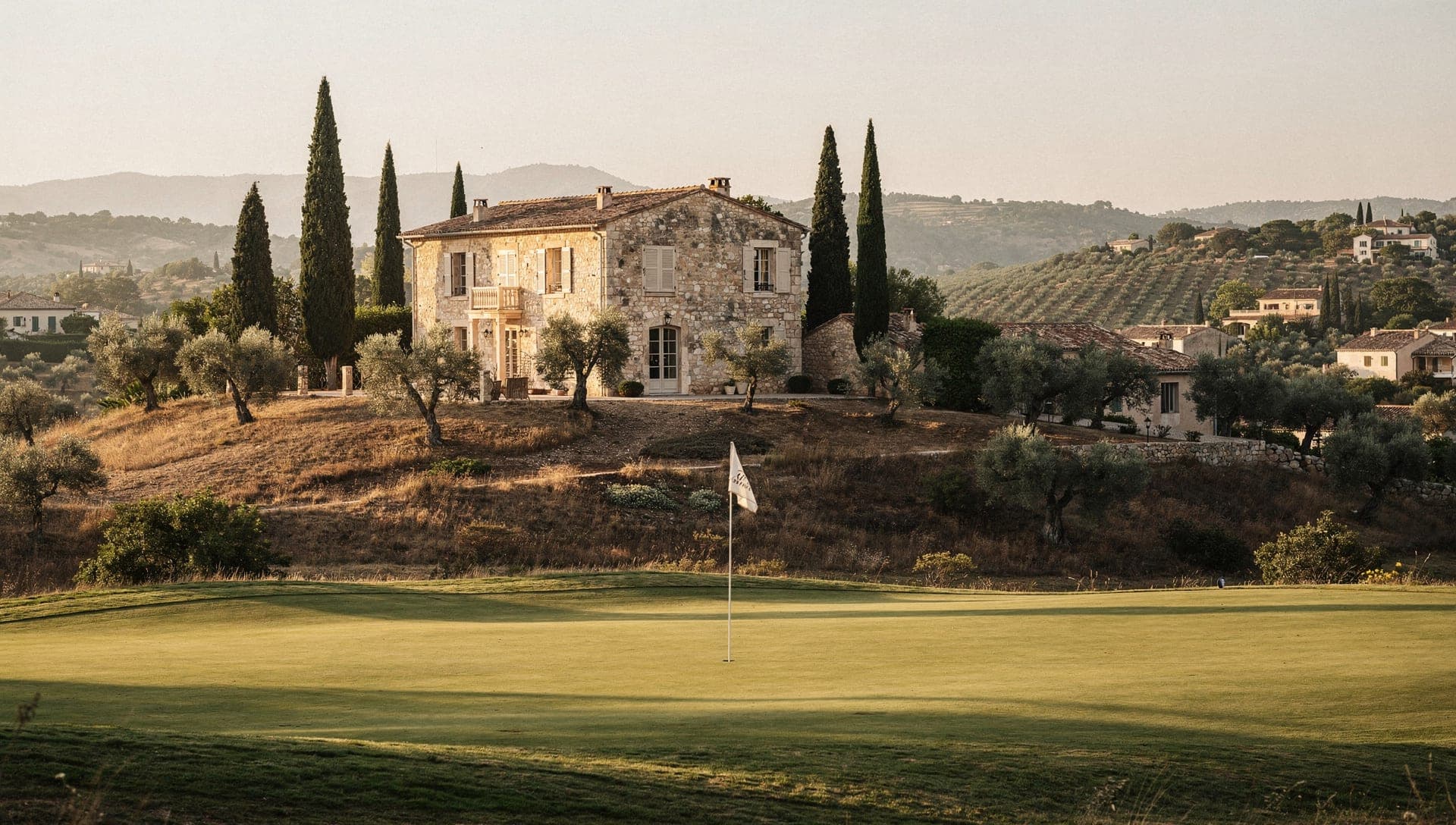
In the hills above Cannes, the question "how close is the golf?" rarely comes up by accident. Buyers who ask it tend to know exactly what they are after: a fairway view that will not be built over, a five-minute buggy ride to the first tee, and the quiet that comes from living beside open turf rather than a neighbour’s wall. The hinterland between Mougins, Opio and Châteauneuf-de-Grasse holds four full eighteen-hole courses inside a fifteen-minute drive of each other, and the homes around them trade as a distinct slice of the market.
That slice behaves differently from the rest. A villa with protected greens at the bottom of the garden holds its value when the wider market softens, because the supply is fixed. Nobody is making more frontage. It also carries costs and constraints that a standard hillside villa does not: stray-ball easements, club service charges, watering schedules that run at dawn. This guide covers what you buy when you buy beside a course here, what the premium amounts to, and which of the four estates suits which kind of life.
We have kept the figures grounded in what changed hands across 2024 and 2025, drawn from notaire records and the asking prices our office tracks each quarter. Where a number is a working estimate rather than a recorded sale, we say so.
One framing helps before any viewing. A golf-side purchase is three decisions bundled into one: where you want to live, how seriously you intend to play, and how much protected outlook is worth to you in cash. Most disappointments we see come from buyers who answered only the first question and let a green view settle the other two by default. Keep the three apart, and the right address on this hill usually becomes clear quickly.
The four courses of hinterland golf
Four golf estates define the market for golf property here, each with its own character and its own kind of buyer. Royal Mougins, Opio Valbonne and Grande Bastide are three of the five courses in our golf guide. The fourth is Cannes-Mougins. Royal Mougins Golf Club, off the Route de Cannes in Mougins, is the youngest and the most self-contained: an eighteen-hole Robert von Hagge design inside a gated residential domain with its own spa, restaurant and rental apartments. Golf Country Club de Cannes-Mougins, founded in 1923 and reworked by Dye Designs, is the heritage club, long enough to have hosted the Cannes Open on the European Tour. Membership here is a social marker as much as a sporting one.
Opio Valbonne Golf Club lies in the wooded grounds of the Château de la Bégude estate at Opio, an eighteen-hole Donald Harradine course laid out around the château, now a hotel. It is the most rural and the most relaxed of the four. Golf de la Grande Bastide at Châteauneuf-de-Grasse, a Cabell Robinson design opened in 1990, is the quieter option, with a calmer membership scene. The other two courses of our guide, Golf de Saint-Donat near Grasse and Golf de Biot, a shorter course below Biot village, widen the field for anyone willing to push the search a few minutes further. Royal Mougins sits inside its own gated residential domain, which shapes both the property on offer and the running costs. The other three are open clubs ringed by ordinary residential streets, where the homes answer to a commune rather than an estate manager.
Buying decisions usually start with one of these names, because the course sets the tone for everything around it: the price per square metre, the profile of the neighbours, the noise of buggies at eight in the morning, and the colour of the view from the terrace in July.
Royal Mougins: the gated golf estate
Royal Mougins is the address most people picture when they think of living on a course here. The von Hagge layout is hemmed by villas and a discreet apartment residence, all inside a guarded gate roughly three kilometres from Mougins village and about ten minutes from the Cannes seafront. The club runs a spa, a fitness centre and a clubhouse restaurant that residents use as an extension of their own kitchens.
Property divides into two tiers. Apartments inside the residence, typically two or three bedrooms with a terrace over the fairway, have traded between roughly €620,000 and €1.4 million across the past two years, depending on floor, view and renovation. Detached villas with direct course frontage start around €2.3 million and run well past €5 million for the larger contemporary builds. On a per-square-metre basis that puts the estate in the €9,000–12,000 band, around the 2025 DVF median of €10,073 for Mougins houses sold for €1M or more.
What you pay for is permanence: the greens are protected, the gate is staffed, and the maintenance is handled to a standard most private gardens never reach. What you accept in return is a service charge, a community that lives at the pace of a club, and an entry price that filters the buyer pool down to a fairly narrow group.
Cannes-Mougins: heritage and the membership question
Golf Country Club de Cannes-Mougins carries a century of history, and the prices of the homes around it reflect that. The streets off the Avenue du Golf, a quiet residential pocket on the Mougins–Mouans-Sartoux border, hold a mix of 1970s and 1980s villas on generous plots, many bought decades ago and now coming to market as the original owners move on. Frontage here is less uniform than at Royal Mougins: some gardens open straight onto a fairway, others sit a street back with only a partial view.
Prices reflect that variety. A renovated villa with true course frontage sits comfortably in the €2.5–4 million range. An older property a row back, needing work, still comes up closer to €1.3–1.8 million, a rare entry point this close to a club of this standing. The catch is that buying a house here does not buy you a tee time. Membership is separate, has its own joining process, and is part of what makes an address on this hill desirable in the first place.
For buyers who play seriously and want a club with a social calendar, that separation is the point. If you simply like the green view and the calm, confirm what course access comes with the deeds. Usually nothing comes automatically.
Opio Valbonne: rural golf living
The Opio Valbonne course sits at the centre of the Château de la Bégude estate, a Harradine eighteen wound through pines and around the restored château, now a hotel. The mood is entirely different from Mougins: this is olive-grove country, ten minutes from Valbonne village and its Friday Provençal market, where homes sit on larger plots and the night sky still goes properly dark.
Property here is less about a residence and more about position. Villas in the lanes around the course (Opio proper, plus the Châteauneuf and Valbonne borders) typically run €1.1–3 million, with course or valley frontage adding around fifteen to twenty per cent over an equivalent inland plot. Per square metre, the area works out around €5,500–6,800, noticeably gentler than Mougins for buyers who will trade a little polish for space, privacy and a slower rhythm.
The trade-offs are rural ones. You will drive for most errands, the nearest large supermarket is a few minutes away at the Pré-du-Lac crossroads, and broadband quality varies street by street, so check it before you commit if you work from home. For families relocating around Sophia Antipolis, though, the combination of golf, calm and a short hop to the Campus International de Valbonne is hard to match elsewhere.
Grande Bastide and Saint-Donat: the quieter end
Not every golf address demands a seven-figure cheque. Golf de la Grande Bastide at Châteauneuf-de-Grasse, a Cabell Robinson course from 1990, sits in a quieter, more workaday pocket of the hills where prices have always run below Mougins. Villas with a view of the holes here change hands in the €850,000–1.8 million range, and apartments in the small developments nearby start lower still. Per square metre, the 2025 DVF median for Châteauneuf-de-Grasse houses sold for €1M or more is €8,705.
A few minutes west, Golf de Saint-Donat near Grasse opens a similar bracket. Neither course carries the membership cachet of Cannes-Mougins, and that is precisely the appeal: you get the open green view, the buggy-ride mornings and the clubhouse lunch without the social-register pricing.
These are the addresses we point first-time golf buyers towards: people testing whether course living suits them before committing at the top of the market. If the lifestyle sticks, the equity built here often funds a later move up the hill to Mougins or Opio.
Resale, liquidity and how these homes behave over time
Course-side homes behave differently from ordinary hillside villas when it comes time to sell, and understanding that pattern is worth as much as knowing the entry price. The defining feature is scarcity. There is a finite number of plots that open directly onto a fairway at each of the four estates, and none will ever be added. When the wider hinterland market cools, as it did briefly through parts of 2023, true frontage tends to hold its asking price while set-back stock discounts to find a buyer. That resilience is the strongest argument for the premium.
Liquidity works the other way at the top of the market. A €4 million villa at Cannes-Mougins addresses a far smaller pool of buyers than a €1.2 million apartment at Royal Mougins or a €900,000 villa at Grande Bastide, so the trophy properties often sit longer even when priced fairly. The apartments inside Royal Mougins, by contrast, resell more easily than most second homes here: a recognisable name, a turnkey product, a rentable asset, and a price band within reach of a broad international audience.
For a buyer thinking about exit before they have even entered (and every disciplined buyer should), the lesson is to match the property to a deep pool of future demand. Frontage that resells is frontage worth paying for. A view so specific that only one kind of buyer will ever want it is a different proposition, however lovely it looks from the terrace today.
Stray balls, water and the practical fine print
Living beside a course is mostly pleasant, with a few specific drawbacks. Stray balls are a real, if minor, fact of life on holes where a garden sits inside the slice line. Reputable estates carry signage and netting, but liability for damage depends on the circumstances and usually falls to the insurers of the player or the club, so ask the agent which holes border the plot and whether any window has ever been hit. A terrace behind a tee is a different proposition from one on the outside of a dogleg, where sliced balls land.
Watering is the other daily reality. Courses irrigate at dawn, and the sprinkler heads nearest a boundary throw spray and noise from around five in the morning in high summer. Most buyers never notice. Light sleepers should walk the boundary early before signing. Pesticide and fertiliser regimes have tightened sharply under French environmental rules, so the old worry about chemical drift is far smaller than it was a decade ago, but a direct question to the greenkeeping team is always reasonable.
Finally, read the easements. Many golf-front plots carry a registered right allowing club staff and players limited access to retrieve balls or maintain the boundary. It is rarely intrusive, but it is on the title, and a good notaire will flag exactly what it permits before completion.
Membership, green fees and who gets to play
One assumption catches buyers out more than any other: that owning beside a course grants the right to play it. With rare exceptions, it does not. Membership and property are separate transactions, and the economics matter.
At the top end, full membership at Cannes-Mougins or Royal Mougins runs into several thousand euros a year once the joining contribution and annual dues are counted, and the better clubs maintain waiting periods rather than open enrolment. Opio Valbonne and Grande Bastide are more accessible, with annual memberships that sit lower and green fees for occasional play, typically €60–110 per round in season at the friendlier courses and much more at the top clubs. Buggy hire, practice facilities and guest fees stack on top.
For an owner who plays twice a week, membership almost always pays for itself against pay-as-you-go rates. For someone who values the view and plays a handful of times a year, green fees as a non-member are the rational choice, and the property still delivers everything that matters from the terrace. Decide which buyer you are before you let a club’s reputation inflate the budget.
Schools, dining and the daily commute
Golf addresses here sit inside one of the strongest school catchments on the coast, which is a large part of why families pay to be near them. Mougins British International School, the British international school on the Avenue Maurice Donat at Font de l’Orme, is a short drive from both Royal Mougins and Cannes-Mougins. The Campus International de Valbonne, with its state-funded international sections, is roughly ten minutes from the Opio course. The local collèges at Mougins and Valbonne cover the French-system families well.
The table is part of the draw too. Mougins village, five minutes from either Mougins course, holds Bohème, at the former two-star Paloma address, and La Place de Mougins, both listed in the Michelin Guide 2026 without stars, as well as the long-running L’Amandier de Mougins. The Le Candille dining room at the Mas Candille hotel sits above the village. Around Opio and Valbonne the register is more bistro than gastronomic, which many residents prefer for everyday life.
Commuting is the quiet advantage. Sophia Antipolis is fifteen to twenty minutes from all four courses, Cannes ten to fifteen from the Mougins pair, and Nice airport about thirty. For a household balancing a tech-park job, an international school run and a Saturday tee time, the geography lines up unusually neatly.
Who should buy beside a golf course, and who should not
Golf-front property rewards two kinds of buyer especially well. The first is the regular player who will use a membership and wants the buggy ride measured in minutes. For them the premium is the price of a daily pleasure. The second is the long-term holder who values a view nobody is allowed to build over and treats the protected outlook as insurance against the next wave of hillside construction. Both groups tend to be happy years after the purchase.
It suits others less well. A buyer who plays rarely and dislikes service charges often finds the same calm, the same valley view and a lower entry price a few hundred metres uphill, away from any club. Families with young children sometimes prefer a fully enclosed garden to one with a registered access easement and the occasional ball. And anyone buying purely as an investment should model the service charges and membership economics carefully, because the headline premium flatters some properties whose running costs eat into the yield.
The honest test is simple: would you still want this house if the course were a public park? If the answer is yes, the golf is a bonus and the purchase is sound. If the answer depends on the fairway, make sure you have priced what the fairway truly costs to live beside.
How we approach a golf-side search
When a client briefs us on a course-side purchase, we start with the use, not the address. How often will you play, and where? That one answer reorders the whole shortlist. A twice-a-week player belongs at Cannes-Mougins or Royal Mougins. A view-led family often does better at Opio or Châteauneuf for the space and the calm. From there we map frontage hole by hole, because not all course views are equal: a quiet par three is nothing like a busy opening tee.
We then pull the unglamorous detail that decides whether a home is a pleasure or a problem. The service-charge trajectory, the easement wording on the title, the irrigation timetable, the club’s own financial health, and the membership terms that govern access. Much of this never appears in a listing, and it is where a local office earns its fee.
If a course-side home is on your list for this year, we are happy to walk the four estates with you and show, plot by plot, where the premium is worth paying and where the same life costs less further up the road. The greens are not going anywhere, which is the point of buying beside them.
Sources
Official sources this guide draws on:
← Part of our guide: Buying property in France as a foreigner