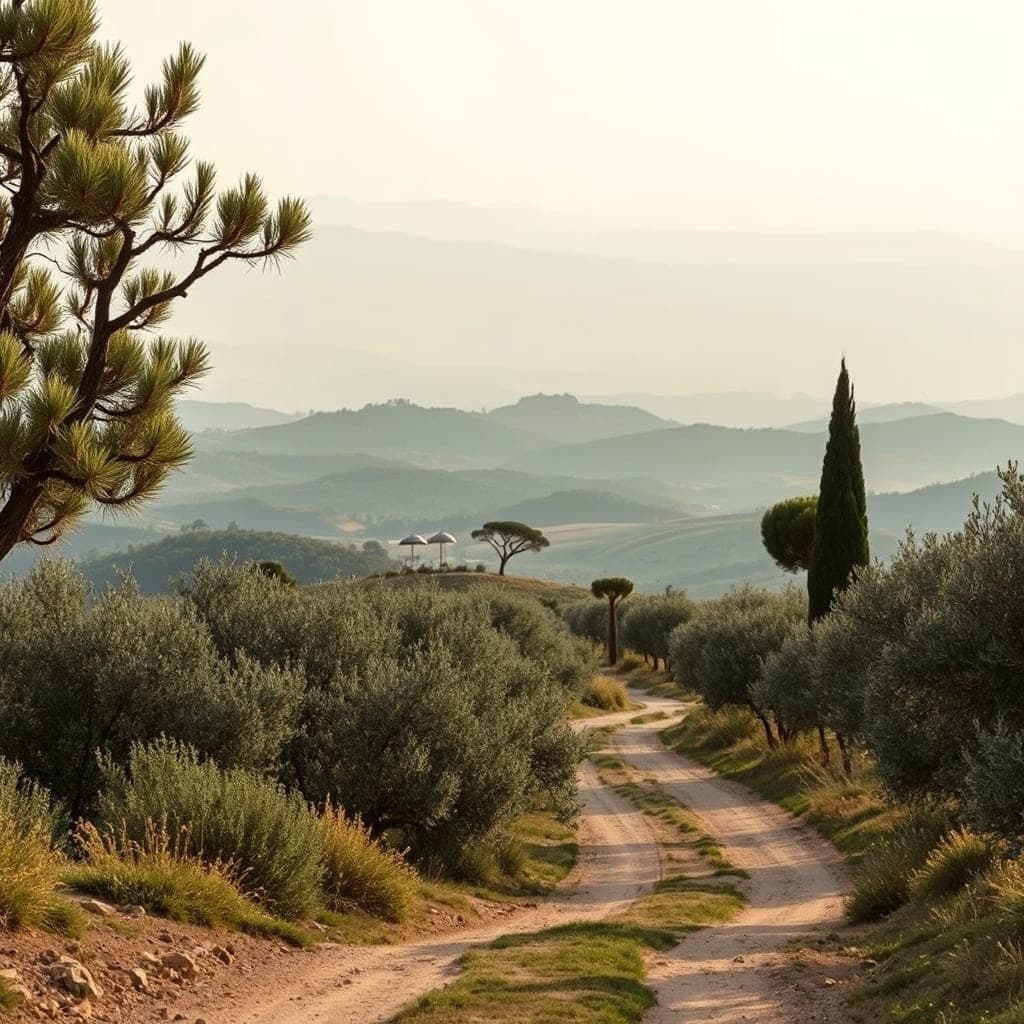
The trail network behind your garden
The GR51 is a long-distance hiking trail, a Grande Randonnée, known as the Balcons de la Méditerranée. It runs roughly 500 kilometres from Menton to Marseille, and in the Alpes-Maritimes it climbs through the hills behind Nice, crosses the Loup valley at Gourdon and the Saint-Barnabé plateau, then drops to Grasse before heading for the Estérel and the Var. The Fédération Française de la Randonnée marks it with the familiar red-and-white blazes.
The GR51 does not pass through Valbonne, Opio, Roquefort-les-Pins, Châteauneuf-de-Grasse, Mougins or Biot. What links those villages is a dense web of local footpaths, the yellow-marked PR routes, forest tracks and old mule paths that each commune maintains. Most people who move here do not find that network for their first eighteen months. They drive to the coast, settle the children at CIV or Mougins British International School and work out the supermarket run. Then a neighbour suggests a Sunday walk, points at a painted mark on a pine, and a second version of where you live opens up.
This guide is for anyone weighing the hinterland as a place to buy and curious whether its outdoor reputation matches the brochure. The short answer is yes. From many houses in Roquefort-les-Pins, Valbonne or Châteauneuf-de-Grasse you step out of the gate onto a waymarked path, and the GR51 itself is a short drive away above Grasse and in the Loup valley.
We cover what the GR51 is, how the local paths work village by village, what footpath access does to values, and the seasonal rules every walker here needs to know.
What the GR51 is
The Grande Randonnée system is a French institution. The trails are numbered, signposted and maintained by volunteer fédération members who repaint the blazes regularly. A red horizontal stripe over a white one means you are on the trail. An X means wrong way. A bent stripe warns of a turn.
The GR51 is called the Balcons de la Méditerranée because it holds to the hills above the coast, with long views over the sea. The highest point on the whole route is about 970 metres. In the Alpes-Maritimes the official line runs from Menton through Castellar, Sainte-Agnès, Gorbio, Drap, Tourrette-Levens, Aspremont, Colomars, Gattières and Saint-Jeannet, then across the Saint-Barnabé plateau to Courmes, Gourdon and Grasse, and on through Le Tignet and Auribeau-sur-Siagne towards the Estérel.
If you live between Valbonne and Grasse, the most useful stretches are the Gourdon to Grasse section above the Loup valley and the run south-west from Grasse towards the Siagne. Both are a short drive from the eight villages. Closer to home, the yellow-marked PR footpaths (Promenade et Randonnée) do the daily work, linking village to village through pine and oak woods.
Difficulty on the local paths is moderate. The terrain underfoot is mostly limestone with patches of clay, slippery after rain. The GR51 legs around Gourdon are steeper and more exposed. Most stretches suit trail runners for anyone who walks regularly. Boots are advised after October.
There is no entrance fee and no booking. The paths are open all year, though hunting days in autumn and winter and fire-risk closures in summer both shape where you walk, as we cover below. During the hunting season, hunters use many woods on set days, often Sundays and Wednesdays. Wear a bright layer, keep to marked paths and respect the signs posted at the edge of a hunt.
Roquefort-les-Pins: a natural base for walkers
Roquefort-les-Pins is one of the best bases in the hinterland for walking. The commune is largely wooded, with pine and oak on gentle ground, and local paths leave from several of its residential quarters.
Many properties in the more rural parts of the commune sit on hectare-plus plots with horse paddocks and oak woods, and a forest track is often a few minutes from the gate. For families with children at the Collège César in Roquefort, a Sunday walk from home through the woods and back is the shape of most weekends. Horse riders share many of these tracks, so keep dogs close and give way at walking pace.
The southern quarters, sloping towards the autoroute, trade some of that woodland for shorter drives: Sophia Antipolis in about 12 minutes, Cannes in about 22. Property here ranges from around €750,000 for a three-bedroom villa on 1,000 sqm to over €2 million for a renovated mas on two hectares.
The village centre has cafés, shops and the covered market hall, where the market runs on Wednesday and Saturday mornings. Bread at 8, a woodland loop from 9, back to the village for lunch: that Sunday morning is one of the quieter pleasures of buying here. The DVF median for houses of 100 m² or more sold for €1M or more in Roquefort-les-Pins was €7,440 per sqm in 2025, with the best villas on large plots trading well above it.
People underestimate how much the walking community matters socially. Joining a local walking club is one of the more effective ways for an incoming family to meet French neighbours, and children who go along hear everyday French in a way no school playground provides. The mairie will point you to the clubs that run weekly outings. Our Roquefort-les-Pins guide covers the sectors and prices.
Valbonne: Castellaras, Peyniblou and the back of the village
Valbonne has no GR route, but its local network is among the best in the hinterland. Waymarked paths run through the wooded slopes around the village and out towards the Brague valley, with occasional views down towards Sophia Antipolis. The village tourist office and the mairie will point you to the current waymarked loops.
Over the boundary in Mouans-Sartoux, the gated Castellaras domains are the address many relocating executives end up looking at. Properties there trade between roughly €2.5 million and €8 million depending on plot size and renovation status, and wooded country lies close by.
Peyniblou and Val de Cuberte are the Valbonne sectors that give the easiest access to woodland paths without the gated-estate price tag. A four-bedroom villa on 1,500 sqm in Peyniblou trades around €1.6 to €2.1 million.
For families based around CIV (Campus International de Valbonne), whose international sections anchor much of the international community here, a woodland walk is the default Sunday plan from late September to early June.
The easiest public option for the whole family is the Parc départemental de la Brague, with marked trails along the river between Valbonne, Biot and Antibes. Allow about two hours for a riverside loop, and bring water in summer.
Châteauneuf-de-Grasse and the Pré-du-Lac paths
Châteauneuf-de-Grasse is among the closest of the eight villages to the GR51. The perched village looks over the Val d’Opio towards the Loup valley and, on a clear day, the Mediterranean, and the Gourdon section of the GR51 is a short drive north.
Pré-du-Lac, the crossroads sector of Châteauneuf, deserves separate mention. It sits where the roads from Grasse, Vence and Opio meet, and local paths climb from the plateau towards the old village and the chapel of Notre-Dame-du-Brusc, an 11th-century church listed as a historic monument.
Property in Châteauneuf-de-Grasse village proper is dominated by character stone houses with terraces and small courtyards. A three-bedroom with a view trades around €850,000 to €1.4 million. The plateau around Pré-du-Lac, more modern and more spacious, sees four-bedroom villas on 1,500 sqm plots at €1.3 to €1.9 million.
For families looking at Mougins British International School or the international sections at CIV, the drive from Châteauneuf takes around 25 minutes. A Sunday walk with classmates’ families is often how the week’s social life gets organised.
The village has its cafés, a bakery and everyday shops, and Pré-du-Lac adds a pharmacy, restaurants and a Monday-morning market. The rhythm is slower than Valbonne, and people moving here generally want it that way. Market morning at Pré-du-Lac is the easiest way to meet the neighbours who know the paths.
Opio: olives, golf and quiet lanes
Opio is the most pastoral of the eight villages for walkers. The commune is a spread of olive groves on restanques, with lanes and footpaths threading between the terraces.
Property in Opio falls into two clear categories. The houses around the Opio-Valbonne golf course, eighteen holes designed by Donald Harradine and Robert Berthet in a 220-hectare estate around the Château de la Bégude, trade between €2 million and €5 million for villas on plots between 2,000 sqm and a hectare. The non-golf sector, including the village centre and the lanes towards Le Rouret, offers smaller-plot family homes from €900,000 to €1.4 million.
Walking from an Opio home onto a woodland or olive-grove path is generally a matter of minutes. Keep off the fairways and respect the private groves, which are working land. In November and December the groves are busy with the harvest, nets spread under the trees, so keep to the lanes.
The Sunday ritual here is well established: a walk through the groves, then lunch in the village. In winter, owners take their olives to the Moulin d’Opio at 1 Place de la Font Neuve. Oil has been pressed on the site since 1426, and one family of millers (the Michels in its later generations) ran it from 1848. The Communauté d’agglomération Sophia Antipolis bought it in September 2024, and since 2025 the SCIC Les Ferrages and the association Neede have run it.
Schools matter less in Opio than in Valbonne because most parents here have already chosen their international option in Mougins or at CIV. The drive from a typical Opio home to CIV is about twelve minutes. Weekend walks are the social glue that connects these school networks.
Mougins, Plascassier and the southern approach
Mougins sits at the southern edge of the walking country. The old village itself is a pedestrian knot of galleries and restaurants, and the paths start beyond it, in the wooded ground around the Étang de Fontmerle and towards the Valbonne and Plascassier side.
For Mougins residents, local paths leave from several sectors, and the Chemin de l’Étang is a popular way into the woods. The étang itself is a pleasant stop with children, and the shaded tracks around it stay cooler in early summer.
Property prices in Mougins reflect the name. The historic village core sees character stone houses at €1.5 to €4 million depending on terrace size and view. Val de Mougins, the modern villa sector, runs €1.8 to €3.5 million for a four-bedroom on 1,500 sqm. The top estates trade far higher.
The walking community in Mougins has a particular character. Many international families at Mougins British International School organise Sunday walks through long-running messaging groups, and new arrivals are usually folded in within a month of putting children into school.
A specific recommendation: start near the chapel of Notre-Dame-de-Vie, beside the house where Picasso spent his last years, and walk the lanes towards Plascassier. The chapel sits on a small rise with its own quiet view. Read the map there and decide how far to push on.
Biot and the Brague valley
Biot is the easternmost of our villages and the one most often forgotten in conversations about walking. Its best asset is the Brague valley, where the Parc départemental de la Brague runs marked trails along the river towards Valbonne and Antibes. The paths follow the valley floor for much of the way, which makes them a good first outing with young children.
For a Biot-based household on the Sophia side, a path into the pine forest is usually minutes away. Biot’s draw is its glassblowing tradition (the Verrerie de Biot dates from 1956) and its proximity to Sophia.
Three-bedroom villas in Les Vignasses trade at around €900,000 to €1.3 million. The proximity to the coast (Antibes is about 8 minutes) and the woodland on the doorstep make Biot one of the most underrated entry points to the hinterland for first-time international buyers.
For harder walking, drive north to the Loup gorges and the GR51 around Gourdon. Those paths are narrower and steeper, with more climbing. Skip them if you are new to hiking and have small children with you, and stay with the gentler valley loops.
How footpath access affects property values
Footpath access is one of the under-discussed factors in our local market. There is no DVF (Demandes de Valeurs Foncières, the French open transaction database) field for it, so nobody publishes a clean figure. What agents working the area see is that buyers pay attention to it, and that listings which describe it well draw more viewings.
Why does it matter? Three reasons. First, the people moving to the hinterland increasingly hike, run or cycle at weekends. They want a path from the gate, not a drive to a car park, and they ask about it at the first viewing.
Second, properties that back onto woodland often adjoin land zoned as natural area, which limits future building and protects the view. Check the PLU zoning of the land behind any plot before you count on it.
Third, the rental market values easy access to paths when listings describe it well, for long lets to relocating families as much as for summer lets. A listing that shows the route from the garden gate to the first waymark answers the question before it is asked.
The effect is not uniform. Inside a gated estate, the estate’s own amenities dominate the decision and a path nearby is a soft plus. In Roquefort-les-Pins and Châteauneuf-de-Grasse, where outdoor life is often the buyer’s first motivation, it weighs more. In Mougins, where dining and art lead the village identity, it weighs less.
Treat it as a point to raise at viewing and resale, not as a fixed premium. A house with woodland at the gate and protected land behind it has an advantage that a busier plot cannot buy later.
Practical tips for the first six months
If you have recently bought in the hinterland and want walking to become part of your routine, here is what residents who have walked these hills for years suggest.
Start with a valley loop. The Parc départemental de la Brague offers marked, mostly gentle trails along the river, easy to reach from Valbonne and Biot. Once you are comfortable, drive up to Gourdon and walk a stretch of the GR51 for the views over the Loup valley.
Buy proper trail shoes before October. The limestone gets slippery after the autumn rains and a twisted ankle in November will keep you off the paths until spring. Any good outdoor shop will fit you.
Pack water and a snack, even on a two-hour walk. The midday sun in May, June and September is stronger than newcomers expect. Two litres per person on a half-day walk is sensible.
Use the IGN 3643ET map. It is the Institut Géographique National 1:25,000 map of the Cannes and Grasse area and shows the footpath network in detail. Phone apps help, but signal drops in the lower valleys, so a paper map in a waterproof bag is the local solution.
Learn the bells. The bells you hear in spring and autumn signal a flock crossing the path. Step aside, do not run, and leash dogs immediately. The shepherd will lead the flock past you within a few minutes.
Pay attention to fire risk. In summer the prefecture publishes a daily fire-risk map for the massifs, and on the highest-risk days access is banned by order, footpaths included. Entering a closed massif carries a fine of €135 per person. Check the map before every summer walk. Owners face their own rules, set out in our guide to fire risk and brush clearing.
Local clubs and guided walks
The hinterland has several walking clubs with active weekly programmes. For new arrivals, particularly retirees and parents whose children have started school, they are the easiest way to build a local circle.
Most clubs are affiliated to the Fédération Française de la Randonnée, which includes insurance in the annual licence. The departmental committee of the fédération lists the affiliated clubs in the Alpes-Maritimes.
Programmes usually mix a longer weekend outing with a gentler weekday walk, which suits both working families and retirees. A trial outing before you join is usually welcome.
English-speaking residents also walk together informally, through groups that new arrivals join by introduction at school or at the sports clubs around Sophia Antipolis.
Private guides operate as well, offering themed walks in the flower season, during the olive harvest or around the perfume fields near Grasse. Book ahead in May, June and October.
Finally, the local mairies and the Département publish programmes of free guided walks, often called sorties nature. The walks are usually in French. The welcome is warm every time.