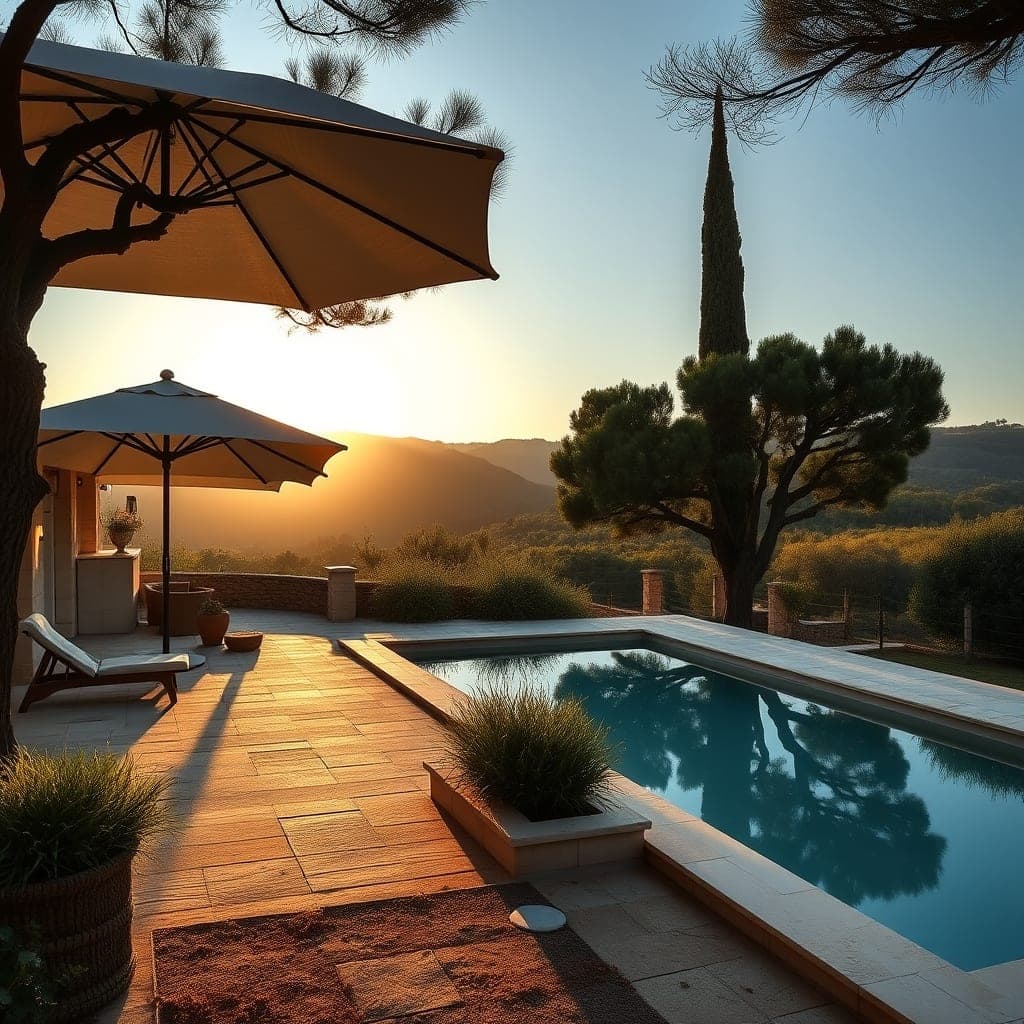
Two summers, twenty minutes apart
By the first week of July, the Côte d’Azur quietly splits into two different worlds. On the coast, the A8 slip roads at Antibes and Cannes start backing up before ten in the morning. Beach clubs along the Croisette charge €45 for a mattress you need to reserve three days ahead. The Marché Provençal in Antibes is wonderful and packed shoulder to shoulder. Parking in Juan-les-Pins becomes a competitive sport with no winners.
Twelve kilometres inland, the same Tuesday looks entirely different. At nine in the morning on Valbonne’s Place des Arcades, there are free tables in the shade, a coffee costs €2.20, and the loudest sound is the fountain. In Opio, the lanes between the olive groves carry almost no traffic. In Châteauneuf-de-Grasse, at 400 metres of altitude, the air still has the freshness of early morning at an hour when Cannes is already shimmering.
This is the open secret of the hinterland villages: Valbonne, Mougins, Biot, Opio, Grasse, Roquefort-les-Pins, Châteauneuf-de-Grasse and Le Rouret. They sit twenty to twenty-five minutes from the sea, close enough to swim before breakfast, far enough that the summer crowds never quite reach them. Some tourists do come up, mostly to Valbonne’s arcaded square and Mougins’ gallery lanes. They arrive for lunch and leave by early evening. The villages then return to the people who live there.
Ask a long-term resident of any of these towns to name the best season and the answer is rarely what newcomers expect. Spring gets votes. September gets many. But summer, lived at village pace rather than coastal pace, is the season most of them defend. This article explains why, in practical detail: the temperatures, the markets, the festivals, the restaurants, the water, and what all of it means if you are weighing a property purchase in the area.
Cooler by design: altitude, pines and stone
The hinterland’s summer advantage starts with geography. Valbonne village sits at roughly 250 metres of altitude, Mougins at 260, Roquefort-les-Pins between 250 and 300, Châteauneuf-de-Grasse at around 400, and the upper quarters of Grasse climb past 350. Every hundred metres of elevation takes roughly 0.6°C off the air temperature. More to the point, it changes what happens after sunset.
On an August afternoon the difference between Valbonne and the Antibes seafront might be only two or three degrees. By eleven at night it is a different story. The coast holds its heat in the masonry and the humid sea air, and nights there hover at a sticky 25–26°C. Inland, the air drains cool off the Préalpes after dark. Evenings on a Valbonne or Opio terrace typically settle to 19–21°C. Dinner outside needs no discussion, and sleeping with the windows open works for most of the season.
The building stock helps. The old village houses of Valbonne, Biot and Le Rouret were built with 50–60 cm stone walls that smooth out the daily temperature swing the way a cellar does. The classic Provençal villas of the 1970s–1990s in Peyniblou, Font de Currault or Les Plans were laid out with deep roof overhangs, north-facing kitchens and shaded southern terraces for exactly this climate. Mature umbrella pines and holm oaks, the usual tree cover in Roquefort-les-Pins and around the Valbonne forest, keep a garden up to five degrees cooler than open lawn.
None of this makes air conditioning useless. Many owners fit discreet units in bedrooms, and rental guests increasingly expect it. But it explains a pattern every local agent recognises: buyers who view in February ask about heating, and buyers who view in late July ask about shade, cross-ventilation and which way the master bedroom faces. Most of the hinterland’s houses were designed for this climate, and they handle the heat well.
Market mornings
Summer mornings in the hinterland are organised around markets, and the rhythm is worth learning. The anchor is Valbonne’s Friday morning market, which fills the village grid from the Place de l’Église through the lanes around the arcades. In July it runs at full strength: stone-fruit growers down from the Var, goat’s cheese from the plateaux above Grasse, courgette flowers sold by the dozen, and Cavaillon melons at €3–4 apiece that need eating the same day. Arrive before nine. By half past ten the coaches from the coast have found it.
Grasse runs its food stalls on the Place aux Aires through the week, and the morning shop there (fougasse, tapenade, the first figs in late July) comes with the bonus of altitude. You walk around comfortably at hours when the coastal towns are already too hot. Le Rouret’s market square keeps a smaller, more agricultural character that matches the village’s roots, and Biot’s weekly market threads between the glass studios at the foot of the old village.
Then there are the evening markets, a purely seasonal pleasure. Through July and August the villages take turns hosting marchés nocturnes: artisan and food stalls from six until midnight, when the day-trippers have gone and the temperature has dropped enough to sit outside. Valbonne’s summer night events around the arcades are the best known. Opio and Roquefort-les-Pins run smaller versions on their squares.
Two practical notes for residents and would-be residents. First, the producers you meet at these markets, such as the Moulin d’Opio for olive oil or the honey and cheese stands that come down from Gréolières, sell at their farms year-round. That is how a summer find becomes a winter habit. Second, the market circuit is one of the fastest ways to take a village’s social temperature before buying there. Ten minutes of watching who greets whom on a Friday morning in Valbonne tells you more about the community than any brochure.
The produce calendar gives the season its structure. June opens with cherries from the Tanneron hills and the first apricots. July is peach and melon month, when the white peaches from the Var that never survive supermarket logistics appear for a few weeks. By early August the figs arrive, first the green, then the black ones the growers tell you to eat warm from the tree, alongside Provençal tomatoes in a dozen shapes. Late August brings the first muscat grapes and, in good years, early girolles from the pine woods above Gréolières. Let the stalls decide the week’s menu. Seasonal cooking then takes less effort, because there are fewer decisions to make. One last tip: most stalls take cards now, but bring coins for the farm tables. The best of them still price by the basket and round down for regulars. The full week is in our market circuit guide.
The long evenings: fêtes, jazz and open air
The hinterland’s summer calendar begins on 21 June with the Fête de la Musique, when every village square in France turns into a free stage. Valbonne’s arcades, Biot’s sloping main street and the Place aux Aires in Grasse all fill with bands of wildly varying quality and uniformly high enthusiasm. It is the unofficial opening night of the season.
From there the weeks stack up. Mougins hosts Les Étoiles de Mougins, the gastronomy festival that brings chef demonstrations, tastings and culinary competitions to the village that Roger Vergé made famous, but in September of even-numbered years rather than in high summer, so plan for the rentrée. For a commune of about 19,800 people, Mougins has an outsized place at the table. At the end of July, Grasse stages the Fête du Jasmin, running in 2026 from 31 July to 2 August 2026: flower floats, parades, fireworks over the old town and jasmine garlands handed out by the armful. In August, Biot’s glass festival opens the studios for demonstrations and an artisan market. You watch the village’s centuries-old trade at the furnace on the hottest nights of the year.
The coast has the headline acts. Jazz à Juan under the pines of Juan-les-Pins and the Nice Jazz Fest both run in July, and they are worth the drive because they happen at night, when the roads are clear. Smaller events fill the gaps between the big dates: open-air cinema screenings in village squares and parks, the fêtes votives each commune holds for its patron saint with pétanque tournaments and long communal dinners, and the simple nightly ritual of the boules pitch, which in Valbonne and Le Rouret functions as the village’s open-air living room from June to September.
What ties all this together is scale. These are events you walk home from. No shuttle buses, no €80 parking, no hour-long crawl back up the A8. The evening ends on your own terrace, in the cool air, fifteen minutes after the last song.
The summer table
Eating well in the hinterland in summer requires no planning at the everyday level and a little at the top end. The everyday level is the café terrace: the Café des Arcades on Valbonne’s square, the bistros around Mougins’ village circle, the terraces wedged into Biot’s main street. A plat du jour runs €16–22, the rosé is local, and from mid-June the kitchens cook with the season: stuffed courgette flowers, grilled loup, tomato salads that taste of tomatoes.
The top end earns its reputation. Mougins remains the gastronomic capital of the hills: Le Moulin de Mougins, the converted 16th-century oil mill where Roger Vergé invented cuisine du soleil, still defines the village’s standing, and L’Amandier, Vergé’s other address, keeps its panoramic terrace. In Grasse, Jacques Chibois’s La Bastide Saint-Antoine, listed in the Michelin Guide 2026 without a star, serves Provençal cooking in a 17th-century country house surrounded by olive trees, with a summer terrace worth the drive on its own. In Biot, Les Terraillers holds a Michelin star inside a 16th-century pottery mill. July and August booking discipline: a week ahead for weekend dinners at the gastronomic tables, two or three days for good village restaurants, same day almost everywhere else.
Two summer-specific habits are worth adopting early. First, lunch is the better deal at the gastronomic addresses. Set menus often run 40–50% below the evening tasting price, and the dining rooms are cooler at noon than any terrace at nine. Second, the rosé question has a local answer: the Côtes de Provence estates, most of them in the Var, are within an hour’s drive, and many sell directly. A cellar visit in the cool of the morning, lunch in a village, a swim before dinner: that is the standard hinterland summer day, and residents do not tire of it.
Water without the crowds
What defines a hinterland summer is private water. A clear majority of detached homes across Valbonne, Mougins, Opio and Roquefort-les-Pins have pools, and from June to September the pool organises the day: lengths before work, children in by ten, adults back in at seven with a glass of something cold. No other amenity changes daily family life here as much. As a later section shows, it also changes a property’s rental arithmetic more than anything else.
Beyond the garden gate, the area’s fresh water is an underrated asset. The Loup river runs through a series of gorges twenty minutes north of Le Rouret: the Gorges du Loup road passes swimming holes of cold, green water, and the Cascade de Courmes drops forty metres into a pool that feels alpine in the middle of August. Closer in, the Brague threads through Biot’s parkland, better for shaded walks than swimming. Forty minutes west, the Lac de Saint-Cassien offers proper lake swimming, paddleboards and waterside lunch shacks. Locals go there for a beach day without the beach traffic.
Residents still use the sea in summer. It is a question of timing. The rule, learned quickly, is to be in the water by nine. At eight thirty on an August morning, the Plage de la Salis in Antibes or the sand below the Cap d’Antibes are calm, the parking is easy, and the water is flat after the night. Swim, coffee on the seafront, and be heading back up the hill as the crowds arrive with their towels at ten thirty. Twenty-five minutes later you are home in the shade. Locals do the coast at dawn and at dinner, and leave the middle of the day to the visitors.
How August works
Newcomers worry about two opposite things in August: that everything will be closed, and that everything will be overrun. Neither survives contact with reality.
On closures: yes, France takes August seriously, and a handful of village restaurants and independent shops shut for two or three weeks. But the system corrects itself. Boulangeries in the same village coordinate their closing rotations so that someone is always baking, pharmacies post their on-duty schedules, and the supermarkets, garden centres and DIY stores on the Plan de Grasse and along the Route de Cannes run normal hours all month. The one professional gap to plan around is administrative: notaires, banks and the mairie work at reduced speed in August, which matters if you are mid-transaction (see below).
On crowds: the hinterland absorbs its visitors well because they concentrate in predictable places at predictable times. Valbonne’s square and Mougins’ gallery loop are lively from noon to six. The residential sectors (Peyniblou, Castellaras, the Opio hillsides, Les Plans in Roquefort) barely notice the season. Meanwhile the area’s biggest crowd generator runs in reverse: Sophia Antipolis, whose technology park counts more than 40,000 jobs, largely empties in August. The morning commute past the Valbonne roundabouts moves freely. Many residents say the roads inland are quieter in August than in any other month.
The social calendar inverts too. August is when friends and family arrive. Every hinterland homeowner learns that a pool and a guest room fill up like a small hotel, and the month develops its own rhythm of long lunches, market mornings with visitors in tow, and evening drives to the coast for jazz or fireworks. It is not a dead month. It is the month the region was designed for.
What summer reveals about a property
For buyers, July and August are the most honest months to view a house, because summer is when this region’s properties are stress-tested. A villa that charms in April sometimes disappoints in August, and the reverse is also true. The checklist worth carrying to every summer viewing:
Shade and orientation. Stand on the main terrace at 4pm, not 10am. A west-facing terrace with no tree cover is unusable on August afternoons. A south terrace under a pergola or a pair of mature pines is the best room of the house. Note which bedrooms face west. They hold the day’s heat exactly when you want them cool.
The pool’s day. A pool shaded by 3pm swims cold in June and September, shortening the season it exists for. Full afternoon sun with a shaded surround is the ideal. Ask about heating: it converts a 3-month pool into a 6-month one and materially lifts rental appeal.
Noise and water. Cicadas are charming. The A8, the Route de Cannes or a neighbour’s heat-pump compressor are less so, and all carry further on still summer nights. Visit once in the evening. Check the irrigation arrangements and whether the garden is planted for drought. Olives, lavender and oleander survive restrictions that leave thirsty lawns brown by mid-July.
The rental arithmetic. A well-presented four-bedroom villa with pool rents for roughly €3,500–€6,000 per week in Valbonne, Biot or Roquefort-les-Pins in high season, and €5,000–€8,000+ in Mougins or the best Opio addresses, over eight to ten bookable peak weeks. Against hinterland purchase prices (family villas from roughly €1.1M and Mougins estates well beyond), seasonal letting will not make a property self-financing, but it comfortably covers running costs and taxe foncière for owners who use the house outside peak season. Registration with the mairie and collection of taxe de séjour are required for short lets. Factor changeover logistics into any plan built on Saturday-to-Saturday weeks. The tax side of letting is in our furnished letting guide.
Over a year, a well-marketed villa with pool in our coverage area produces 35,000 to 70,000 euros in summer income alone (eight to twelve weeks let between mid-June and mid-September). Gross yields, on a 1.2m purchase, work out at roughly 3 to 5.5 per cent on summer alone, with potential to add another 15,000 to 30,000 from shoulder-season weekly and short-stay business.
Escape routes: mountains, lake and Italy
Part of what makes the hinterland’s summer work is how easily you leave it when you want a change: upward, westward, or across a border.
Upward is the quickest fix. Gourdon, the eagle’s-nest village at 760 metres, is twenty-five minutes from Le Rouret up the Gorges du Loup road. The temperature drops noticeably with every switchback, and the view from the château terrace runs from Nice to the Esterel. Push on to Gréolières, at nearly 800 metres, for lunch at altitude and air that smells of thyme rather than suncream, or take the Col de Vence road for the bare limestone of the high plateau, a favourite evening drive when the light turns gold. The Route Napoléon north of Grasse climbs even higher, towards Saint-Vallier-de-Thiey and the high plateaus beyond.
Westward means the Lac de Saint-Cassien, covered earlier, or the red rock coves of the Esterel, at dawn, before the corniche fills. Across the border, Italy is an easy day trip: Ventimiglia’s sprawling Friday market sits about an hour away via the A8, and the Hanbury Gardens beyond it make a cooler, greener afternoon. San Remo and the Ligurian lunch table are thirty minutes further.
And then there are the Îles de Lérins. The 9am ferry from Cannes reaches Sainte-Marguerite in fifteen minutes. The island’s eucalyptus and pine paths, the calm water of its north shore and lunch at one of the island restaurants make what many residents consider the best summer day on the coast, provided you go early. The same rule applies to every trip on this list: the hinterland teaches you to use the morning.
West, the destination is the Var. The Massif des Maures, the Domaine du Rayol gardens, the coastal walk from Le Lavandou to La Croix-Valmer, the Île de Porquerolles by ferry from La Tour Fondue. At around two hours each way, this is a full day, and it tends to be an occasional weekend plan rather than a casual outing.
Children’s summer: camps, courts and the long holidays
French school holidays run from early July to the first days of September. Two full months frighten parents in most places, and they work well here. For children, the hinterland functions as a summer resort with no entry fee.
The infrastructure starts with the communes themselves. Valbonne, Mougins and Roquefort-les-Pins all run municipal centres de loisirs through July and August, taking children from roughly age 3 to 12 for days built around sport, crafts and excursions at heavily subsidised rates. Around them sits a private layer: tennis academies at the clubs in Mougins and Valbonne, golf initiation weeks at the Opio-Valbonne and Royal Mougins courses, riding camps at the stables that make Roquefort-les-Pins the area’s horse country, sailing weeks down at the Antibes and Villeneuve-Loubet bases, and language-immersion programmes that fill the gap for newly arrived international families.
For families considering the move with school-age children, summer is also when the school question gets settled. The Campus International de Valbonne (CIV) in Sophia Antipolis and Mougins British International School, the British-curriculum school at the centre of the area’s international community since 1964, both see their application cycles peak in late spring and early summer, and visiting in July, when campuses are quiet, is a sensible scouting trip. The practical point that surprises arrivals: the school run, not the beach run, is what should shape which sector you buy in, and the difference between a 10-minute and 35-minute morning drive is the difference between Peyniblou and the wrong side of Grasse.
By late August, the boulangerie queues fill with children buying pain au chocolat in beach sandals, the centres de loisirs wind down, and the rentrée displays appear in the supermarkets. The long holiday ends as gently as it began.
The September dividend
Every hinterland summer ends with a reward the coast does not offer. In the first week of September, the visitor tide goes out all at once: the rental changeovers stop, the night markets pack up, and the A8 returns to its winter manners. What follows is, for many residents, the best month of the year: sea water still at 23–24°C, terraces still warm at dinner, every restaurant suddenly bookable, and the villages handed back to their residents in time for the vendange in the hills and the first cèpes in the market stalls.
September is also when the property market wakes. Listings that sat through August come back with motivated sellers. New instructions arrive from owners who decided over the summer that this was their last season. Buyers who tested the region in a July rental return with intent. The notaires reopen at full speed. If summer is when you should view, early autumn is often when you should act. The window between la rentrée and the November slowdown is the year’s busiest contracting season in the hinterland, and the best-priced family houses rarely survive it.
That, in the end, is the honest summary of the hinterland summer. It is not a fallback for people who missed out on a sea view. It is a different and, for full-time living, better-designed season: cooler nights, walkable evenings, water in every direction, a social calendar that runs on village scale, and a property market that rewards those who learned the region in the hot months. The tourists head for the coast every July for two weeks. The people who bought in Valbonne, Opio or Le Rouret get the other fifty as well.
If this summer has you weighing a move inland, our town guides cover each of the eight communes in detail, and our listings across the hinterland are updated daily. Start with the eight villages we cover, or see homes we present privately.