Town Guide
Val de Cuberte: Inside Valbonne's Most Exclusive Sector
A close look at Valbonne's quiet villa sector beside Sophia Antipolis: 2026 prices, the CIV school question, commute times and honest buying advice.
In This Guide
Val de Cuberte: Inside Valbonne's Most Exclusive Sector
Val de Cuberte: the quiet side of Valbonne's prestige
Val de Cuberte is one of the most sought-after addresses in Valbonne, and it earns that standing without ever raising its voice. Sitting on the gentle slopes east of the medieval village, it is a sector of large detached villas on generous plots, screened by stone pines and cypress, where the loudest sound on a weekday morning is usually birdsong and the click of a garden gate. As of mid-2026, well-located villas here trade between roughly €7,000 and €9,000 per square metre, a clear premium over the town-wide Valbonne house average of about €6,000 per square metre reported by MeilleursAgents in April 2026.
What buyers pay for is not flash. It is space, calm, mature gardens and a five-minute reach to both the Friday market on Place des Arcades and the offices of Sophia Antipolis. From what we see on the ground, the people who fall for Val de Cuberte tend to be families who want room to breathe without giving up walkability, and professionals who want the village on one side and Europe's largest technology park on the other. This guide walks through exactly what you buy here, what it costs, and who it suits.
Between the medieval village and the tech park
Geography explains most of Val de Cuberte's appeal. The sector occupies the ground between Valbonne's village centre and the western edge of Sophia Antipolis, so it borrows from both worlds. Walk or cycle ten minutes downhill and you are under the arcades of a village founded in 1519 by the monks of Lérins, laid out on a near-perfect grid that still works as a place to live rather than a museum. Drive five minutes the other way and you are inside a technology park that houses around 2,500 companies and more than 36,000 jobs.
The streets themselves are residential and low-density, lined with villas set back behind hedges and gravel drives. There is little through-traffic because the lanes mostly serve the houses on them, which is part of why families with young children gravitate here. The terrain rolls just enough to give many plots a view of garrigue-covered hills or a slice of the village rooftops, and the planting is the real green of Provence: olive, oak, pine and the occasional old mulberry. It feels rural at the front door and connected within minutes, which is a balance very few sectors on the Côte d'Azur hinterland manage to strike.
It helps to picture the layout. Valbonne sits inland from Antibes, with Sophia Antipolis on its eastern plateau and the village in a hollow to the west; Val de Cuberte occupies the rising ground between them. Opio and Châteauneuf-de-Grasse lie just beyond to the north and west, Mougins to the south-east, so you are surrounded by some of the most sought-after communes in the hills. That setting is why a Val de Cuberte address reads, to anyone who knows the area, as a deliberate choice rather than a compromise.
What you actually buy here
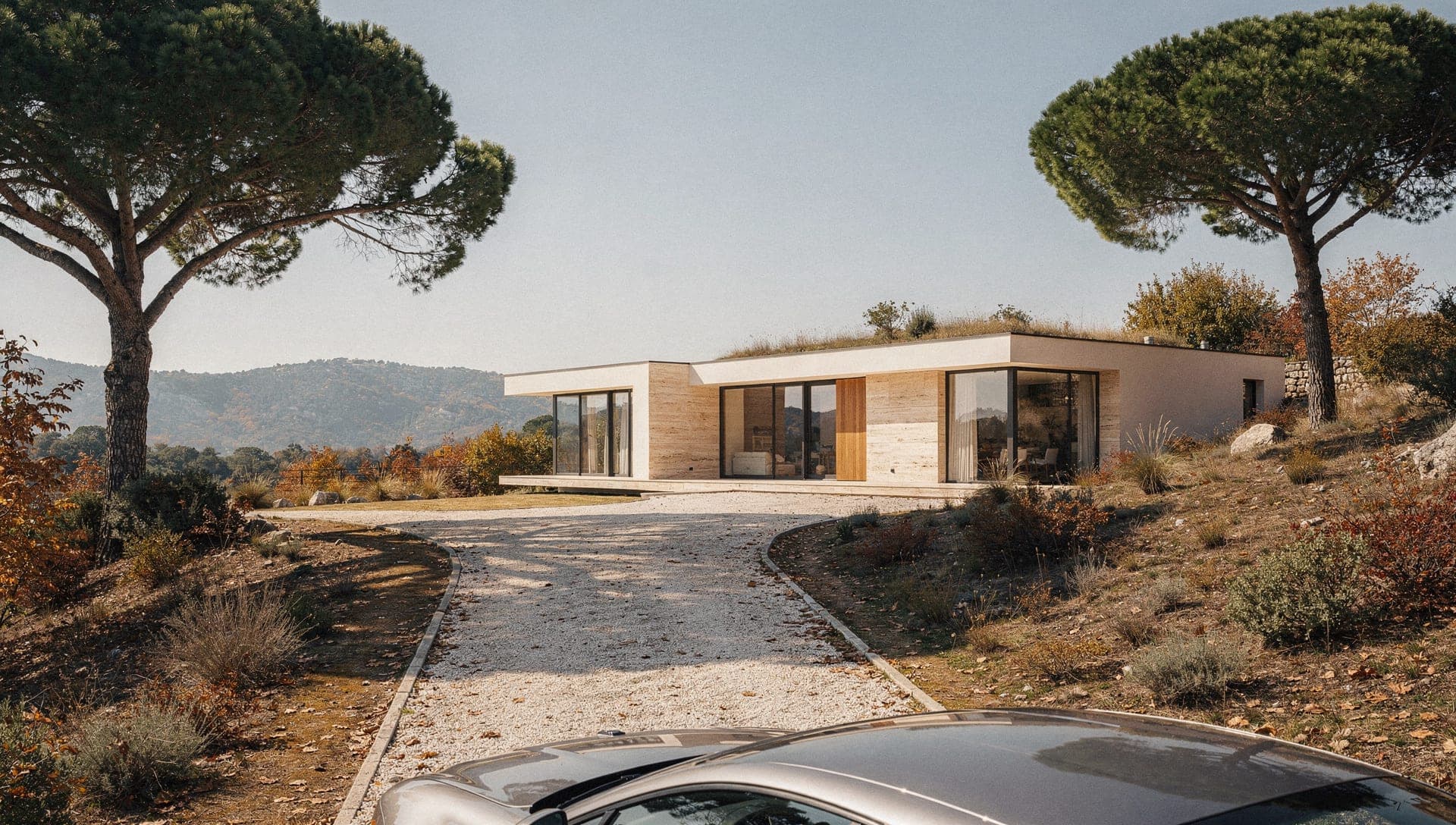
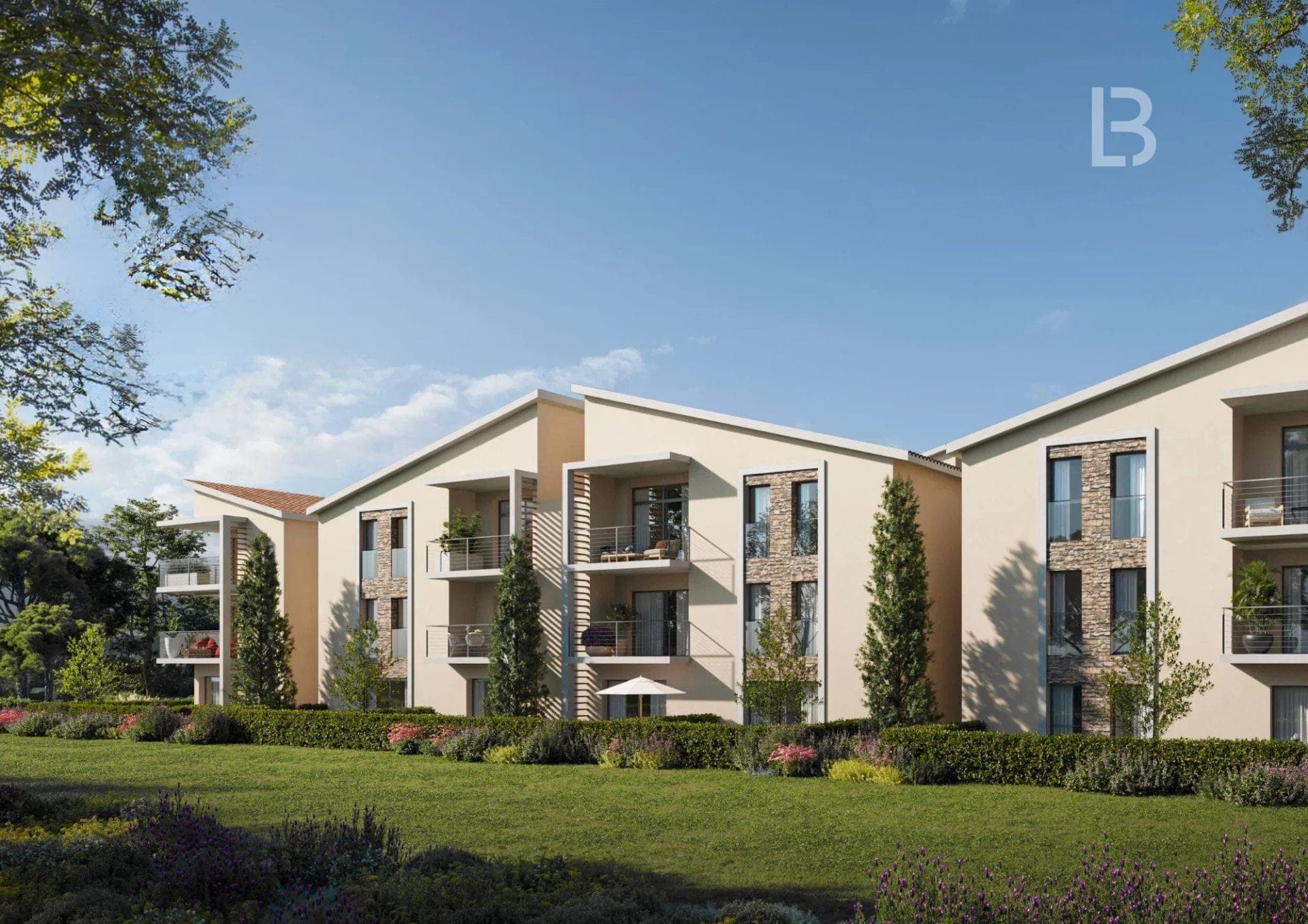
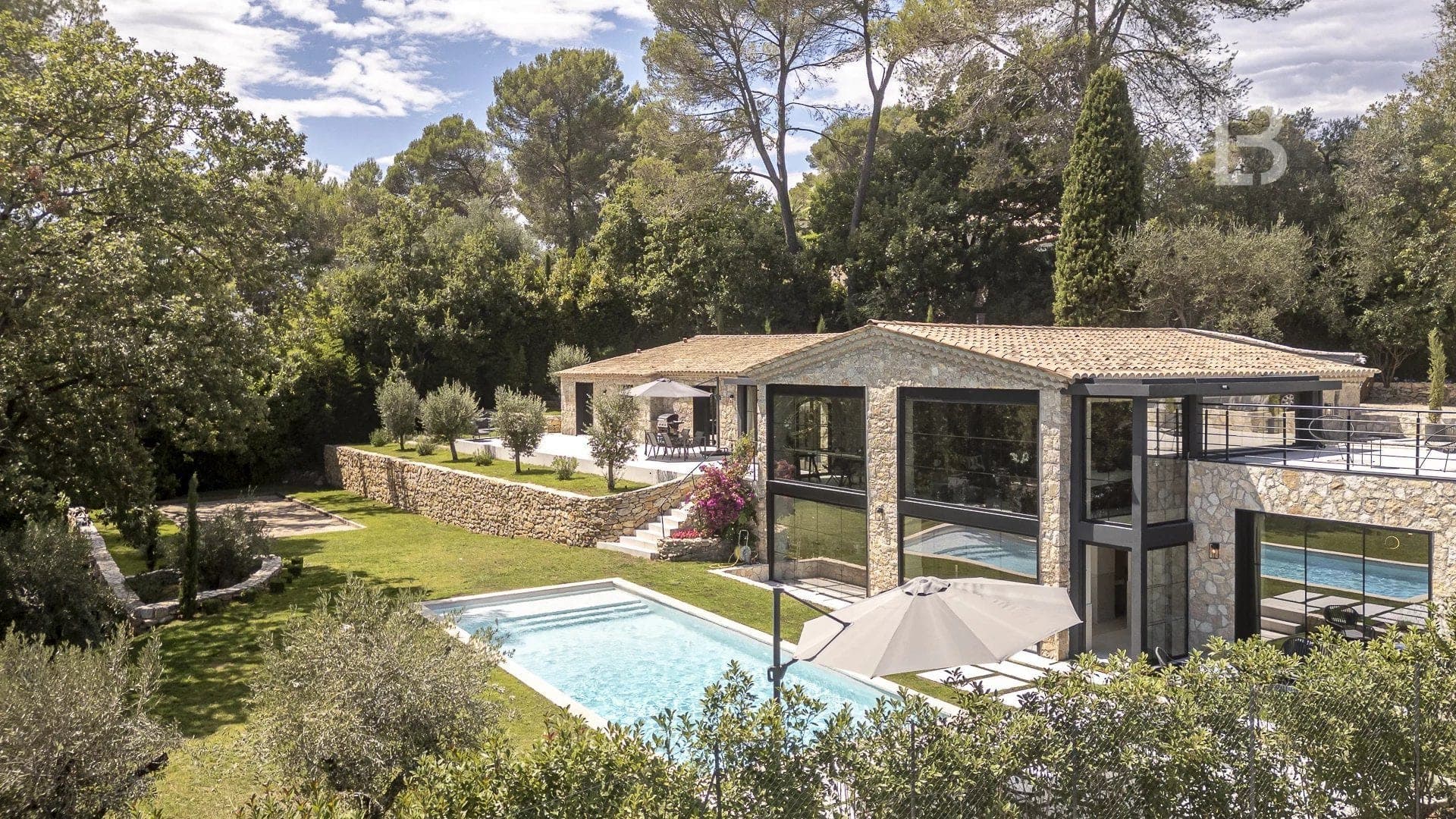
Val de Cuberte is villa country. The typical property is a detached single-family house of 150 to 280 square metres on a plot of 1,200 to 2,500 square metres, usually with a pool, a garage and a mature garden. You will find two broad eras. The first is the classic Provençal villa built between the 1970s and 1990s: pale render, terracotta roof tiles, shutters in faded blue or grey-green, and rooms that open onto a terrace facing south. The second is the contemporary rebuild or new-build, with larger glazing, flat or low-pitched roofs, and the open-plan living that younger families ask for.
Apartments are rare in the sector proper; for those you look to the village centre or the newer residences nearer Sophia. That scarcity is part of the point. People come to Val de Cuberte precisely because they want a house with land, not a flat. A word of practical advice from our team: many of the 1980s villas are structurally sound but dated inside, so factor a renovation budget of roughly €1,500 to €2,500 per square metre if you intend to modernise a kitchen, bathrooms and insulation to current standards. The bones are usually excellent; it is the finishes and the energy performance that often need attention.
Orientation and plot shape repay close attention when you view. The villas that command the strongest prices face south or south-west, hold a flat lawn near the house for children and entertaining, and keep their pool in sun through the afternoon. A steeply terraced garden can be beautiful but harder to use with young children, and a north-facing living room feels very different in February than the photographs suggest. We always walk a plot at the time of day a family would actually use it, and we encourage buyers to do the same rather than judge from a sunny midday viewing alone.
What Val de Cuberte costs in 2026
Here is the direct answer most buyers want first. As of mid-2026, expect to pay between €1.3 million and €2.2 million for a comfortable four-bedroom villa with a pool on a good plot in Val de Cuberte, and meaningfully more for a renovated contemporary property or a larger estate. On a per-square-metre basis, the sector runs roughly €7,000 to €9,000 for villas, against a Valbonne house average near €6,000 per square metre (MeilleursAgents, April 2026) and a premium peak around €7,800 per square metre noted by SeLoger in late 2025 for the best addresses.
| Property | Indicative price (mid-2026) | Notes |
|---|---|---|
| 3-bed villa to renovate, ~1,200 m² plot | €1.05M–€1.35M | Add €1,500–€2,500/m² to modernise |
| 4-bed villa with pool, good condition | €1.3M–€2.2M | The sector's core market |
| Renovated contemporary, 250–300 m² | €2.2M–€3.5M | Open-plan, energy-efficient |
| Larger estate, >3,000 m² plot | €3.5M+ | Privacy, view, sometimes guest house |
Treat these as a guide rather than a quote: condition, exact position, view and plot size move prices considerably. Remember too that French notaire fees add roughly 7–8% to the purchase price of an existing home, so a €1.6M villa costs closer to €1.72M all-in. We update these ranges quarterly as fresh sold-price data lands.
One pattern worth understanding is how little the best villas in Val de Cuberte discount. In softer market years across the wider Côte d'Azur, asking prices on coastal apartments often slip; here, a well-presented family villa with the right plot tends to hold its number because the pool of buyers, families tied to Sophia Antipolis and the CIV, refreshes every year regardless of the wider cycle. That does not mean you should overpay. It means the room to negotiate usually sits with tired, dated properties that have lingered, not with the move-in-ready houses that draw competing offers within days of listing.
The school question: CIV and international education
For a large share of buyers, the deciding factor in Valbonne is education, and the name that comes up first is the Centre International de Valbonne. Founded in 1978 by the Mission Laïque Française, the CIV is a public school inside Sophia Antipolis with around 2,300 students and international sections in English, German, Spanish, Italian, Chinese and Russian. Pupils follow the French curriculum and can sit the OIB, the French baccalauréat with an international option, alongside classmates from close to 40 nationalities. There is a boarding house for those who come from further afield.
From Val de Cuberte the CIV is a short drive or a manageable cycle, which is exactly why families relocating for Sophia Antipolis put this sector at the top of their list. Entry to the international sections is selective and demand is high, so we always advise buyers to contact the school early rather than assume a place. Beyond the CIV, the area is served by Valbonne's village primary schools and, a little further out, private and bilingual options such as Mougins School. A British family relocating for the CIV and a French-Italian couple wanting the Italian section will both find that this corner of Valbonne keeps the morning school run short.
It is worth being realistic about how the school shapes a purchase. Because the CIV draws families from across the region and well beyond, the sectors closest to it carry a built-in floor of demand that has little to do with the holiday market. Parents plan moves around the academic year, which is why we see the strongest run of viewings in Val de Cuberte from late winter into spring, as families line up a home for a September start. If your own move is school-driven, give yourself a full term of lead time: secure the school place, then the house, and avoid the trap of committing to a villa before you have confirmation your children have somewhere to study.
Sophia Antipolis on the doorstep
Val de Cuberte is, in practical terms, a residential annexe of Sophia Antipolis, and that proximity is the engine of the local market. The park stretches across the plateau immediately east, home to roughly 2,500 companies in technology, life sciences and research, employing more than 36,000 people. For anyone working there, living in Val de Cuberte means a commute measured in minutes, not hours: no motorway, no city traffic, often a route you can ride on a bike when the weather is kind, which on this coast is most of the year.
That short commute changes daily life in ways buyers often underestimate until they live it. You can be home for lunch, collect children from school without rearranging your day, and reclaim the hours that a coastal commute would swallow. It also underpins the rental market: when a senior engineer or a researcher relocates on a two-year contract, a quality villa near the park lets quickly and well. We see steady interest from corporate tenants, which makes the sector worth a look for buyers who want a home that could also hold its value as an occasional let. The presence of the park is the reason Val de Cuberte rarely sits quiet for long.
Daily life: the Friday market and village table
The centre of gravity for everyday life is Place des Arcades, the 16th-century square at the heart of Valbonne village. Every Friday morning the Provençal market fills the square and the streets around it: trestle tables of fruit and vegetables, fish, cheeses, olives, herbs by the scoopful, and the seasonal specialities that mark the year, from spring asparagus to autumn ce£ps. It is the kind of weekly ritual that turns a place to live into a community, and for Val de Cuberte residents it is a ten-minute errand rather than an expedition.
The village eats well too. Under the arcades, Café des Arcades is the long-standing spot for an evening apéro, a pizza or a salade niçoise as the square settles into the night. Lou Cigalon has carried Valbonne's fine-dining reputation for years, and around the grid you will find bistros and small Italian kitchens that locals keep to themselves. None of it is showy. That is the point of Valbonne: a place where a Michelin-level meal in Mougins is fifteen minutes away, yet the daily pleasure is a coffee under stone arches and bread still warm from the Friday market. For a household choosing between coast and hinterland, that texture of ordinary days is often what tips the decision.
Outdoors: the Brague valley and green space
One reason families stay in this part of Valbonne for decades is the green that surrounds it. The river Brague runs through the commune, and the Parc départemental de la Brague offers wooded walking and cycling trails within easy reach of Val de Cuberte. The Vallon des Vaux, a quiet valley of restored mills and old farmland north of the village, is a favourite Sunday route for walkers and trail runners. None of this requires a car: from many Val de Cuberte addresses you can be on a footpath in minutes.
For sport, the hinterland is generous. Golfers have the Opio-Valbonne course a short drive away among olive groves, with several more layouts within twenty minutes. Tennis clubs, riding stables around Roquefort-les-Pins, and the climbing and mountain-biking of the back-country are all close. And when the family wants sand, the beaches of Antibes and the Cap are roughly twenty minutes down the hill. The appeal of Val de Cuberte is that you can have a morning hike in the Brague, an afternoon on the coast, and dinner under the arcades, all from a house with its own garden and pool. That range, packed into a small radius, is what keeps demand here durable.
The seasons each have their own character, and long-term residents tend to prefer the shoulder months to high summer. Spring brings the garrigue into flower and the first long lunches on the terrace; autumn, with warm days and empty trails, is the season locals quietly love most. Even winter has its pleasures here, with bright low light, woodsmoke in the lanes and the village calm once the summer crowds have gone. A house with a garden and a pool earns its keep across all of it, which is part of why people who buy in Val de Cuberte so rarely sell.
Who buys in Val de Cuberte
Three buyer profiles dominate this sector, and recognising which one you are helps clarify what to look for. The first is the relocating family, often international, moving for a role at Sophia Antipolis and choosing Val de Cuberte for the short commute and the proximity to the CIV. They tend to want four or more bedrooms, a flat garden for children, and a move-in-ready or lightly updated villa. The second is the established Côte d'Azur household trading the coast for space and quiet, drawn by the larger plots and the village within walking distance.
The third is the long-term investor or weekend owner who values the sector's rental strength and its resilience. Because Sophia Antipolis renews demand year after year, a well-kept villa here is a steady asset as much as a home. Across all three, the common thread is a wish to live somewhere genuinely residential rather than touristic. Val de Cuberte does not perform for visitors; it works for the people who live in it. If you want a holiday-let postcode you would look to the coast, but if you want a house where your children grow up walking to the market on Fridays, this is one of the strongest addresses in the commune.
Getting around: airport, coast and neighbours
For all its calm, Val de Cuberte is well connected. The A8 motorway is reached within about ten minutes, and from there the coast opens up. Here is the practical distance picture buyers ask about most.
| Destination | Approx. driving time |
|---|---|
| Sophia Antipolis (park edge) | 5–10 minutes |
| Valbonne village centre | 5 minutes |
| Mougins | ~15 minutes |
| Antibes & the beaches | ~20 minutes |
| Grasse | ~20 minutes |
| Cannes | ~25 minutes |
| Nice Côte d'Azur Airport | ~25–30 minutes via A8 |
Two points worth knowing. First, times stretch in summer and at the morning Sophia rush, so test your own commute at the hour you would actually drive it. Second, a car remains useful in Val de Cuberte itself, since the sector is residential and spread out, even though the village and the park are both close. Bus links run between Valbonne, Sophia Antipolis and the coast, but most households here keep at least one car. For a region this well served, the trade of a few minutes' drive for a garden and quiet is one most buyers make happily.
For longer journeys the options are good. Nice Côte d'Azur is the second-busiest airport in France, with direct flights across Europe and beyond, so weekend trips home or business travel are straightforward. The TGV at Antibes and Cannes links to Paris and the wider network, and the A8 puts Monaco and the Italian border within easy reach for a day out. You buy in Val de Cuberte for the quiet, but you are never far from the rest of the world when you want it.
Buying here: process and practical tips
The mechanics of buying in Val de Cuberte are the standard French process, with a few local notes worth flagging. After an accepted offer you sign a compromis de vente, pay a deposit of around 10%, and observe the ten-day cooling-off period for the buyer. Completion at the notaire typically follows two to three months later. Budget for notaire fees of roughly 7–8% on an existing property; these are transaction taxes and fees, not an agency commission.
Two practical tips from our team. First, the energy performance certificate (DPE) matters more every year. Many older Val de Cuberte villas score modestly, and France continues to tighten rules around the least efficient homes, so read the DPE carefully and price renovation accordingly. Second, international buyers often ask whether to purchase through an SCI, a French property-holding company. It can help with succession planning and shared ownership, but it is not right for everyone and carries its own administration, so take proper advice from a notaire and a tax specialist before deciding. Whoever you are, the single best move is to get pre-approved finance and your paperwork ready before you view, because the best villas in this sector do not linger, and a buyer who can move quickly has a real advantage.
If you are buying from abroad, a couple of extra steps smooth the path. Open a French bank account early, since you will need one for the deposit and for utilities, and appoint a notaire who is comfortable working in English if French is not your first language. Currency timing matters too on a purchase of this size: a one or two percent swing in the exchange rate is real money on a €1.6M villa, so many international buyers fix their rate with a forward contract once an offer is agreed. None of this is difficult, but doing it in the right order saves weeks, and our team coordinates the moving parts so the process feels calm rather than rushed.
Is Val de Cuberte right for you?
Val de Cuberte rewards a particular kind of buyer: one who wants a real house with land and garden, values quiet and privacy, and still wants the village, the school and the workplace all within a few minutes. If that is you, few sectors on the Côte d'Azur hinterland deliver the combination as completely. You pay a premium over the Valbonne average for it, but you are buying scarcity, position and a daily life that holds up over years rather than a single sunny week.
It will suit you less if you want a turnkey holiday flat, nightlife on your doorstep, or a sea view from the terrace. For those, the coast or a hilltop village such as Châteauneuf-de-Grasse may fit better, and we are happy to point you there honestly. But for families relocating to Sophia Antipolis, for households trading coastal bustle for space, and for buyers who measure a home by ordinary Tuesdays as much as by special occasions, Val de Cuberte remains one of Valbonne's most dependable addresses. If you would like to see what is currently available, or compare it with neighbouring Opio, Mougins or Châteauneuf-de-Grasse, our team knows these streets house by house.
Frequently Asked Questions
Frequently Asked Questions
Need personalised guidance?
Our team knows every street and every sector across the hinterland.