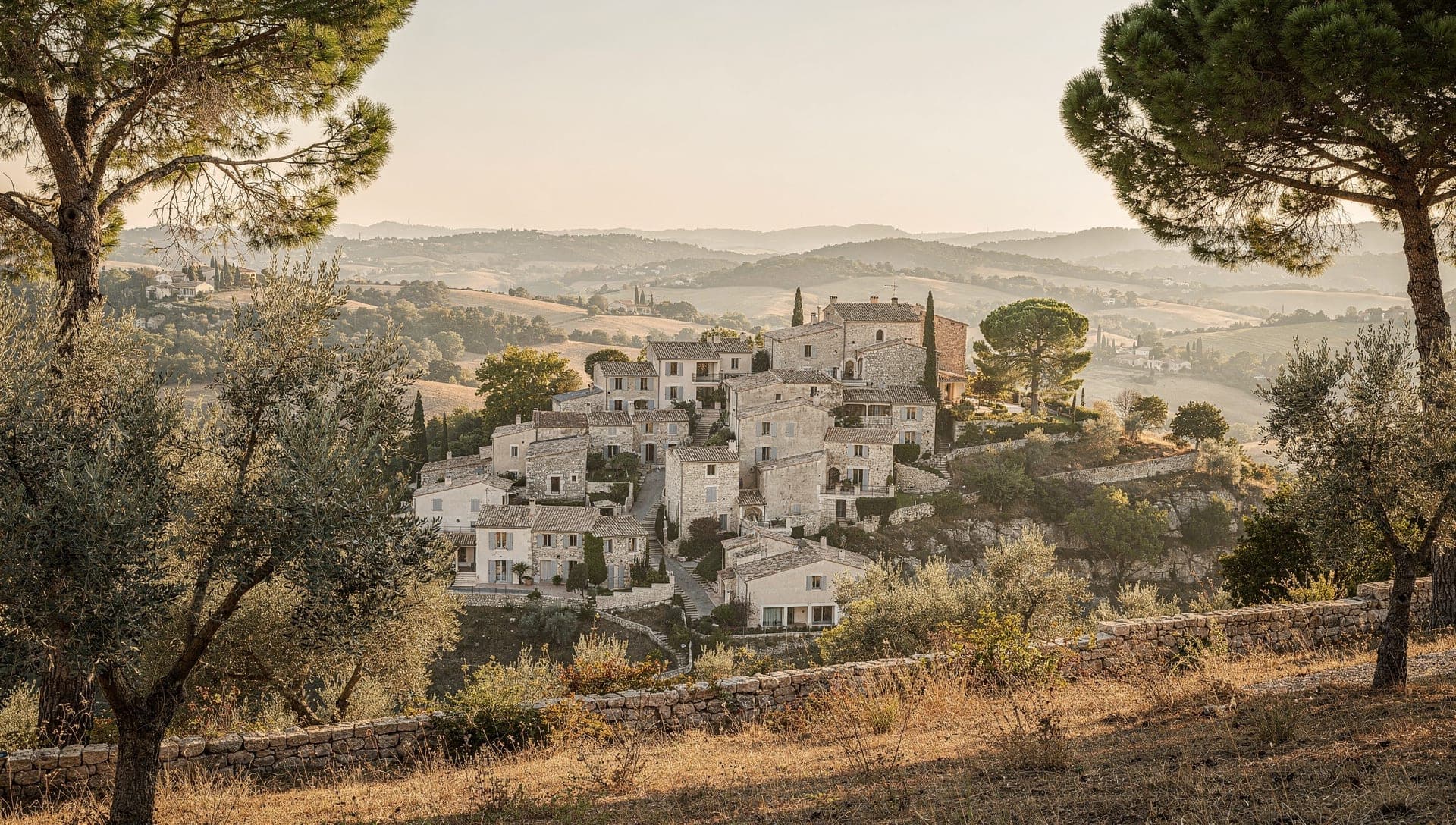
Why walkability matters here
Quick answer: Valbonne village is the most walkable address of the eight communes we cover. Its 16th-century grid, about 350 by 250 metres, holds bakeries, butchers, pharmacies, a small supermarket, the Friday market, a primary school and restaurants, all within a five to ten minute walk. Mougins village works on foot for restaurants and evening strolls but has no pharmacy, supermarket or school inside the walls. Biot is walkable with a climb, Grasse old town is walkable on the flat and steep everywhere else, and most residents still keep one car per household.
Most people move to the Côte d’Azur hinterland for a house and a garden. After a year or two, they notice something they didn’t expect: the days they love most are the ones spent on foot. Walking to the Friday market for tomatoes. Walking the children to school. Walking to a friend’s apartment for an apéro and not worrying about driving home. That low-key, car-free rhythm is rarer than the brochures suggest. Plenty of villages look pretty from a distance but require a car for everything practical once you’ve moved in.
Clients relocating from London, Paris, Geneva or Singapore ask us this all the time. They’ve spent ten or twenty years walking everywhere, and they don’t want to give that up because they’re moving to the south of France. We’ve spent enough time in every village from Valbonne to Le Rouret to have a clear view of which ones deliver that life and which ones only look the part.
This piece is a working map of walkability across the hinterland. Where your daily errands work on foot. Where the school run works without a steering wheel. Where you have dinner with wine and walk home. And, importantly, where none of that works, because some of the prettiest villages around here are also the least practical to live in day to day. We’ve used the same eight towns we cover across the site: Valbonne, Mougins, Biot, Grasse, Opio, Roquefort-les-Pins, Châteauneuf-de-Grasse and Le Rouret.
What 'walkable' means in the hinterland
In a Parisian context, walkable means a metro stop within five minutes and groceries on every corner. In our hinterland the bar sits lower, but the question is the same. Will your normal week work without your car keys?
We use a working definition with four parts. First, daily essentials: a boulangerie, a small grocer (or a covered market), a pharmacy and a tabac all within a ten-minute walk of your front door. Second, social fabric: at least three cafés or restaurants you’d happily walk to, including one that’s open in the evening. Third, the school run: if you have children, either a school within a kilometre or a covered bus stop close enough that you don’t drive them to it. Fourth, what we call the 'after-dinner test'. Is the walk home from dinner easy enough that it doesn’t feel like a planned expedition, and would you want to do it?
Apply that filter to all eight towns and the picture changes. Plenty of villages have a square and a bakery. That’s the easy part. What separates the walkable ones is the density of useful things within a quarter-mile radius, and whether the streets between them are pleasant to walk on. A village might be 800 metres across in theory and still feel like a thirty-minute round trip in practice if the route involves a steep climb, a busy départementale or a pavement that disappears for long stretches.
The other variable we watch is parking. Counterintuitively, the most walkable villages are usually the worst for parking. That’s no accident. The same design made them walkable in the first place. The streets are too narrow, the historical core was built for donkeys, and the local mairie has spent decades pushing cars out to dedicated lots on the edge. When clients tell us they want walkability and easy parking at the same address, our answer is usually that they need to pick one.
Valbonne village: the gold standard
If you’re optimising for walkability in the hinterland, Valbonne village is the answer. The historical centre is a grid, which is unusual in this part of France, where most villages spread organically around a hill. It dates from 1519, when Augustin Grimaldi, abbot of Lérins, had the village rebuilt beside the old abbey on a grid plan. Streets run at right angles, the central square (Place des Arcades) is exactly that, and the whole thing fits inside a rectangle roughly 350 metres by 250 metres. You walk the full perimeter in under ten minutes and never once feel out of breath.
What sits inside that rectangle is what makes the difference. Boulangeries, boucheries, a fromagerie, a fishmonger, pharmacies, a small supermarket for the unglamorous staples, a wine shop, and a Friday morning Provençal market that takes over Place des Arcades and the adjoining streets. There’s a primary school inside the village, and a covered bus stop on Avenue Frédéric Mistral that serves the Campus International de Valbonne (CIV) and most of the Sophia Antipolis private schools.
For dinner, you’d struggle to do better than Lou Cigalon, the long-standing fine-dining table on Boulevard Carnot. The village has several more relaxed tables around Place des Arcades, all within a few minutes’ walk of one another. If you live inside the village or on the immediate fringe (Avenue de la Libération, Avenue Saint-Roch, the streets running down to Chemin de la Bouilide), the after-dinner test passes without question.
Pricing reflects this. A two-bedroom apartment in the historical core trades in the €700,000–€900,000 range, depending on terrace and exposure. The village lieu-dit records too few house sales of €1M or more for a DVF figure. Houses inside the village proper are rare and rarely come to market quietly priced. Most listings we see start at €1.5 million. For families willing to walk five minutes uphill, the sectors immediately above the village (Saint-Roch, the lower slopes of Peyniblou) give you walking access at house-rather-than-apartment prices.
The downside, predictably, is parking. Residents queue for permits, and Place des Arcades is permit-only most of the week. If you don’t have a private space, factor in either a daily walk from the public lot on Avenue Frédéric Mistral or the patience to wait for a permit. Most of the village’s permanent residents adapt within a month. Most of them also stop using their car for anything inside a three-kilometre radius, which is part of why they bought here in the first place.
Mougins village: smaller, prettier, less practical
Mougins village is one of the most photographed places in the south of France, and for good reason. The medieval core spirals up a small hill, with restaurants and galleries tucked into pale-stone houses, the whole thing topped by a clocktower and a 360-degree view that runs from the Estérel mountains to the Bay of Cannes. We send a lot of weekend visitors here. We’re also honest with prospective buyers about what living there involves.
The village proper is small, perhaps 250 metres across at the widest. Within it you’ll find seven or eight restaurants (La Place de Mougins among them), two or three small épiceries selling olive oil and tomatoes at tourist prices, an excellent ice-cream shop in summer, and one boulangerie that closes on Wednesdays. There is no pharmacy, no real supermarket, no tabac and no school inside the village. For all four, you drive (or take a steep walk down) to the Tournamy commercial area below.
That distinction matters. Mougins village works beautifully as a walkable address for the daily things you enjoy doing: coffee, lunch on a terrace, a glass of wine before dinner, a 15-minute stroll round the loop. It doesn’t work as a walkable address for the daily things you have to do. Most permanent residents we know in the village proper buy their groceries weekly at Carrefour Tournamy and walk down to the village in the evenings.
For families, Mougins British International School sits on the Font de l’Orme side of the commune, a drive from the village, so the school run means the car.
Prices reflect the unusual mix. Inside the village walls, recorded sales are too few to publish a price per square metre, so treat any figure you are quoted as an asking price, and expect the view and the southern face to carry most of it. A buyer asking us about Mougins village should know they’re paying for the view and the address, not for daily-life walkability. For that, they should look at Valbonne, or treat Mougins village as a second home rather than a primary residence.
Biot village: the artisan circuit, with a climb
Biot is one of our personal favourites among the eight towns, and one of the most underrated by international buyers. The village has the bones of medieval defence, with a hilltop core, narrow streets and two main gates. Its identity, though, is handmade work: pottery for centuries, and glass since the 1950s. The Verrerie de Biot sits right below the village, and smaller ateliers and ceramicists work in the streets above.
Walkability inside the village is good. Place des Arcades (Biot’s, not Valbonne’s: there are two in the hinterland) holds the weekly market on Tuesdays. Within a 200-metre radius you have bakeries, a small grocer, a butcher, a pharmacy and a primary school. The café on the square is the village’s main social hub. For dinner there’s Les Terraillers, the Michelin-starred mainstay below the village (one star in the 2026 guide), plus more relaxed tables in the lanes.
The catch is the climb. The village sits at the top of a steep approach, and the route from the public car parks to the village square involves either a fairly aggressive set of stairs or a long curve up by road. Daily life inside the village is flat once you’re there. Getting in and out is not. Older clients sometimes love the idea of Biot and reconsider after walking up from the parking area in August heat.
The school question is more flexible than in Mougins. The primary school inside the village handles French-system children fine. For international schools, most families either send a child to CIV in Valbonne (10 minutes by car) or to Mougins British International School (15 minutes). Both are realistic school-bus routes from the lower streets of Biot.
Pricing here suits walkable village living on a measured budget. The old village records no house sale of €1M or more on DVF over 2021–2025, and small houses inside the village walls (rare, but they exist) sometimes sell under €700,000 if they need work. For buyers who care about culture and texture more than view, and who don’t mind the climb, Biot offers more walking-distance daily life per euro than almost anywhere else we cover.
Grasse Old Town: walkable on the flat, vertical everywhere else
Grasse is the most complicated case on this list. The Old Town has serious density: perfumeries, cafés, food shops, a Saturday market on Place aux Aires, a Wednesday morning market on Cours Honoré Cresp, and more daily essentials than you would expect from a town of 51,000 people. By the four-part definition above, Grasse is walkable.
What you have to know before buying here is the topography. Grasse is built on the side of a hill, and the Old Town is a series of stepped streets, narrow alleys and small squares connected by stairs. Walking from Place aux Aires up to Cours Honoré Cresp is a real climb. Walking from there down to the cathedral is another one. A simple errand often involves 80 vertical metres of up-and-down.
For a fit buyer in their thirties or forties, this is part of the appeal. For a family with a stroller, or an older buyer thinking about the next twenty years, it’s a significant practical issue. We always walk clients through their likely route between the apartment they’re considering and the two or three places they’d visit most often (boulangerie, café, market) before they make an offer.
The reward for accepting the verticality is price. A character apartment with original tomettes, beams and a small terrace inside the Old Town still sells for under €400,000. The same property on the same footprint in Valbonne would be €700,000–€900,000. That gap is why we see more young buyers and creative professionals here than anywhere else we cover.
For specifics: La Bastide Saint-Antoine, Jacques Chibois’s restaurant (listed in the 2026 Michelin Guide, with no star), sits at 48 avenue Henri Dunant, on the edge of the centre. Closer in, the Old Town has several reliable bistros for lunch. The Old Town also stays lively in the evenings, more so than most of the hilltop villages on this list, which empty out after 9 pm.
Le Rouret and Châteauneuf-de-Grasse: small squares that work, and one that doesn’t
The two smallest village centres on our coverage list are Le Rouret and Châteauneuf-de-Grasse. They handle walkability in opposite ways.
Le Rouret has a single working square and a weekly market that’s smaller than Valbonne’s but feels more local. Within 200 metres of the square you have a boulangerie, a small butcher, an épicerie, a pharmacy, the mairie and the primary school. There’s a restaurant on the square and another, the long-loved Le Clos Saint-Pierre, a short walk away on allée des Anciens-Combattants, where the young chef Augustin Dupuis now cooks for the owners, Catherine and Daniel Ettlinger. We’ve sent dozens of clients here in the last two years who were looking for a smaller-scale Valbonne and found Le Rouret a comfortable fit. The square is flat, the routes are gentle, and the after-dinner test passes easily.
Châteauneuf-de-Grasse is the harder case. The village is famously beautiful, a hilltop perché with panoramic views west across to Grasse and south to the sea. The village proper, though, is tiny, often called a hameau rather than a village in local conversation. The walkable core is essentially the square below the church and the streets that radiate from it. You have a boulangerie, a small grocer, a restaurant, and that’s effectively the daily menu. There’s no pharmacy, no school inside the village, and the slope down to Pré-du-Lac (where most of the daily-life infrastructure sits) is not a route you’d walk regularly.
Châteauneuf works as a walkable address only for a particular kind of buyer: someone who values the village atmosphere for evening walks and Saturday mornings, but accepts that the weekly routine will involve driving to Opio, Le Rouret or Valbonne for groceries, schools and most appointments. For that buyer, Châteauneuf is one of the more rewarding addresses we sell. For a buyer who wanted to live without a car, it’s the wrong choice, and we’ll say so.
Opio and Roquefort-les-Pins both belong in a different category altogether. Both have village centres, but in both cases the centre is a small administrative core surrounded by a much larger pattern of detached estates set back from the road. We don’t classify either as walkable in the daily sense. They’re driving communes where you occasionally walk to the bakery if you live within a few hundred metres of the mairie.
Our walkability checklist: how to test an address before you buy
When clients ask us to evaluate a specific property for walkability, we do five things on the visit itself. These are simple, take about an hour, and almost always change how the buyer feels about an address.
First, we walk to the nearest boulangerie. Not drive. Walk. We time it both ways at normal pace. If the round trip is more than 25 minutes for a morning baguette, the address fails the daily-life test even if it scores well on every other front. Second, we walk the same route at 9 in the evening, in summer if possible. Streetlighting, foot traffic and pavement condition all matter more after dark than they do at midday. Third, we identify the school the children would attend and we walk that route too. If the route includes any uncrossed stretch of D-road, the parents will drive. Always.
Fourth, we look at parking. Specifically, where the resident would park their second car if the property has only one private space. A village that requires you to find a free public spot every evening adds friction to every plan, and over time that friction kills the walkability. Residents start driving because parking is 'annoying tomorrow morning'. Fifth, we ask the seller or agent which restaurant the previous owners walked to most often, and we go there. The honest answer reveals more about the address than any market report.
We also ask buyers to make a small list before they fall in love with anywhere. What are the five things they’d want to walk to most often? Bakery, café, school, pharmacy, friend’s house, gym, train station, wine shop: the five vary by person. Then we measure each. If three or more are over a 10-minute walk, the buyer is buying a driving address and should know that.
A final practical note. The walkability of an address often correlates with the difficulty of accessing it by car. Narrow streets, one-way restrictions and summer pedestrianisation help walkers and obstruct drivers, and the same family is both, depending on the moment. Most clients we sell to in the historical cores end up keeping one car for the household, not two, by the end of their first year. That’s a real cost saving: easily €4,000–€6,000 a year in France once you account for the second contrôle technique, the second insurance, the second set of pneus, parking, fuel and depreciation. Worth weighing.
What walkability does to resale
We track this carefully. Across the deals we’ve handled in the last three years in the hinterland villages, walkable village apartments (meeting the four-criteria definition above) have outperformed comparable properties on the village edge or in residential lotissements by roughly 8–12% in price per square metre at resale. We see it in the closing prices.
The mechanism is straightforward. The pool of buyers who actively want a walkable village address is large and reliably restocked. It includes downsizers from outlying villas who no longer want to drive everywhere, international buyers relocating for a quieter pace, weekenders who want to step out for dinner without a car, and retired French buyers from Paris or Lyon who explicitly look for villages with markets. None of those demographics is in decline. Meanwhile, the supply of genuine village-core properties is finite. Nobody builds new ones inside a 16th-century perimeter.
The resale advantage is strongest in Valbonne and Mougins, where the buyer base is deepest. It exists, more variably, in Biot and Grasse Old Town. It largely disappears in addresses where 'village' turns out to mean 'near the village but not in it'. Those properties trade like the lotissements they functionally are.
A specific number, for context: a 75 m² two-bedroom apartment inside Valbonne village walls bought at €580,000 in 2019 sold for €795,000 in early 2026 in a deal we represented. That’s a 37% gross gain across seven years, against a hinterland-wide average of roughly 25–28% over the same period for comparable apartment stock. The difference is partly the village address itself, partly the unrenovated state it was in when bought, but mostly the depth of demand for that specific kind of property when it comes back to market.
For buyers thinking about a 5–10 year horizon, that’s worth knowing. Walkability is a lifestyle preference, and in the hinterland market it is also a measurable asset characteristic.
So which village should you choose?
The short version, for buyers who want a properly walkable address and ask us where to start:
If you want the most complete daily-life walkability (markets, schools, restaurants, social life, an evening rhythm), Valbonne village is the answer. Pay the price premium, accept the parking constraint, and you’ll get a way of living that nowhere else on this list quite matches. For families relocating with school-age children and choosing between CIV and Mougins British International School, the village is the default sensible starting point.
If you want walkability with a hilltop view, and you’re using the property as a second home or a retirement base where weekly errands aren’t the issue, Mougins village or Châteauneuf-de-Grasse will reward you more. Both are extraordinary places to wake up in the morning. Both demand that you treat the car as part of the weekly rhythm rather than something you leave behind.
If you want walkability at a more accessible price, Biot village or Grasse Old Town give you the best ratio of walking life to euro spent. Both have real character, and both demand more of you physically than Valbonne does. Biot suits buyers drawn to its glassmakers and ateliers. Grasse suits those who want density and a younger crowd that goes out in the evening.
If you want a smaller, more local rhythm (a single square, a market morning that everyone shows up to, neighbours who recognise the children), Le Rouret is the under-the-radar pick. We’ve placed more families there in the past 18 months than in any year previous. It’s a quieter, more rooted version of the Valbonne formula, at a price that still allows for a freehold house rather than a village apartment.
The wrong move, in our experience, is choosing a 'village' address that turns out to be a lotissement 800 metres from the mairie. The aesthetic is the same in photos. The life is not. We’d rather a client buy a house on the right street in Biot than a marketing-brochure village address that quietly requires the car for everything.
If you’re working through this question and you’d like to walk an address with someone who knows the route, that’s what we’re here for. Send us the listing, or even the postcode, and we’ll tell you straight whether the walkability claim holds up. Take a look at our town profiles for Valbonne, Mougins, Biot, Grasse, Opio, Roquefort-les-Pins, Châteauneuf-de-Grasse and Le Rouret for the full sector breakdowns.
Sources
Sources
Market data and demographic claims in this article are anchored to the following primary sources:
- DVF (Demandes de Valeurs Foncières), data.gouv.fr for every price and transaction figure.
- INSEE for demographic, household and employment data.
- Notaires de France for quarterly market commentary and regional commentary.
- service-public.fr for legal and procedural references (Notaire, Compromis, Acte authentique, taxes).
- ADEME for energy-performance (DPE) regulatory context.
Published by La Reserve Research. Editorial governance and correction policy: editorial standards. Corrections: contact@lareserve.co.