Why spring changes everything in Grasse
Quick answer: Spring (mid-March to June) is the best time to view property in Grasse. The flower fields come into bloom, café terraces reopen, and many sellers list in spring, so you have a wider choice. Grasse is the perfume capital and the hinterland’s value entry point, with a 2025 DVF median of €6,212/m² for houses sold for €1M or more (see the Price Index).
Grasse in winter is quiet. The narrow streets of the Vieille Ville empty by five o’clock, the stallholders pack up early, and the perfume houses keep shorter hours. It is still pleasant. The light is lovely and long-term residents value the calm. But winter does not show you the whole town.
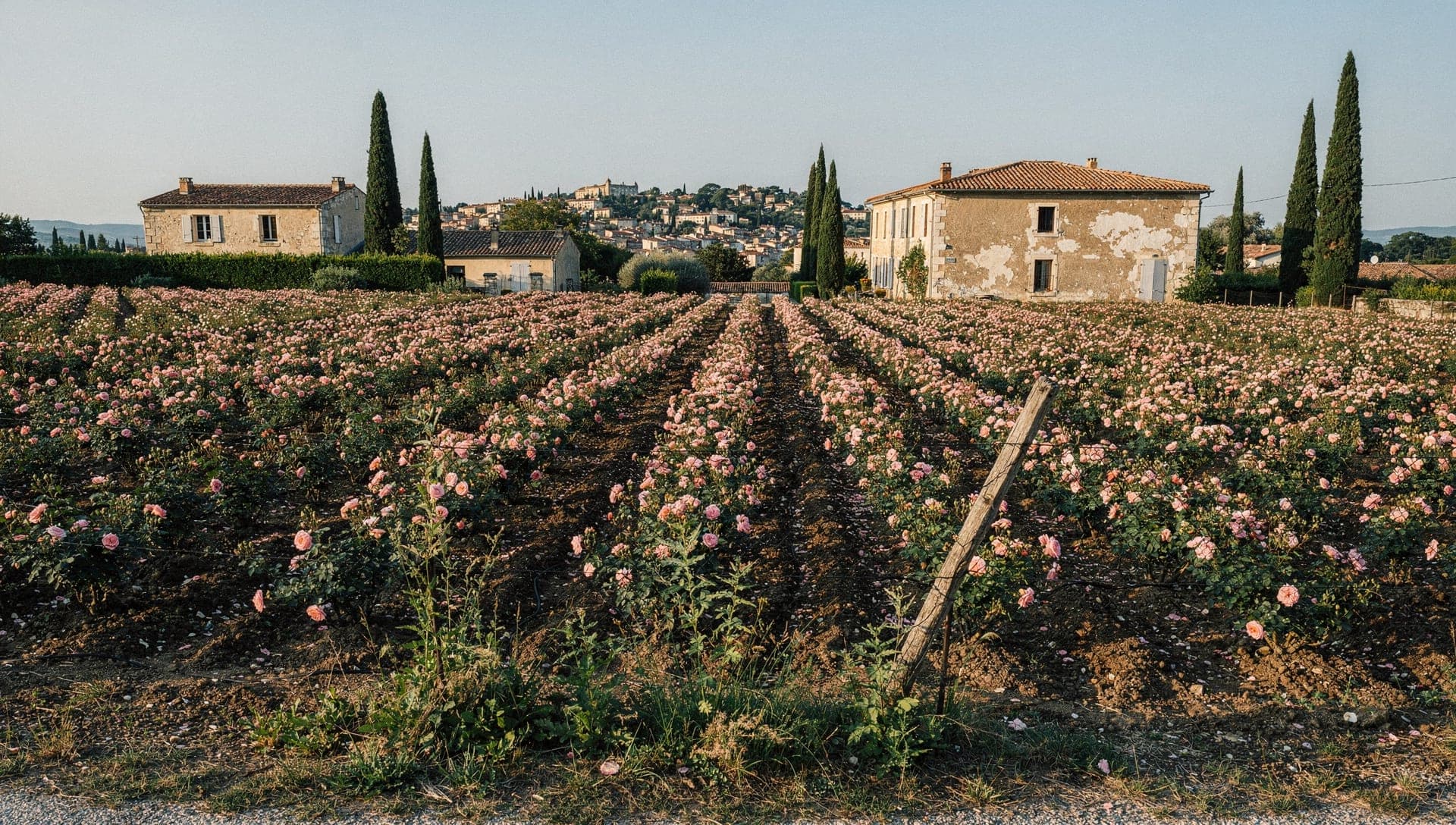
Spring is different. By mid-March, the café terraces on Place aux Aires are fully open again. The flower fields around the town, planted with rose, jasmine, tuberose and lavender, start their growing cycle. Even the air changes. Stand on the terrace of a house on the south-facing hillsides, look south towards the sea, and once the haze lifts you pick out the Îles de Lérins.
For buyers, spring also matters for practical reasons. Gardens are in flower, so you see a property’s outdoor space at its best. Between 10 am and 4 pm the light is strong enough to show up damp on north-facing walls or structural wear that winter shadows tend to hide. Above all, you view houses in the season you will use them most: on the terraces, by the pool, with the doors open to the garden. A house that feels dark in December often feels like a different place in April.
"We always tell clients: if you only visit once, come in late April or May. You will see the property the way it is meant to be lived in, and you will understand why people fall for Grasse."
Many sellers list in March so that their homes are on the market for the spring viewing season. For buyers, that often means a wider selection than in winter.
ExpoRose 2026: dates, programme and what to know
ExpoRose is Grasse’s annual rose festival, and the 2026 edition runs from May 8 to 10. If you visit for one weekend, make it this one, when the town is at its busiest.
Expect roses on display in the Old Town streets and the gardens of Villa Fragonard. The pink umbrellas the festival is known for are back: 2,800 of them hang above the alleys, so walking through feels like walking under a ceiling of petals. The whole centre turns into an open-air stage, with art installations, live music, perfume workshops and screenings.
In the gardens of Villa Fragonard, the international rose exhibition brings together growers, designers and local producers, and the programme adds workshops, demonstrations and concerts. Book workshops early through the Pays de Grasse Tourisme website.
ExpoRose 2026: key details
- Dates: May 8–10, 2026 (Friday to Sunday)
- Location: Grasse Old Town, Villa Fragonard gardens, Cours Honoré Cresp
- Cost: Free to walk the streets and the open-air market. The rose exhibition at Villa Fragonard costs €5 (€3 reduced, free under 6). Some workshops require advance booking.
- Getting there: Street parking in the centre is scarce, so arrive early.
- Tip: On Saturday morning, ExpoRose coincides with the regular Place aux Aires market. Arrive by 9 am to see both.
ExpoRose matters for property too. No other weekend brings as many international visitors to Grasse at once. We have seen several purchases start with a long weekend at ExpoRose. One British couple browsed the market stalls, stopped for lunch on Cours Honoré Cresp and asked, almost in passing, about the renovated townhouse across the square. Three months later, they owned it.
The markets: Saturday mornings on Place aux Aires
If you want to know what daily life in Grasse feels like, go to the Saturday market. Skip the tourist version and find the real one, where the same woman has sold goat’s cheese from her farm in Cabris since before you were born.
Place aux Aires, the long sloping square with its fountain and plane trees, hosts the main market every Saturday morning, together with nearby Place Morel. It runs all year, but the stalls are at their fullest in spring. By April you will find the first local asparagus, strawberries from the Var, bunches of wild garlic, fresh fèves (broad beans) and the small courgette flowers you fry in batter for dinner. Flower sellers carry armfuls of peonies and anemones, and there is local olive oil and honey from hives in the hills above Cabris.
The Cours Honoré Cresp, a few minutes’ walk away, holds its own market on Wednesday and Thursday mornings. Between them, you buy fresh produce three days a week without driving to a supermarket. For the families and retirees who settle here, that detail makes a big difference to daily life.

A tip from our team: park at the Parking Honoré Cresp (covered) and walk up through the Old Town. You pass the 12th- to 13th-century cathedral and the Musée International de la Parfumerie, then reach Place aux Aires from the top. From there you get the best view of the market below, with the hills falling away to the south.
UNESCO perfume heritage and what it means for property
In November 2018, UNESCO inscribed "the skills related to perfume in Pays de Grasse" on its list of Intangible Cultural Heritage. The listing covers three things: growing perfume plants, processing natural raw materials, and the art of composing perfume. The decision mattered for the town’s culture, and for its economy as well.
In practice, UNESCO status means recognition of a living heritage. The know-how of the growers who work the flower fields around Grasse, the same fields you will see in bloom this spring, is part of what France has committed to safeguard. Programmes are under way to revive local flower growing, with support for rose and jasmine growers who expand production by traditional methods. Training in perfumery skills is also being developed in the Pays de Grasse.
For property owners, note what the listing does not do. It protects know-how, not land, and it places no planning restriction on the fields. What limits building around them is the commune’s local plan (PLU), which zones farmland as agricultural. That zoning, and the town’s interest in keeping its flower growers, help preserve the character of these areas over the long term.
"UNESCO recognition puts Grasse on the cultural map. If you buy a villa overlooking the flower fields, check what the PLU says about the land below you before you count on the view."
The perfume industry keeps changing. Grasse Perfume Week, launched in 2025, fills a full week with scent-themed events, exhibitions and industry meetings. Research into new extraction and distillation methods is under way, and natural materials are gaining ground over synthetics. The town builds on its heritage as well as preserving it, and that brings jobs, international attention and cultural standing, all of which feed back into the property market.
Buying in Grasse: a sector-by-sector guide
Grasse is bigger and more varied than the other hinterland villages we cover. Parts of it are properly urban, others are open farmland, and the stock runs from €120,000 studios to €2.5 million bastides. Here is how the main sectors compare.
Old Town (Vieille Ville)
The historic centre is a tangle of narrow streets climbing from Place aux Aires to the cathedral and the Cours Honoré Cresp, and it is where Grasse’s character is strongest. You will find apartments in 17th- and 18th-century buildings, many with exposed stone walls, beamed ceilings and small terraces looking over the rooftops to the coast. DVF records no house sale of €1M or more in the Old Town over 2021–2025: too few to publish a figure. Across Grasse, the median for the same years is €6,132/m². Our figures cover houses, and most homes here are apartments. Much of it has been renovated in recent years, and several buildings have been restored to a high standard. It suits investors looking for rental income (short lets on Airbnb do well here during festivals) and pied-à-terre buyers who want a base in the south without the budget that coastal Antibes or Cannes demand.
Saint-Jacques
South-west of the centre, near the Pénétrante (the fast road between Grasse and Cannes), Saint-Jacques is a green residential neighbourhood that families like. Once farmland, it now mixes Provençal villas on generous plots with some newer houses. DVF records 14 house sales of €1M or more in Saint-Jacques over 2021–2025, at a median of €8,002/m², well above Grasse’s €6,132/m² for the same years. The draw is space, with plots of 1,000 to 3,000 m² common, and quick road access to Cannes (20 minutes) and Sophia Antipolis (15 minutes). Demand is growing from Sophia Antipolis professionals who want a bigger garden.
The south-facing hillsides
High on the south-facing slopes, with views running down to the Mediterranean, these hillsides draw buyers who want a villa with a wide outlook and the privacy of a bigger plot. These hillsides are not one of the sectors we map, so we publish no DVF figure for them. The houses tend to be large: four to six bedrooms, pools, landscaped gardens, and the kind of mature planting that takes decades to grow. If Mougins is beyond your budget but you want a similar feel, look at these hillsides.
Plan de Grasse
East of the centre, Plan de Grasse is the most modern and easiest sector to get around. Here you will find newer apartment complexes, some with pools and gardens. Plan de Grasse is not one of the sectors we map, and our DVF figures cover houses only. Bus links, a supermarket and everyday services are close by. For a young couple working in Sophia Antipolis or Cannes who want a first home on the Riviera, Plan de Grasse is the sensible choice. Resale values have held up well, rising broadly in line with the wider Grasse market.
| Sector | DVF median €/m², houses €1M+, 2021–2025 | Property types | Best for |
|---|---|---|---|
| Old Town | Too few recorded sales to publish a figure | Apartments, townhouses | Investors, pied-à-terre |
| Saint-Jacques | €8,002/m² (DVF 2021–2025 · 14 sales) | Villas, family houses | Families, Sophia commuters |
| South-facing hillsides | Not a mapped sector, no DVF figure | Large villas, bastides | Top-budget buyers, sea views |
| Plan de Grasse | Not a mapped sector, no DVF figure | Modern apartments, new builds | First-time buyers, couples |
Price data: what properties sell for
Grasse’s 2025 DVF median for houses sold for €1M or more is €6,212/m², the lowest of the seven villages measured on that basis and the clearest sign of its value. DVF records 14 house sales of €1M or more in Saint-Jacques over 2021–2025, at a median of €8,002/m², well above Grasse’s €6,132/m² for the same years. On this DVF measure the median moved +13% between 2021 and 2025, and −9% over the last year.
When you are deciding whether to buy, numbers matter more than adjectives, so here is what the data shows. These figures come from DVF (Demandes de Valeurs Foncières), the French government’s public record of completed property sales, for houses sold for €1M or more, all of 100 m² or more (April 2026 release).
| Metric | DVF, houses sold for €1M or more | |
|---|---|---|
| Median price / m² (2025) | €6,212 | |
| Median sale price (2025) | €1,279,750 | |
| Median price / m² (2024) | €6,800 | |
| Change since 2021 (2021–2025) | +13% | |
| 1-year change (2024–2025) | −9% | |
| Sales recorded in 2025 | 30 | |
Two points stand out. First, at this price level the yearly median has moved between €5,799 and €7,900/m² since 2022, on 17 to 30 sales a year in the last two years, so single years swing with a few large houses. Since 2021 it moved +13%. Buyers are not chasing inflated prices: read the direction since 2021 before any one year.
Second, the gap between the cheapest and the most expensive homes is wide. A studio in the Old Town sometimes sells for under €100,000, while a villa on the south-facing hillsides goes above €2 million. That range gives Grasse something for almost every budget, unlike Valbonne or Mougins, where the entry price for a family home has climbed above €500,000.
What €500,000 buys
What does half a million euros buy in each hinterland town? In Mougins, a two-bedroom apartment or a villa that needs major renovation. In Valbonne, a three-bedroom house on a modest plot. In Grasse, a renovated four-bedroom villa with a garden, or a three-bedroom townhouse with character in the Old Town, with money left over. The value gap is still wide, and it is the main reason more international buyers are looking here.
The number of sales changed after 2022: DVF recorded 33 sales of houses sold for €1M or more that year, 17 in 2024 and 30 in 2025. Across France, higher interest rates and tighter lending cooled markets after 2022. For buyers, fewer sales means less competition when you negotiate.
Schools and family life
Families relocating to the Côte d’Azur tend to pick schools first and the house second. On that test, Grasse does well.
The leading choice is Institut Fénelon, a private Catholic school under contract with the State, with a collège and a lycée. Its lycée offers the Baccalauréat Français International (BFI) in English, which replaced the OIB from the 2022 school year: pupils follow the French national curriculum and keep their English at a high level through dedicated language, literature and history classes. Families arriving from UK schools often find it the easiest bridge into the French system.
The Campus International de Valbonne (CIV), 15 minutes south in Sophia Antipolis, prepares pupils for the Baccalauréat Français International (BFI). It has six international sections: American, German, Chinese, Spanish, Italian and Russian. From Grasse’s southern sectors (Saint-Jacques and the south-facing hillsides), the drive to CIV takes 12–15 minutes.
For a fully British curriculum, Mougins British International School is a 20-minute drive south. It follows the English National Curriculum up to IGCSE and A-Levels.
Grasse also has public primary schools and collèges. For French-speaking families, or those who want full immersion, the public system here is solid. And because the town is large, you have a real choice of schools, unlike smaller hinterland communes with a single option.
Getting around: transport and connections
Grasse is 18 km from Cannes and 40 km from Nice Côte d’Azur International Airport. By car, Cannes takes about 25 minutes on the Pénétrante, a dual carriageway that makes the commute easy, and Nice airport about 40–45 minutes via the A8 autoroute.
Grasse SNCF station, on the TER Provence-Alpes-Côte d’Azur regional line, reaches Cannes in under half an hour. The line runs through the hinterland and the views are good. Regular commuters swear by it: no traffic, no parking, and Cannes station is a short walk from La Croisette.
Locally, the Sillages bus network serves the 23 communes of the Pays de Grasse agglomeration, and its ticketing is fully contactless. In town, you see the Old Town best on foot, which is part of its appeal.
Sophia Antipolis, Europe’s first technology park, with about 2,500 companies and more than 40,000 jobs, lies about 15 km south. The drive takes 15–20 minutes outside rush hour. At morning and evening peaks the Pénétrante slows down, but the commute is still faster than from many addresses on the coast.
Where to eat: spring menus and local favourites
Grasse has always been a good town for food, even if Mougins gets more attention from the gastronomy crowd. Spring menus here follow what arrives at the markets: asparagus from the Var, fresh peas, morels from the hills, lamb from Sisteron and the first rosés of Provence.
La Bastide Saint-Antoine, the town’s best-known table, occupies a bastide set among olive groves. It held Michelin stars for many years, two at its peak. It no longer has one, but the Michelin Guide still lists it, and in spring you eat on its terrace above the olive trees. The menu follows the seasons, and in April and May chef Jacques Chibois cooks mostly with local produce.
For something less formal, Le Gazan, in the old town, serves good Provençal cooking at honest prices: ratatouille, grilled fish and a carafe of rosé. For a special occasion, locals drive out to Lou Fassum, chef Emmanuel Ruz’s restaurant in Plascassier, on the edge of Grasse.
Spring also brings pop-up wine tastings and food events to the Old Town squares. The countryside around Grasse, with its olive groves and estates, is at its best in April and May.
Daily life in spring: what a week looks like
People often ask us what everyday life in Grasse is like. Here is a typical spring week, drawn from our own experience and from conversations with residents.
Monday morning starts slowly. The Old Town is quiet, the bakeries open by 7 am, and the light running down Rue Jean Ossola makes you stop and look. Many international residents work from home, and the cafés around the Cours suit them, with wifi, strong espresso and terraces that catch the sun from mid-morning.
Wednesday brings the mid-week market. It is smaller than Saturday’s, the produce is as good, and the shoppers are almost all local. French schools finish early on Wednesdays, so by noon the squares fill with children and parents heading for the ice-cream shops on Cours Honoré Cresp.
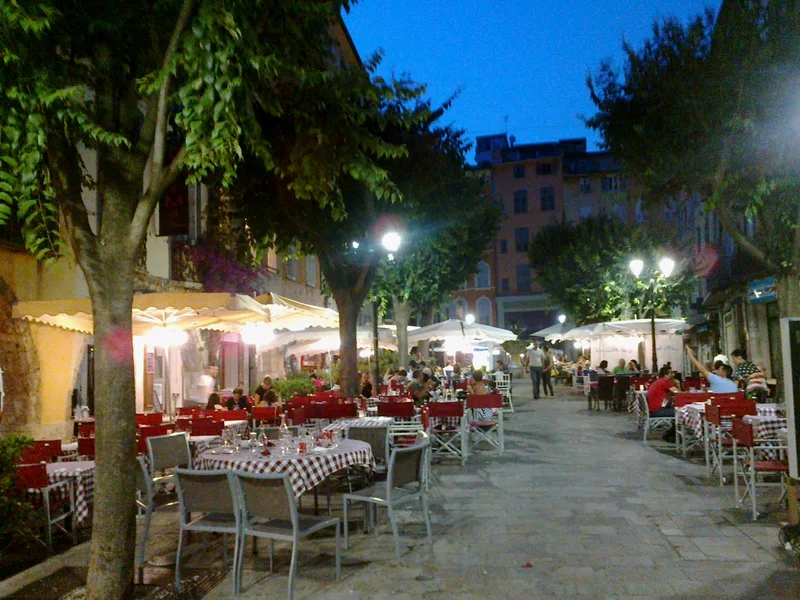
On Friday the weekend pace sets in. Restaurants start filling by 7:30 pm. In spring you eat outdoors: on terraces above the valley, in courtyard gardens hung with string lights, or in the shadow of the cathedral with a glass of Bellet rosé.
Saturday is market day. You are up early, walking the stalls, buying too much cheese and stopping for a café crème by the fountain. By 1 pm the market has packed away and the afternoon is yours: a walk on the GR51 trail through the hills above town, a swim at one of the municipal pools, or a drive down to the coast. Cannes’ beaches are 25 minutes away.
Sunday belongs to the family. The cathedral bells ring at 10 am, lunch runs until 3 pm, and perhaps you visit the Musée International de la Parfumerie or drive up to the medieval village of Gourdon for the view. The pace is slow and deliberate, and thoroughly Provençal.
Grasse vs the hinterland: how it compares
One question we hear more than most: why Grasse rather than Valbonne or Mougins? It is a fair question, and the straight answer is that it depends on what you are looking for. Here is how the three compare.
| Factor | Grasse | Valbonne | Mougins |
|---|---|---|---|
| Median price / m² (DVF 2025, houses sold for €1M or more) | €6,212 | €8,986 | €10,073 |
| Population | 50,970 | 11,939 | 19,782 |
| UNESCO status | Yes (2018) | No | No |
| Train station | Yes (SNCF) | No | No |
| International school in town | Fénelon (bilingual) | CIV (nearby) | Mougins British International School |
| Weekly markets | 3 days/week | Friday | Saturday, Sunday |
| Drive to Cannes | 25 min | 20 min | 15 min |
| Sophia Antipolis | 15–20 min | 5–10 min | 10–15 min |
| Character | Historic city, perfume heritage | Medieval village, tech hub | Gastronomy, golf, art |
Valbonne wins on closeness to Sophia Antipolis and on village charm. Mougins wins on food, golf and closeness to Cannes. Grasse offers what neither of them has: a working French town with UNESCO-listed perfume know-how, a train station, real variety in its architecture, and prices that buy you a lot more space. For a British family moving for CIV, Grasse’s southern sectors are as convenient as Valbonne. At the 2025 DVF medians (houses sold for €1M or more), a 150 m² house costs about €416,000 less than in Valbonne, money that goes into renovation, furniture or an easier first year.
For a Parisian couple buying a weekend house, Grasse’s station is a real advantage. It has no TGV, but Paris Gare de Lyon to Grasse takes one change, from TGV to TER, in Cannes or Nice, and if your home is in the Old Town you need no car at the other end.
And for a tech professional at Sophia Antipolis, Saint-Jacques or Plan de Grasse give the same 15–20 minute commute as Biot or Roquefort-les-Pins, with far more cultural life on your doorstep.
Sources
Sources
Sources used in this article:
- DVF (Demandes de Valeurs Foncières), data.gouv.fr for all property price and transaction figures.
- INSEE statistics for Grasse (commune 06069) for demographic and economic context.
- Notaires de France for quarterly and regional market commentary.
- Mairie de Grasse for heritage, planning and local references.
- ADEME for the energy-performance (DPE) rules.
Published by La Reserve Research. Editorial governance and correction policy: editorial standards. Corrections: contact@lareserve.co.