Quick read: what a pool really costs and requires in 2026
A swimming pool on a Riviera hinterland villa carries four legal costs that most buyers miss: a one-off pool tax of €251 per square metre of basin in 2026 (down from €262 in 2025) multiplied by local rates, a declaration to the tax office within 90 days of completion, a mandatory safety device under French law with a €45,000 fine for individuals who ignore it, and exposure to prefectoral drought orders that can ban filling a private pool. None of these should stop you buying. All of them belong in your offer conditions.
A pool sells a house in Valbonne, Mougins, Opio and Châteauneuf-de-Grasse, but it also sits on top of a file that the previous owner may or may not have kept properly. We see three recurring problems. The pool was built without the right authorisation. The completion was never declared. The safety device is missing, worn or not to standard. Each one can be fixed, yet each one costs money or time, and each one is a negotiation lever if you spot it before signing.
In this guide we cover the permit thresholds (10 m² and 100 m²), the 2026 tax formula with worked examples, how the tax office now finds undeclared pools with aerial imagery and AI, the four legal safety devices, drought rules, what MeilleursAgents shows for houses in eight towns, an inspection routine, and the paperwork file to demand from the seller. We close with seven short answers to the questions buyers ask us most.
One caution before we start. We are property advisers, not lawyers or tax advisers, and rates and thresholds change. Confirm anything that affects your offer with the mairie’s urbanisme department, your notaire and the DDFiP before you sign the compromis.
Permits: when a pool needs a declaration or a full permit
The permit question comes down to basin size and location. Outside protected zones, a basin of 10 m² or less needs no authorisation and carries no pool tax. Between 10 m² and 100 m², you file a déclaration préalable de travaux. Above 100 m², you need a permis de construire. In protected zones, meaning the perimeter of a monument historique (the Architecte des Bâtiments de France, or ABF, has a say), a site patrimonial remarquable or a classified site, even a basin of 10 m² or less needs a déclaration préalable. Anywhere, a shelter more than 1.80 m high calls for a permis de construire, whatever the basin size. Demountable pools that are installed without works are generally outside the tax, though the 90-day installation rule discussed below can change that.
Why does this matter in the hinterland? Because the old villages are full of protected perimeters. Grasse’s old town, the centre of Valbonne village, Mougins village and Biot’s medieval core all sit in sectors where the ABF reviews works. A pool at a house just outside the village wall can fall inside the 500 metre radius of a listed building. Ask for the actual authorisation, not reassurance.
A fixed shelter or cover changes the file. A fixed structure over 5 m² with an internal height above 1.80 m counts as taxable closed and covered surface, which means a pool enclosure can add tax on top of the basin. If the house you are looking at has a glass or polycarbonate pool house, check that it was declared too.
The permit is valid for three years and can be extended. That matters when you buy a plot or a house with a pool project that the seller started but never built. A lapsed permit does not transfer a right to build. Ask the mairie to confirm in writing that the authorisation is still alive, and check the Plan Local d’Urbanisme (PLU) of the commune, because several hinterland communes limit pool size, distance to the boundary and impermeable surfaces around the basin. The PLU may also restrict building near wooded classified zones (EBC).
Our rule of thumb: if the seller cannot produce a stamped authorisation or a certificate of non-opposition, treat the pool as unauthorised until the mairie says otherwise. Regularising later is not guaranteed, and the cost lands on you.
The 2026 pool tax: €251 per square metre and what it becomes
Pools are taxed through the taxe d’aménagement. For 2026 the flat value is €251 per square metre of basin, against €262 in 2025. The formula is simple: basin surface × €251 × (communal rate + departmental rate). The communal rate usually runs from 1% to 5% and can go up to 20% in high land-pressure sectors. The departmental rate is capped at 2.5%. Île-de-France has a regional add-on, which does not apply here. Rates are set by each commune and by the Alpes-Maritimes department, so ask the mairie for the current figure on the day you buy rather than trusting a national average.
The table below shows what the formula gives for common basin sizes. The combined rates are illustrative only. They are not the actual rates of any hinterland commune.
| Basin size | Tax base (× €251) | At 5% combined | At 7.5% combined | At 10% combined |
|---|---|---|---|---|
| 20 m² | €5,020 | €251 | €377 | €502 |
| 32 m² (8 × 4 m) | €8,032 | €402 | €602 | €803 |
| 50 m² | €12,550 | €628 | €941 | €1,255 |
| 80 m² | €20,080 | €1,004 | €1,506 | €2,008 |
Since September 2022 the tax falls due after the works are finished, at the rates in force on the date of the authorisation. You declare completion to the tax office within 90 days, and the bill follows: one payment 90 days after completion if the total is €1,500 or less, otherwise two equal instalments, the first 90 days after completion and the second six months after that. Late payment brings a 10% surcharge.
This is a one-off tax on creation. It is not an annual charge. The annual cost arrives through the taxe foncière, because a pool raises the cadastral rental value of the property. New constructions can get a two-year temporary exemption from the taxe foncière, but only if the owner files the right form (the H2) within 90 days of completion, and only if the commune has not decided otherwise. A buyer inherits whatever the seller did or did not file.
What to do with this as a buyer? If the pool is newly built (less than about three years old), ask whether the taxe d’aménagement has been paid in full. An unpaid instalment can become the new owner’s problem, so put a clause in the compromis that the seller bears every tax due for the period before the sale, and ask for the payment receipts.
Foncier Innovant: how the tax office finds undeclared pools
The French tax administration, the DGFiP, runs a programme called Foncier Innovant that was industrialised in June 2024. It compares IGN aerial imagery with cadastral records, uses AI to flag pools and other constructions that are missing from the file, and then a human agent confirms or rejects each flag. Owners receive an invitation, often by email, to regularise.
From the owner’s side, the deadlines are short. You declare the completion of works within 90 days. If you get an invitation to regularise, you have about 30 days to respond. If you do not, local taxes are adjusted without you.
For a buyer, the practical consequence is straightforward. A pool that is invisible in the cadastre today is unlikely to stay invisible. If the villa you want has a pool that the seller never declared, the new taxe foncière, and in some cases back-taxes and the taxe d’aménagement, can land on whoever holds the property when the tax office catches up. Look at the current avis de taxe foncière. It lists the built surfaces and any pool entry. If the villa has a pool in the photos and no pool on the tax notice, you have found your first question.
Do not treat this as a reason to walk away. We have seen sellers regularise before a sale, pay what is owed and hand over a clean file. That is the outcome to ask for. If the seller prefers to sell as is, price the exposure into the offer and get it written into the acte.
Safety law: four devices, children under 5, a €45,000 fine
French law has required a safety device on private outdoor pools since the law of January 2003, with the technical decree and standards following. The rule applies to buried or semi-buried outdoor private pools that are not enclosed, for family use or collective use such as residences, gîtes, hotels and campsites. It does not apply to above-ground, inflatable or demountable pools, to indoor pools or to supervised public swimming facilities.
The owner must pick one of four devices, each tied to a French standard (NF P90). A barrier (NF P90-306) is designed to stop children under 5 from entering without an adult. An alarm (NF P90-307) detects a child under 5 entering the water and triggers a siren, and it must not give false alarms. A safety cover (NF P90-308) must carry an adult’s weight and prevent accidental falls. A shelter (NF P90-309) must make the pool inaccessible when closed. Devices that meet French standards or an equivalent European standard are presumed compliant. The installer or builder is expected to supply a technical note at handover.
The penalty is the part buyers remember. ANIL, the national housing information agency, sets out the penalty: an individual who fails to equip a pool faces a fine of €45,000. A legal entity faces up to €225,000 and a possible ban on the professional or social activity concerned.
For a villa you plan to let by the week, this is not optional. Seasonal tenants include families with small children, and a missing alarm is both a legal and an insurance problem. If your plan includes letting, add a line to your offer conditions that the seller supplies the compliance documents for the safety device.
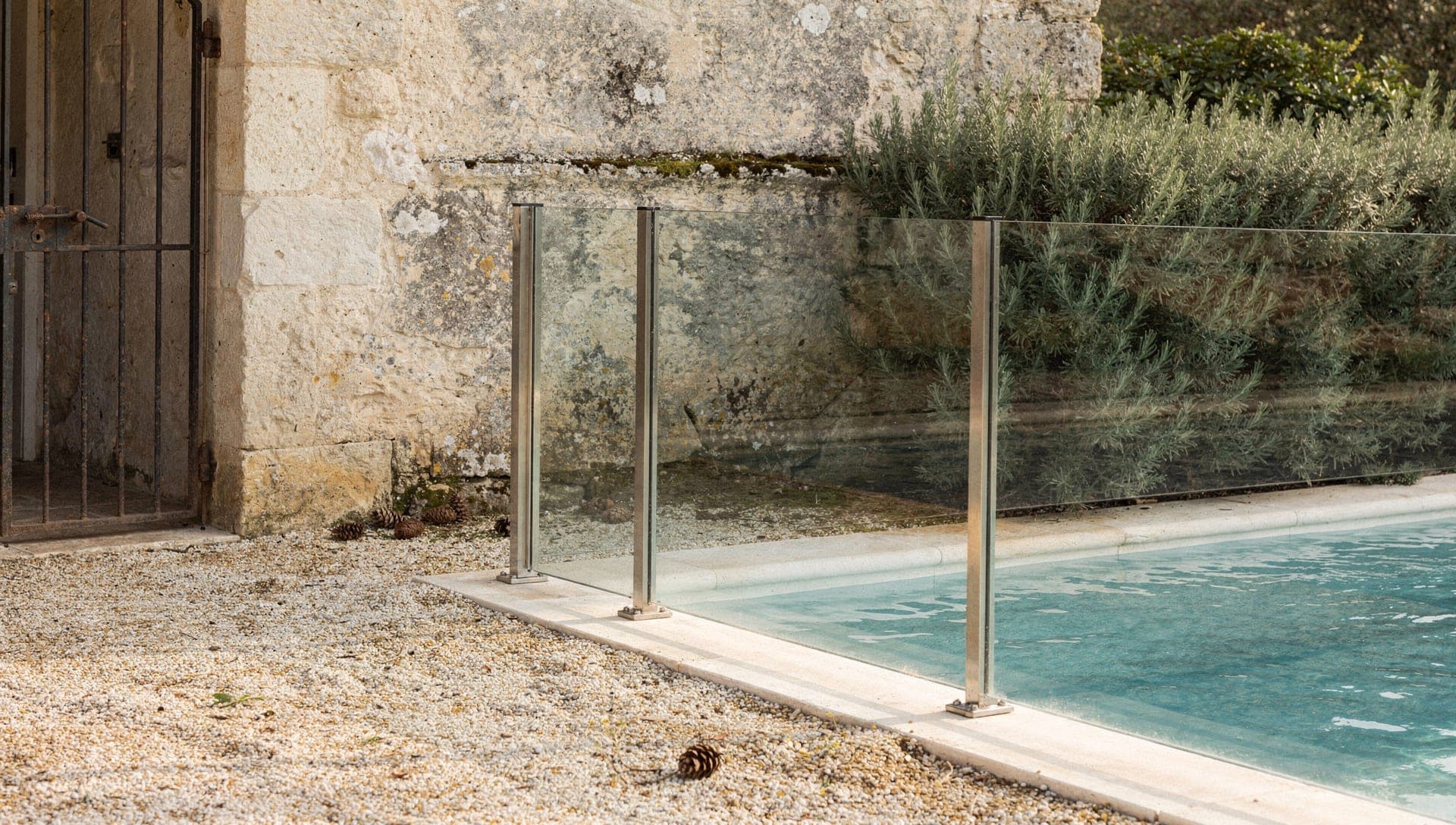
Here is what we look at on a viewing. Is there a barrier, and does the gate close on its own and latch at a height a small child cannot reach? Is the alarm a perimeter type or an immersion type, and is the control unit working? Is the cover rigid or roll-up, and does it have its anchors? Is there a brand label with the standard number? A hedge, a stone wall or a Provençal terrace step is not a device. Many older villas in Opio, Roquefort-les-Pins and Le Rouret still rely on exactly that.
Fixing a missing device is part of your negotiating arithmetic. Prices vary by pool shape and terrace, so get two or three written quotes from local installers during the option period.
Drought orders and pool water in the hinterland
The Alpes-Maritimes has been placed under water restrictions in several recent summers. During earlier orders, for example in March and April 2023, the prefect put the whole department at the drought alert stage, and the rules banned filling private pools while still allowing existing pools to be topped up. There was one exception for a first filling when the building site had started before the restrictions were triggered. Orders change from one summer to the next, so check the current arrêté on the prefecture’s website before you plan anything.
What does that mean for a buyer? Three things. First, a pool that has been emptied for winter works or repairs may not be refillable at the stage of alert in force. Second, a newly built pool near completion may sit empty for weeks. Third, evaporation and leaks are tolerated for topping up but not for a full refill, so a pool with a slow leak becomes an expensive problem in a dry year.
When you view a house in the hinterland, ask the seller when the pool was last emptied and how often it needs topping up. A pool that eats water is telling you something about the liner, the plumbing or the skimmer joint.
Our view: do not buy a villa because of the pool and then find out you cannot fill it. Treat water security as part of the due diligence. Properties on the municipal network are different from properties served by a private borehole or well, and the right to draw from a borehole is itself regulated. A property with a private well may look attractive in a drought year. Ask for the declaration of the well with the mairie and confirm that it is in order.
A cover helps. It cuts evaporation, and if you choose between a barrier and a cover as your safety device, a cover does both jobs in a dry climate.
What the price data says by town
MeilleursAgents estimates for October 2026 (1 September for Opio and Le Rouret) show a wide gap between house and apartment prices across the eight towns. That gap is where pool and land value live. We use MeilleursAgents as a market estimate, not as a transaction record. The DVF database (Demandes de valeurs foncières) lists notarised sales, but it does not flag whether a house has a pool, so there is no clean public number for the "pool premium." Anyone who quotes you one is estimating.
| Town | Apartments (€/m²) | Houses (€/m²) | House premium over apartments |
|---|---|---|---|
| Mougins | 5,181 | 7,003 | about 35% |
| Châteauneuf-de-Grasse | 4,519 | 6,679 | about 48% |
| Valbonne | 4,613 | 6,549 | about 42% |
| Opio | 5,858 | 6,464 | about 10% |
| Biot | 4,962 | 6,078 | about 22% |
| Roquefort-les-Pins | 5,561 | 5,959 | about 7% |
| Le Rouret | 4,809 | 5,348 | about 11% |
| Grasse | 3,548 | 4,222 | about 19% |
The Alpes-Maritimes department average on the same source is €5,323 per square metre for apartments and €5,665 for houses. Mougins, Châteauneuf-de-Grasse, Valbonne, Opio and Biot all sit above the department house average. Roquefort-les-Pins and Le Rouret sit just under it. Grasse, with its large inner-town apartment stock and many houses on steep, older plots, sits well below.
How to read the premium column? In Châteauneuf-de-Grasse and Valbonne the house premium is largest, and that is where pool, garden and plot size distinguish a house most clearly from an apartment. In Opio and Roquefort-les-Pins the premium is narrow. Remember also that the 95% ranges on MeilleursAgents are wide. For Opio houses the range runs from about €2,586 to €12,802 per square metre. An average tells you which neighbourhood you are in. It does not tell you what your villa is worth.
For one-year movement, the MeilleursAgents pages show houses rising at roughly 6% in Opio and Le Rouret. Treat that as indicative, since the site does not state its methodology in detail and shows the same figure for several communes. Recorded sales at the top tell a flatter story in Opio: on DVF, houses sold for €1M or more moved −1% in 2025.
Our view: do not pay a flat pool premium because a seller’s agent says so. A well-built, authorised, compliant pool with a good orientation and a covered terrace is worth more than a leaky one under a pine tree on a north slope. The same pool can be worth very little to a buyer who wants an open view and a paddock. Price the house first, then price the pool as a function of its condition and its file.
Inspecting a pool before you make an offer
Bring a short checklist to the viewing. If you are serious, hire a pool technician for an hour before the compromis expires.
Start with the shell. Look at the waterline tiles for cracks, loose joints and efflorescence. Look at the coping stones for movement, and at the terrace for hairline cracks running away from the basin.
Then the equipment. Ask to see the technical room (local technique). The pump, filter, salt chlorinator or dosing system and the control board should be accessible and labelled. Corrosion on the pipework, a pump that is noisy, or a filter tank that is patched are all signs of deferred maintenance. Ask the age of each item and request the last service invoice.
Check the liner or finish. A liner has a limited life, so ask when it was last replaced. Tiled pools last longer, but joints and adhesive age.
Check the heating and the energy bill. A heat pump works best with a cover. Look at the last annual electricity bill, and ask the seller which months the pool is heated.
Look at safety again. Does the safety device you saw on the first walk-through still look compliant when you test it? Open the gate, close it, and see whether it latches. Ask to see the alarm and press its test button. If the pool relies on a cover, ask to see it deployed.
Finally, ask about the surroundings. Pines drop needles and cones into the basin from June, a nearby fig tree attracts wasps, and trees near the wall can lift paving over time. Ask what maintenance has cost over the last two years, and ask for the invoices.
The paperwork file to ask the seller for
A clean file turns a pool from a question into an asset. Here is what we ask for, in the order we ask for it.
First, the authorisation: the décision de non-opposition to the déclaration préalable, or the permis de construire, with its dossier plans. Second, the déclaration d’achèvement et de conformité des travaux (DAACT), which proves the works were declared complete, and the certificate of non-contestation of conformity, if one was issued. Third, the taxe d’aménagement notices and payment proof. Fourth, the H2 form filed with the tax office, or the explanation of why none was filed. Fifth, the latest taxe foncière notice, to see whether the pool surface is listed.
Then the technical papers: the installer’s invoice, the technical note on the safety device and the compliance attestation, the warranty documents if the pool is recent (the garantie décennale covers structural defects for ten years from completion), and the maintenance contract, if any. Ask for photos taken during construction if the seller kept them. They show the reinforcement and the drainage that you cannot see now.
If the pool is more than ten years old, the decennial warranty will have expired, so the technical inspection matters more. If the pool was built by the seller or by a friend without invoices, put the risk into the price.
Ask your notaire to include in the compromis a clause covering the pool authorisation, the safety device and the tax status. It is normal to have a condition suspensive that is tied to the urbanisme certificate (certificat d’urbanisme or the urbanisme note issued by the mairie), and some buyers add a specific condition on regularisation. Your notaire will tell you what is realistic in your case.
The standard diagnostics bundle for a French sale does not include a pool diagnostic. That means the seller has no statutory obligation to give you a pool report, which is why the file above matters. We keep a longer treatment of the diagnostics that are mandatory in our guide on property diagnostics, and our fire-risk guide covers the débroussaillement obligation that often sits right next to the pool terrace.
Negotiation: how we price a pool
We do not like blanket rules such as "a pool adds 10%." The data we can cite do not support them. Here is how we think about it instead.
Start with the house. Use recent DVF sales for comparable houses in the same sector, and use MeilleursAgents only to check that you are in the right band. For a Valbonne house in the Val de Cuberte sector, Garbejaire or Haut-Sartoux, or a Mougins villa around Notre-Dame-de-Vie, look at sales within the last 18 months with similar built area and plot size. Ignore listings, which show asking prices.
Then judge the pool on its file and its condition. A pool with a full file, a compliant safety device and clean tax records deserves full credit. A pool with a missing DAACT or an unclear authorisation deserves a discount equal to the cost and risk of regularising it. A pool with a worn liner, a failing pump or an outdated heater deserves a discount equal to the cost of replacing those items. Use written quotes. Sellers respond better to a quote than to an opinion.
Next, consider the use case. A family buying to live in the property wants a pool that is safe, heated for spring and autumn, and reasonably cheap to run. A buyer planning seasonal lets wants a pool that is compliant, alarmed and well-covered, with a clear insurance position. A buyer who mostly wants space, a view and olive trees may value a pool at close to zero and might even want it removed. Removal is a cost too, so price it.
On timing: autumn and winter is the easiest time to book a pool technician, because nobody is racing the summer season.
Finally, keep your offer conditions tidy. Ask for the compromis to list the pool documents as annexes. Ask for the seller to warrant that the pool has been declared. Ask for a retention (séquestre) if a regularisation is under way. And never let a pool become a reason to skip a fire-safety, flood-risk or servitude check on the same plot.
Town by town: where a pool matters most
The same pool plays differently across the eight towns. Here is our short read on each one, tied to the data above and to what we see on the ground.
Valbonne. Houses at €6,549 per square metre against €4,613 for apartments shows how much plot and pool distinguish a house. The Val de Cuberte sector and the villas around Garbejaire and Haut-Sartoux have many older pools. Check the safety device on those. The international families tied to Sophia Antipolis and the Campus International de Valbonne (CIV) often rent, so rental compliance matters. Access via the A8 and the Sophia roads is quick.
Mougins. The highest house price of the group at €7,003. Villas around Notre-Dame-de-Vie and the golf sectors often come with large pools and terrace works. Large basins carry a higher tax base and, above 100 m², need a full permit. The village centre and its surroundings involve ABF review.
Biot. Houses at €6,078. Around the village and towards Sophia Antipolis you find a mix of older villas and recent residences. The old village sits in a protected perimeter, so any pool project nearby deserves a check with the mairie.
Grasse. Houses at €4,222, the lowest of the group. Hillside plots with terraces and retaining walls are common, so check the structure around the pool. Plan de Grasse and the Saint-Antoine sector offer larger plots at a lower entry cost than Mougins or Valbonne.
Opio. Houses at €6,464, apartments at €5,858, a narrow gap. Olive groves and generous plots. Check the water source and, if there is a well, its declaration.
Roquefort-les-Pins. Houses at €5,959, apartments at €5,561. A residential commune of about 7,300 people with a high share of owner-occupiers. Pools are common in the villa estates. Ask about the age of the shell.
Châteauneuf-de-Grasse. Houses at €6,679, with the largest house premium over apartments in the group at about 48%. Large plots and hillside views, with pools that are often big. Check the permit threshold, the PLU and the slope.
Le Rouret. Houses at €5,348, the second lowest after Grasse. A quieter village with plots that are often wooded. Pools there sit among pines, so factor in cleaning and the wildfire rules. Our fire-risk guide covers the débroussaillement duty.
The A8 motorway is the east-west spine, and the RD 6085 and RD 35 corridors link Grasse, Mougins and the Cannes side. A house near an A8 exit lets differently from one at the end of a narrow hillside lane.
← Part of our guide: Buying property in France as a foreigner