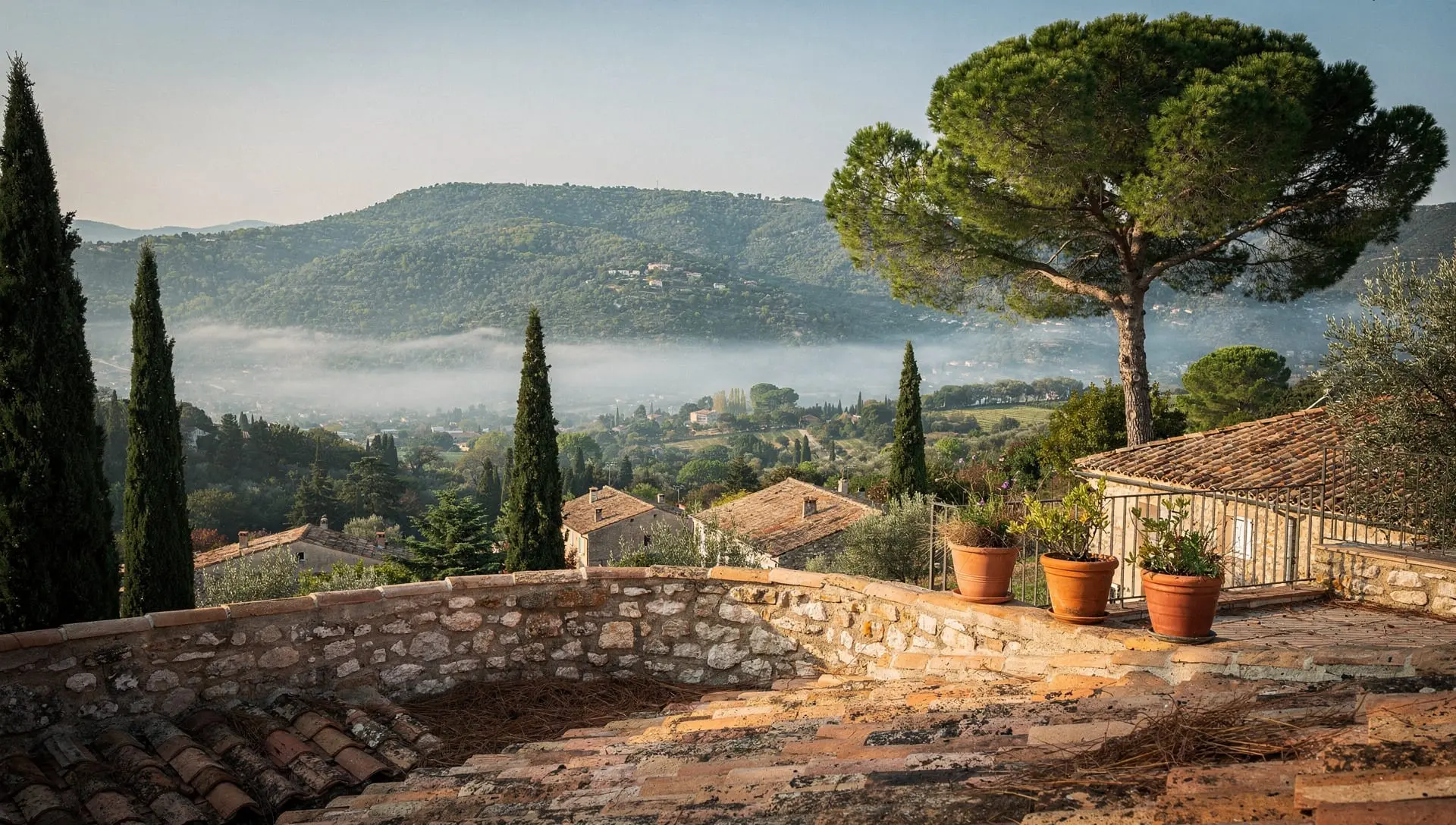
Valbonne property market in 2026: the quick read
Valbonne apartments sell for roughly €4,300 to €5,000 per m² and houses for roughly €6,100 to €7,100 per m² in October 2026, depending on which price portal you read. Our working figures are €4,600 per m² for an apartment and €6,450 per m² for a house, which are the medians of five published sources.
Prices have risen between about 2% and 6% over twelve months, with houses ahead of apartments. SeLoger shows +3.9% for apartments and +5.7% for houses, while Efficity shows +1% and +2.8%. Nobody is reporting a fall, and nobody is reporting a boom.
The sector you buy in matters more than the town average. SeLoger's sector data puts Le Village at about €6,000 per m² across all property types, and Garbejaire-Haut Sartoux at about €3,850. That is a gap of more than 55% inside one commune, because the two sectors are different products. One is a historic village with a market square. The other is a Sophia-side apartment district built around the technopole's employers.
Three forces will shape the next six months. Mortgage rates have climbed back, with Pretto putting the 20-year average at 3.66% in October against 3.17% in the first quarter. Well-priced family houses near the CIV (Centre International de Valbonne) remain scarce. And the Clausonnes redevelopment at the Sophia entrance will add coliving, offices and school space once it is delivered.
Our honest read: buyers with finance in place still have room to negotiate on overpriced stock, and almost none on the good houses. The rest of this guide shows the numbers behind that view, sector by sector.
Why Valbonne is really two markets under one postcode
Valbonne carries one postcode, 06560, but buyers who treat it as a single market end up overpaying in one half and underestimating the other. Our team sees the same mistake each season.
The first market is the village. Valbonne was refounded in 1519 on a strict grid by the abbey of Lérins, and the arcaded Place des Arcades still anchors it. Apartments in the old centre are small, often renovated, and sold on charm and walkability. Houses within a few minutes of the square are rare and priced accordingly. Residents here walk to the weekly market, the bakeries and the cafés, and they leave the car at home for most of the week.
The second market is Sophia Antipolis. The technopole was conceived by Pierre Laffitte in the late 1960s and has grown into one of Europe's best-known science parks. Around it sit residential districts such as Garbejaire and Haut-Sartoux, where apartments serve engineers, researchers and relocated families who want a short commute. Demand here follows employment, not tourism, and that changes how prices behave. These apartments sell more steadily, rent more easily, and rarely carry a view premium.
Between the two sit the wooded outlying neighbourhoods, which the statisticians group as Écarts Sud and Ile Verte-Nord-Est. This is where the family villas are, on generous plots with pools, olive trees and a driveway. Buyers here usually have the CIV, the A8 motorway and the Sophia employment zone in mind at the same time.
Why does this matter for pricing? Because portals blend all of it into one number. When a site tells you Valbonne averages €5,300 per m² across all property types, that figure mixes €3,800 apartments in one sector with €6,600 houses in another. It describes nobody's actual purchase. Always ask for the sector, the property type and the date of the data before you accept an average.
Valbonne price per m² in October 2026: what five sources say
We pulled five public price sources for Valbonne and set them side by side. None of them is wrong, but none is complete, and the gaps between them tell you how much uncertainty sits in any single figure.
| Source | Apartments (€/m²) | Houses (€/m²) | Data date | Stated trend |
|---|---|---|---|---|
| Square Habitat | 4,329 | 6,140 | October 2026 | +2.24% over 1 year (type not specified) |
| SeLoger | 4,548 | 6,421 | July 2026 (published 7 Sept) | +3.89% apartments, +5.70% houses over 1 year |
| av-transaction | 4,627 | 6,448 | 1 October 2026 | Not given |
| Efficity (resale) | 4,680 | 7,070 | October 2026 | +1% apartments, +2.8% houses over 1 year |
| Journal du Net | 5,027 | 6,738 | 28 May 2026 | 6-month figures only |
The spread is real. The lowest apartment figure is €4,329 and the highest is €5,027, a gap of about 16%. For houses, €6,140 against €7,070 is a gap of about 15%. On a 120 m² villa, that is a difference of more than €110,000 between two portals describing the same town on the same month.
Why do they differ? Three reasons. First, methods: some portals average advertised prices, some model from recorded sales, and some blend both. Second, sample size: Valbonne records a limited number of sales each year, so a handful of unusual transactions can move an average. Third, timing: the Journal du Net figures date from May, and the SeLoger figures are tagged July, while the others are October.
Our working approach is simple. We take the median of the sources, which gives €4,600 per m² for apartments and €6,450 for houses, and then we adjust for the specific sector, the condition and the plot. An average is where a negotiation starts, not where it ends.
One caution on the Efficity house figure of €7,070. It is the highest in the set, and Efficity's own page gives two different all-type averages in different places, so we treat it as an upper bound rather than a benchmark. The Journal du Net page also carries an internal inconsistency on its six-month trend, which is why we do not quote it.
Valbonne prices by sector: Le Village, Écarts Sud, Ile Verte and Garbejaire
SeLoger publishes the only sector-level split we found that follows the commune's statistical districts. The figures below come from its July 2026 data, published in September. They carry no sector trend, so read them as a snapshot of relative position.
| Sector | Apartments (€/m²) | Houses (€/m²) | All property (€/m²) |
|---|---|---|---|
| Le Village | 5,477 | 6,590 | 6,024 |
| Ile Verte-Nord-Est | 5,390 | 5,919 | 5,819 |
| Écarts Sud | 4,855 | 6,278 | 5,642 |
| Garbejaire-Haut Sartoux | 3,822 | 4,181 | 3,847 |
Le Village. The village tops the table for apartments (€5,477) and for houses (€6,590). Stock is tiny, so a single renovated townhouse sale can move the figure. Buyers pay for the arcades, the market and the short walk to everything. Expect competition for anything with outdoor space or a terrace.
Ile Verte-Nord-Est. Apartments here (€5,390) sit almost level with the village, while houses (€5,919) are the cheapest of the three premium sectors. For a buyer who wants a house within reach of the centre without paying the village premium, this is the sector our team checks first.
Écarts Sud. This is the villa sector. Houses average €6,278 per m², close to the village, while apartments are noticeably cheaper at €4,855. The land is the value driver here. Plots are generous, and so are the legal brush-clearing duties that come with them, which we cover in our fire-risk guide.
Garbejaire-Haut Sartoux. At €3,822 for apartments and €4,181 for houses, this is the accessible end. The sector sits on the Sophia side, close to employers and the RD103 Route des Lucioles axis. The all-property figure of €3,847 is about 36% below the village. It is the natural entry point for a first purchase or a buy-to-let near the technopole.
A word of caution on street-level data. The av-transaction site ranks individual Valbonne streets, with apartments around Place Sophie Laffitte at roughly €8,300 per m² and streets such as Rue Soutrane under €3,800. The site itself says this is not a district ranking and that the values are market averages. With so few sales per street, we would not price a purchase on them. Use sector data to frame the range, then use comparable recent sales to pin it down.
Houses versus apartments: the 41% premium and what it buys
On SeLoger's July figures, a Valbonne house costs €6,421 per m² and an apartment €4,548. That is a premium of about 41% per square metre for the house. The av-transaction page shows a similar 39.3% gap on its October numbers.
The per-m² comparison flatters apartments, because it ignores land. A 120 m² house at €6,421 per m² implies about €770,000. That price usually includes a plot, a pool and parking. A 120 m² apartment at €4,548 implies about €546,000 and includes a shared garden at best. Buyers are paying for outdoor space, and the premium is the market's price for it.
The rental side tells a second story. SeLoger lists average rents of €20 per m² per month for Valbonne apartments and €23 for houses. Our arithmetic on those figures gives a gross yield of about 5.3% for apartments (€240 a year per m² against €4,548) and about 4.3% for houses (€276 against €6,421). In Garbejaire-Haut Sartoux, where apartments average €3,822, the same rent would imply about 6.3%. That last number assumes the rent holds at €20, which we have not verified for the sector, so treat it as an upper estimate.
Gross yield is not net yield. Taxe foncière, co-ownership charges, vacancy between tenants and management fees all come off the top. Our guides on taxes and letting returns cover the deductions in detail. Still, the pattern is clear. Apartments near the technopole reward an income buyer, and houses reward a buyer who wants to live there.
Two practical points for house buyers. First, check the débroussaillement obligations, since Valbonne's wooded sectors fall under the Alpes-Maritimes fire rules. Second, ask for the full file of diagnostics, the pool compliance paperwork and the planning history for any extension. Unpermitted veranda enclosures come up often, and they can complicate a sale.
Valbonne against Opio, Biot, Mougins and Roquefort-les-Pins
Valbonne has a reputation as a premium address, yet its blended price is the lowest of its close neighbours. The Journal du Net data, updated on 28 May 2026, shows why.
| Town | All property (€/m²) |
|---|---|
| Opio | 5,934 |
| Biot | 5,719 |
| Roquefort-les-Pins | 5,486 |
| Mougins | 5,427 |
| Mouans-Sartoux | 5,312 |
| Valbonne | 5,303 |
Valbonne sits last in this group. The reason is composition. A large share of Valbonne's stock is apartments around Sophia Antipolis, and those pull the blended figure down. Compare like with like and the picture shifts. Valbonne houses at €6,100 to €7,100 per m² are in the same range as the most expensive hinterland villages.
Opio comes out highest in this snapshot, and its stock leans toward houses with large plots and olive-grove settings. Biot mixes a glassmaking village with villas toward the sea and Sophia. Mougins carries a higher average for its premium sectors but a long tail of apartments. Roquefort-les-Pins is horse country with family estates. We cover each of those in dedicated market reports.
For a wider anchor, the FNAIM figures quoted by Le Site Immo on 30 July 2026 put Alpes-Maritimes at about €5,135 per m² for apartments and about €5,685 for houses, with prices rising close to 3.7% over a year. Note that other portals show lower departmental averages, because they weight the Nice and coastal stock differently. Valbonne apartments at €4,600 sit below the FNAIM departmental figure. Valbonne houses at €6,450 sit above it by roughly 13%.
The takeaway is practical. If you are comparing Valbonne with a neighbour, compare houses with houses. The hinterland price ladder is real, but it only shows once you strip out the apartments.
Mortgage rates in October 2026 and what they do to a Valbonne budget
Rates are the main near-term risk to the price trend. Pretto's October 2026 analysis gives average rates of 3.50% over 15 years, 3.66% over 20 years and 3.75% over 25 years. Those are increases of 0.07, 0.12 and 0.15 points on September.
| Term | Q1 2026 | Q2 2026 | Q3 2026 | October 2026 |
|---|---|---|---|---|
| 15 years | 3.08% | 3.08% | 3.16% | 3.50% |
| 20 years | 3.17% | 3.23% | 3.26% | 3.66% |
| 25 years | 3.24% | 3.30% | 3.34% | 3.75% |
Pretto points to three drivers. The French 10-year OAT reached 4.94% on 1 October, up from just over 4% in the summer. Brent crude moved to about $107, from about $90 in early September, which revives inflation worries. And France now borrows more than a full point above Germany, a gap not seen since 2012. The broker also says banks have less room to absorb these moves, and that the spread between lenders is widening.
What does that mean in euros? Our arithmetic on a €600,000 loan over 20 years: at 3.17% the monthly repayment is about €3,380, and at 3.66% it is about €3,530. That is roughly €150 more each month, or €36,000 over the full term. For a household stretched to a debt-to-income limit, that can remove a few percent of purchasing power.
Our honest read is that rising rates cap the upside for the apartment segment first. Apartment buyers are more likely to be financing a larger share, and first-time buyers in Garbejaire-Haut Sartoux are the most rate-sensitive group. Cash buyers and equity-rich movers in the villa sectors feel it far less, which is one reason houses have outpaced apartments over twelve months.
Three practical steps. Get a financing agreement in principle before you view, because sellers in this price band take it seriously. Ask a broker to compare at least three lenders, since the spread is widening. And remember the purchase costs on top: notary fees on an older property usually run around 7% to 8% of the price, and the departmental transfer tax in Alpes-Maritimes is quoted at 5.81% by mesfraisnotaire.fr, which is included in that range. Non-resident buyers should confirm loan-to-value limits with their bank early.
Clausonnes, the Sophia entrance road and what is on hold
Three infrastructure and development stories matter to Valbonne buyers right now. Only one of them has a signed developer, so we separate the confirmed from the pending.
The Clausonnes redevelopment. On 16 December 2025, Icade announced that the Icade-Apsys group had won the consultation for building land in the Clausonnes sector, run by the Communauté d'Agglomération Sophia Antipolis (CASA) and the town of Valbonne. The site is about 21,000 m² at the entrance to the technopole, along the route du Parc. The programme includes more than 10,000 m² of coliving, 5,150 m² of shared school and training space, 4,500 m² of offices and 1,300 m² of restaurant, sport and leisure services. The press release gives no construction start or delivery date, so we cannot tell you when it opens.
The southern entrance road. Riviera Radio reports a €33 million road redevelopment at the southern entrance to Sophia Antipolis, on the route linking Valbonne and Mougins. Work began more than two years before the article. Parts of the main junction, including the elevated roundabout, are open, and other sections are still under construction. The article gives no completion date. Our read is that the finished sections already ease the daily squeeze, and that completion should lift the appeal of Valbonne's south-side sectors for commuters.
Village Sophia. The same article says the nearby retail development in the Clausonnes zone is on hold pending a legal decision. A public petition opposes the retail scheme, and we would not price any property on the assumption it goes ahead.
What does this mean for values? Here is our opinion, not a forecast. The coliving component adds rental beds aimed at younger employees and students. That could soften demand for small investor apartments in the immediate Sophia sectors over time, since renters get another option. On the other hand, better traffic flow and more services tend to support values in nearby residential sectors. Net effect: modest and slow, and not a reason to rush or to wait.
A practical tip for buyers near the A8 and the Sophia entrance. Before you commit, ask the mairie for the current road works schedule and check the PLU (local urban plan) zoning around the property. Noise, construction traffic and future zoning are the three questions that outlast any price chart.
Schools, jobs and the buyer profile behind the CIV effect
Demand in Valbonne rests on two pillars: the technopole's employers and the international school. Understanding both explains why prices hold up when the wider luxury market wobbles.
The CIV (Centre International de Valbonne) groups primary, collège and lycée education with international language sections, and it is the school that families relocating to Sophia ask about first. Buyers often shortlist houses and apartments by their catchment position relative to the CIV. School assignment follows the carte scolaire, so confirm the exact address with the mairie before making an offer. Never assume a listing agent's description is binding, because catchment boundaries can change.
On the jobs side, Sophia Antipolis hosts a concentration of technology, research and life-science employers. That produces a steady flow of relocating professionals, most of whom rent first and then buy. Their time horizon is usually three to seven years, which shapes what they want: turnkey condition, pool or garden, a short drive to the office and to the A8.
This buyer profile has three consequences for the market.
First, demand is less seasonal than in coastal towns. Relocations follow corporate calendars, so viewings tend to cluster in September and January, which a purely lifestyle market would not produce. Second, buyers are price-literate. Many come from international careers, and they know what a comparable sale looks like. They resist an inflated ask quickly. Third, resale liquidity is better for properties that tick the family boxes, meaning at least three bedrooms, a usable garden, secure parking and a clear route to the CIV.
Our honest view: if you are buying for a five-year horizon, pay for the catchment and the commute, not for a view. A view helps you enjoy the house. The catchment and the commute help you sell it.
For comparison, we cover school-led buying across the hinterland in our school-run guide, and the best villages near Sophia Antipolis in a separate piece. Those two give the wider map around the technopole.
Our honest read: how to buy and how to sell in Valbonne right now
Here is how we would play the market if we were advising a friend. The advice splits by sector and by property type, so find your case below.
If you are buying a house in Écarts Sud or Ile Verte-Nord-Est. Good houses move quickly, usually within weeks, and there is very little discount on them. Overpriced houses sit for months, and there the discount is real. As a guide, a house that has been listed for more than four months without a price change deserves a first offer 8% to 12% below the ask. A freshly listed, well-presented house near the CIV does not. Offer close to the ask, with finance proof and a clean timetable, and you will beat a lower bid.
If you are buying a village apartment. Scarcity sets the price. Do not expect big discounts. Spend your bargaining room on the details: charges, works already voted in the copropriété, and the lift or terrace situation.
If you are buying in Garbejaire-Haut Sartoux. This is the buyer's sector. You can compare more stock, and the spread between asking and sold prices is wider. Check the copropriété's reserve fund, planned façade works and parking allocation, since those costs can wipe out a yield advantage.
If you are selling. Price to the median, not to the best-case portal. A property listed at the top of the published range, like the €7,070 figure for houses, will sit unless it is a rare plot. Prepare the diagnostics, the pool papers and the planning history before the first viewing. Sellers who arrive with a complete file close faster, and they avoid the late price chips that follow a surprise.
If you are an investor. Target apartments near the technopole where the gross yield sits above 5.5% after you check actual local rents. Avoid assuming Garbejaire rents match the commune average. Ask two local letting agents for achieved rents, not advertised ones.
Whatever your case, never negotiate from the average. Negotiate from three recent comparable sales within the same sector, the same size band and the same condition. Our team builds that comparison for clients, and you can do a basic version yourself with the DVF data described in the next section.
How to read DVF, MeilleursAgents and notary data without being misled
Every number in this guide came from a public source, and every source has a blind spot. Here is how we use each one.
DVF (Demandes de valeurs foncières). This is the French tax administration's open dataset of recorded property sales, available on data.gouv.fr. It is the closest thing to ground truth, because it lists actual transaction prices, dates, surfaces and parcel references. Its weakness is delay. Sales appear months after signing, so DVF always describes the market as it was, not as it is. It also does not tell you the condition of the property, the view, the pool or the renovation level, which can swing a price by 20% or more. Our July 2026 hinterland report used DVF through December 2025, and that lag is normal.
MeilleursAgents. This is an estimation platform that models street-level values from transactions and listing data. Its Valbonne street pages carry monthly updates, for example July 2026 for Rue d'Opio. It is useful for direction and for spotting a street that looks unusual. It is a model, though, and a model fed few sales produces confident-looking numbers on thin evidence.
Listing portals (SeLoger, Square Habitat, Efficity, av-transaction). Some average asking prices and some blend recorded sales. Asking prices run ahead of sold prices, sometimes by a wide margin on overpriced stock. We use these portals for trends and sector rankings, not for deal prices.
Notary and professional indices. The Alpes-Maritimes notaries and the FNAIM publish departmental and sometimes commune-level medians. They cover a wider geography, so they smooth Valbonne's peculiarities away. Good for the big picture, poor for a specific house.
Our process for a client is a four-step triangulation. We take the median of the portals as a range. We pull the last 24 months of DVF sales within the same sector and size band. We adjust for condition, plot, pool and any extension. And we test the result against two agents who have recently sold nearby. If those four disagree by more than 10%, we dig further before anyone makes an offer.
One last point on timing. Many sources show a different date for the same figure. The SeLoger sector data is tagged July 2026 and published in September, whereas the Efficity and Square Habitat pages are tagged October. When you cite a number to a seller, cite the source and the date. It stops the conversation from sliding into anecdotes.
Sources
Sources this guide draws on: