The quick read
Châteauneuf-de-Grasse in 2026 is a mid-tier hinterland address where the average price sits at about 6,197 euros per square metre across all property types, with houses near 6,553 euros and apartments near 4,479 euros, according to MeilleursAgents figures dated 1 July 2026. That places the commune above Grasse and Biot, roughly level with Valbonne and Mougins, and a little below its neighbour Opio. The value here is not in the headline figure. It sits in the gap between the panoramic sectors that command a real view premium and the quieter roads below the ridge, where the same money buys more house and a shorter walk to the boulangerie.
Our read: this is a firming market, not a hot one. The view sectors around the village and Pré-du-Lac hold their price because supply is thin and buyers keep coming for the sea horizon towards the Lérins islands. The Magagnosc side, closer to Grasse, is where a patient buyer still finds room to negotiate. The recorded sales give a narrower check at the top of the market: on DVF, houses sold for €1M or more in Châteauneuf had a 2025 median of €8,705/m² across 15 sales. That DVF file (April 2026 release) runs to the end of 2025, so the newest street-level moves only reach official records with the October 2026 release, which postdates the figures here. Below we break down the numbers by sector, weigh the view premium in euros, and set Châteauneuf against Opio and Le Rouret to show where the money goes.
The numbers, town by town
Start with the comparison, because Châteauneuf-de-Grasse only makes sense next to the eight villages around it. The table below shows the average price per square metre for houses, the format most buyers here are after, using MeilleursAgents estimates from mid-2026. Treat these as a guide to the middle of each market, not a valuation of any single property. A ridge-line villa with a clean sea view and a Grasse-side house with no outlook often sit 3,000 euros per square metre apart inside the same commune.
| Commune | Houses (€/m²) | Reference |
|---|---|---|
| Mougins | 6,903 | MeilleursAgents, Jun 2026 |
| Opio | approx. 6,857 | efficity, Jun 2026 |
| Châteauneuf-de-Grasse | 6,553 | MeilleursAgents, Jul 2026 |
| Valbonne | 6,453 | MeilleursAgents, Jun 2026 |
| Biot | 5,983 | MeilleursAgents, Jun 2026 |
| Roquefort-les-Pins | 5,851 | MeilleursAgents, Jul 2026 |
| Le Rouret | approx. 4,789 | Orpi, May 2026 |
| Grasse | 4,247 | MeilleursAgents, Jul 2026 |
Two things stand out. First, Châteauneuf-de-Grasse sits in the upper band, close to Mougins and above Valbonne, which surprises buyers who think of it as a quiet village behind Grasse. The postcode 06740 carries a real premium. Second, the drop from Châteauneuf to Grasse itself, a ten-minute descent, is more than 2,300 euros per square metre on houses. That figure explains why so many buyers who start looking in Grasse end up stretching for the plateau above it, and why the Magagnosc side, on the Grasse border, is where the negotiation gets interesting.
Within Châteauneuf, MeilleursAgents puts the house range at roughly 2,944 to 13,107 euros per square metre. The spread tells the story. The low end is an unrenovated house on a shaded lot with no view. The high end is a restored bastide on the ridge with a pool and the Bay of Cannes laid out below. Apartments, a smaller part of the stock, average about 4,479 euros and run from 2,716 to 7,585 euros per square metre.
The sectors: village, Pré-du-Lac and Magagnosc
Châteauneuf-de-Grasse is three markets under one town hall. Knowing which one a listing sits in matters more than the commune average.
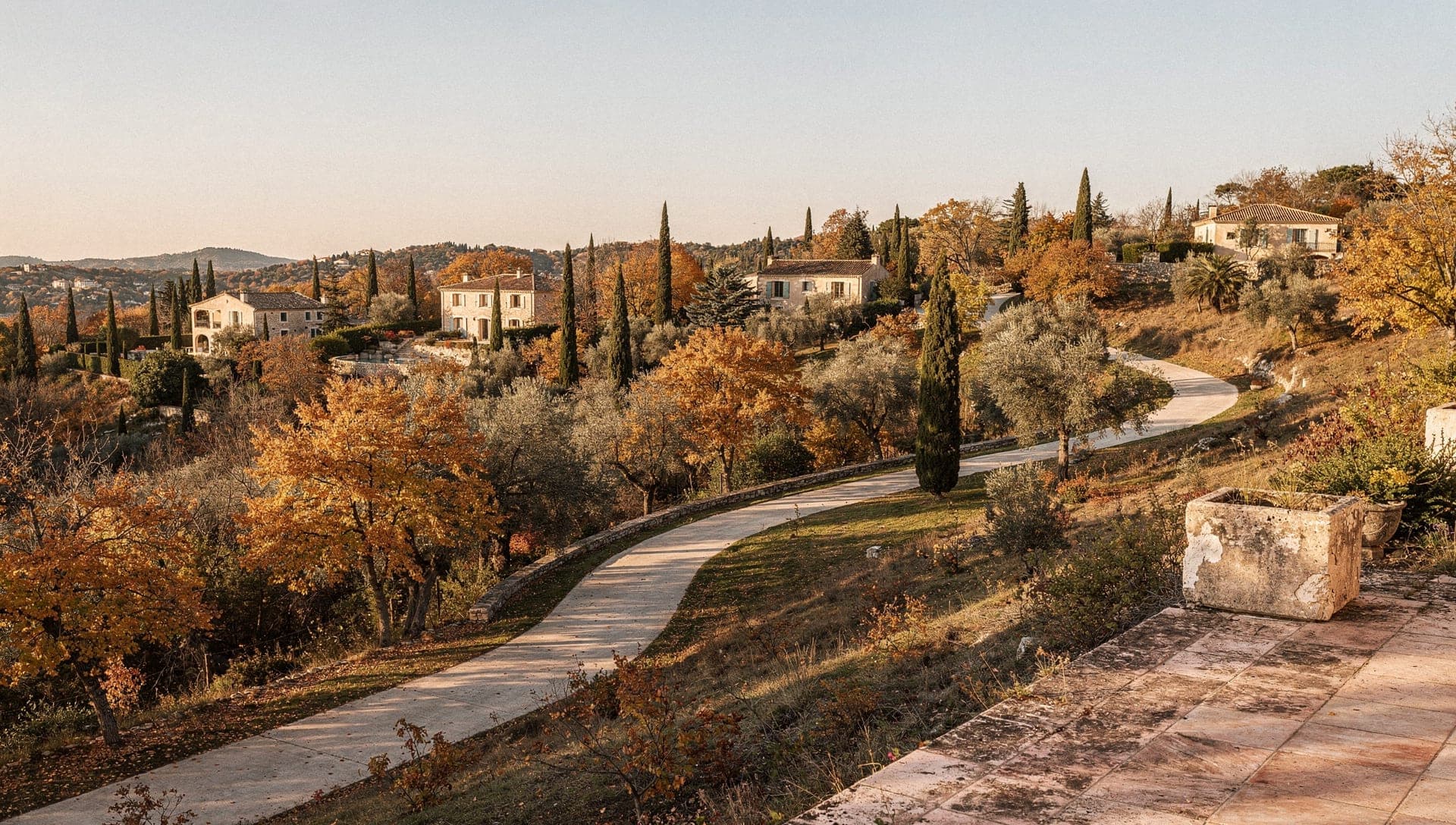
The Village and the ridge. The perched old village and the roads that fan out along the crest towards the church terrace hold the widest views. The sea view is wide and uninterrupted here, out past the Opio plain to the Bay of Cannes and the Lérins islands on a clear morning. Stone houses with terraces, restored mas and villas with a pool on the south slope make up the stock. DVF records only three house sales of €1M or more in the village lieu-dit over 2021–2025: too few to publish a figure. Across Châteauneuf-de-Grasse, the median for the same years is €8,033/m². Stock is thin and turns slowly. Owners here are rarely in a hurry.
Pré-du-Lac. The crossroads where the RD2085 meets the roads towards Opio and Gourdon is the commune’s practical centre of gravity. Shops, the pharmacy and everyday services sit here, which makes it the sector families choose when they want the shops close rather than a single-track lane between them and a litre of milk. DVF records no house sale of €1M or more in the Pré-du-Lac lieu-dit over 2021–2025: too few to publish a figure. Across Châteauneuf-de-Grasse, the median for the same years is €8,033/m². A house with a flat garden near Pré-du-Lac is the most liquid thing Châteauneuf offers, and it is where we send buyers who want to resell cleanly in five years.
Magagnosc. The lanes along the old Route de Nice towards the Grasse hamlet of Magagnosc are the third market. Magagnosc itself belongs to Grasse. This side of Châteauneuf is not one of the sectors we map, so we publish no DVF figure for it. In our experience it is where a buyer most often negotiates below asking. The trade-offs are real. Some of it is close to the RD2085 traffic, and the sea view is partial or absent on the lower plots. For a first hinterland home or a lock-and-leave, the maths often works better here than stretching for the ridge.
How to use these three sectors in practice: match the sector to the reason you are buying, then let the average guide you rather than anchor you. If the view is the point, only the ridge and the best of Pré-du-Lac deliver it, and a protected outlook is what you pay for. If daily life and resale liquidity matter more, Pré-du-Lac near the shops is the safest hold. If the budget is the hard limit, the Magagnosc side is where we see the most room to negotiate. We have watched buyers waste months comparing listings across all three as if they were one market. They are not, and the commune average of 6,197 euros per square metre is a blend that describes none of them exactly. On recorded sales, two Châteauneuf sectors have enough houses sold for €1M or more for a figure of their own: Le Vignal at €8,321/m² (18 sales) and the Opio border at €8,953/m² (23 sales), against €8,033/m² for the commune over 2021–2025. Our sector pages cover the historic village and Pré-du-Lac in more detail.
Where value sits: Opio and Le Rouret
Châteauneuf-de-Grasse does not stand alone. Two neighbours frame the decision for most buyers looking on this plateau, and the value read changes depending on which one you weigh it against.
Opio sits right below, on the plain, and it is the more expensive of the two neighbours at roughly 6,857 euros per square metre for houses per efficity’s June 2026 read. Opio buys you flatter land, the olive country around the village mill, and a golf course of its own, with Grande Bastide a few minutes away in Châteauneuf itself. What it does not buy you is the ridge view. Choosing between Opio and Châteauneuf comes down to horizontal space among olive groves or height with a sea horizon. Families with young children and a pool often prefer Opio’s flat plots. View buyers pay up for the Châteauneuf ridge.
Le Rouret sits the other way, towards Roquefort-les-Pins, and it is the clear value option at about 4,789 euros per square metre, up around 3 per cent over six months per Orpi’s May 2026 figure. That is roughly 1,700 euros per square metre below Châteauneuf on houses. Le Rouret trades a little reputation and the postcode for more house and a strong village school reputation. For a buyer whose budget is the binding constraint and who does not need the sea view, Le Rouret is where the same money stretches furthest on this side of the hinterland.
Our read: Châteauneuf-de-Grasse earns its premium over Le Rouret through the view sectors and the shorter reach to Grasse and the coast. Against Opio, it is closer to a toss-up, and it comes down to whether you want to look down at the sea or live among the olives. We would not pay the Châteauneuf ridge premium for a house whose view is partial or unprotected. In that case, Le Rouret or the Magagnosc side gives you back the difference. Compare the Opio market by sector and our Le Rouret 2026 guide.
Momentum: what is firming, what has stalled
The mid-2026 picture on this plateau is a two-speed one, and Châteauneuf-de-Grasse sits on the firmer side of it. Prices in the view sectors have held through the higher-rate period of the past two years because the stock is scarce and the buyers are mostly equity-rich, not mortgage-dependent. A ridge house with a protected view is not a rate-sensitive asset. It sells when it comes to market, and it rarely comes to market.
The softer part of the commune is the same as everywhere in the hinterland. Houses that need work, that sit close to the road, or that ask a view price for a partial view have taken longer to sell and have seen the sharpest negotiation. Le Rouret’s roughly 3 per cent six-month rise, by contrast, tells you the value end of this plateau is where the buying energy has moved as budgets tighten. Money is rotating towards the places where the price per square metre still has room.
The recorded sales give the longer view at the top of the market. On DVF, houses sold for €1M or more in Châteauneuf-de-Grasse went from a median of €7,062/m² in 2021 to €8,705/m² in 2025, up 23% since 2021 (17 and 15 sales). The last year went the other way, down 8% from €9,449/m² in 2024 (16 and 15 sales), and with samples that small two or three villas move the figure. DGFiP publishes five years of sales, so there is no ten-year figure on this basis. If you plan to hold for a decade, the line since 2021 tells you more than the last twelve months.
A word on the data lag. The official DVF file, published by the Direction Générale des Finances Publiques through Etalab, was last refreshed on 7 April 2026 and runs to 31 December 2025. The October 2026 release adds transactions through 30 June 2026 and postdates the figures in this article. That matters for how you read any figure. The MeilleursAgents and efficity estimates we quote are model-based and more current, but the hard, recorded sale prices for the first half of 2026 are not public yet. When an agent tells you the market jumped this spring, ask what they are basing it on. The recorded proof is still a few months out.
The tax edge: why 06 costs less to buy into
Here is a point most price tables miss. The Alpes-Maritimes is one of the few departments in France that did not raise its transfer tax in 2026, and for a buyer in Châteauneuf-de-Grasse that means real money kept at completion.
The background: the 2025 Finance Law let departments lift the departmental share of the droits de mutation, the transfer duty folded into what buyers call notaire fees, from 4.5 to 5.0 per cent for purchases between April 2025 and March 2028. By the DGFiP table of rates at 1 February 2026, about 83 departments took the option. The Alpes-Maritimes did not. It held its rate at 4.5 per cent, which keeps the total transfer duty at roughly 5.8 per cent of the price rather than the 6.3 per cent charged in the departments that raised it. On a one-million-euro house, holding the lower rate saves about 5,000 euros against a department that went to 5.0 per cent. It is not the largest line in a purchase, but it is a rare case of the 06 being cheaper than most of France on something.
Two further notes for the buyers we advise. First, if the property is your main residence and it is your first purchase, you are excluded from the 0.5-point increase anywhere in France, so this particular gap does not apply to you. Second, at the values common on the Châteauneuf ridge, the wealth tax on property, the IFI, comes into view for buyers whose French real estate crosses 1.3 million euros net. That is a holding cost, not a purchase cost, and it is worth modelling before you commit rather than after. We flag it early because the ridge houses are exactly the ones that cross the threshold. The detail is in our notaire fees guide for 2026.
Rules that moved the maths in 2026
Two regulatory changes are working through the hinterland market this year, and both touch older houses in Châteauneuf-de-Grasse more than new ones.
The energy rating rules. Since January 2025, homes rated G on the DPE energy scale are barred from long-term letting, and F-rated homes follow in 2028. On this plateau, where a good part of the stock is stone houses built before insulation was a thought, that has pulled a discount onto the worst-rated properties. A ridge house with single glazing and an old oil boiler now carries a renovation bill that a buyer prices straight into the offer. The upside for a buyer who plans to live in it rather than let it is that the rental ban does not apply to you, so a G-rated house with a good view becomes a buying opportunity that a landlord has to walk past.
The DPE recalculation for small units. The method for rating small apartments was corrected in 2024, which lifted many studios and one-bedrooms out of the worst bands. That matters less in Châteauneuf, where apartments are a minority of the stock, though it affects the handful of village flats that come up. Check the date on any DPE you are shown. A rating issued before the correction often reads worse than the same flat would score today.
Neither change is a reason to buy or not buy here. Both are reasons to read the DPE, the boiler and the glazing before you fix a number, because the market has already started pricing them and a seller who has not updated their thinking is a seller open to negotiation.
Who should buy in Châteauneuf-de-Grasse
The commune fits a specific buyer, and it pays to be clear about who that is. The access and the schools shape it as much as the view.
Access. Châteauneuf sits on the RD2085 between Grasse and the Pré-du-Lac crossroads, with the A8 motorway reached in about 25 to 35 minutes through Grasse-Sud or down towards the coast. That is a proper commute, longer than Valbonne’s reach to Sophia Antipolis. If your working life runs through the Sophia technology park every day, Valbonne, Biot or Le Rouret put you closer. Châteauneuf suits the buyer who works from home, travels for work rather than commutes, or has reached the stage where the daily drive matters less than the view at the end of it.
Schools. The international draw on this side is the Campus International de Valbonne, the CIV, roughly 15 to 20 minutes away, which is the reason a good number of international families land on this plateau at all. The Mougins British International School, the British curriculum option, sits about 25 minutes south. Local French schooling runs through Grasse. For families, the school decision usually sets the sector before the view does, and we have seen buyers pick Pré-du-Lac over the ridge purely for the shorter school run.
Lifestyle. This is olive and golf country. The village mills press oil each winter, the Claux Amic course sits above Grasse and the Opio-Valbonne golf is a few minutes down the hill. The buyer who thrives here wants a slower rhythm, a Saturday market, a terrace for the long summer evenings, and the sea kept at arm’s length as a view rather than a beach ten minutes away. If you want to walk to a lively town centre every night, this is not your commune. Valbonne village or Mougins village will suit you better.
Our read
Châteauneuf-de-Grasse is a well-priced commune that earns its place near the top of the hinterland, but the average tells you almost nothing. Everything here turns on the view and the sector. Pay the ridge premium only for a protected sea view you have checked on the ground and in the PLU. Take the Magagnosc side or drift towards Le Rouret if the view is partial and the budget is tight. That decision moves the price per square metre by thousands of euros, which is far more than any month-to-month market swing.
The market itself is firm rather than frothy. View stock is scarce and slow to trade, so a good ridge house rewards patience and a decisive offer when it appears. Le Rouret and the Magagnosc side are where the buying energy has moved as budgets tighten, and where a careful buyer still negotiates. The Alpes-Maritimes transfer-tax hold and the energy-rating discounts on older houses both tilt slightly in the buyer’s favour this year, if you read the paperwork before you fix a number.
Our advice to anyone weighing this commune: get the sector right first, verify the view is yours to keep, and price the renovation before you fall for the terrace. Do that, and Châteauneuf-de-Grasse gives you a sea horizon, olive country and a Grasse-side value floor within ten minutes of each other. Skip it, and you risk overpaying for a partial view that a neighbour will build across in three years. We would buy here. We would buy the right house in the right sector, and we would walk the plot below the terrace first.