Lifestyle
Autumn and Winter in the Riviera Hinterland: The Season Buyers Never See
Rainfall, second-home ratios, ski runs 45 minutes from Grasse and which villages actually close. Our honest read on October to March across the eight villages.
In This Guide
Autumn and Winter in the Riviera Hinterland: The Season Buyers Never See
The Quick Read: What the Hinterland Is Actually Like From October to March
Winter in the Riviera hinterland is mild, briefly wet, and far quieter than most buyers expect. Daytime highs at Cannes average 13.6C in January and 17.1C in November, and the villages above the coast sit two to two and a half degrees colder at night than Nice. The rain arrives in autumn rather than winter: October and November average 134.3 mm and 145.4 mm, the two wettest months of the year, against 18.7 mm in July. From December the sky reopens, and January still delivers 148 hours of sunshine.
The bigger change is social, not meteorological. Second homes make up 21.2 per cent of the housing stock at Châteauneuf-de-Grasse, 18.1 per cent at Opio and 17.0 per cent at Mougins and Roquefort-les-Pins, against 8.5 per cent at Valbonne and 6.9 per cent at Grasse. That single figure predicts which lanes go dark in January better than anything an agent will tell you on a viewing.
What fills the gap is a different calendar. Olive pressing runs from late October at the Moulin d'Opio and the Huilerie Sainte-Anne in Grasse. Black truffle comes to market at Grasse and Le Rouret in mid-January. Valbonne holds its Saint-Blaise and Servan grape weekend on the last weekend of January. And the ski lifts at Gréolières-les-Neiges open 35 km and about 45 minutes from Grasse.
Our honest read: the hinterland off-season is genuinely good, but it rewards a specific buyer. If you want a full village around you in February, buy at Valbonne, Grasse or Biot. If you want quiet and you accept that half your neighbours are elsewhere, Châteauneuf-de-Grasse and Opio will suit you and cost you less competition when you bid. What follows is the detail, village by village, with the numbers behind each claim.
The Weather Nobody Mentions on a July Viewing
The hinterland sells itself in summer and is bought in summer, which is how the rain gets missed. Météo-France normals for the Cannes station over 1991 to 2020 put annual rainfall at 881.2 mm across 63.9 rain days. That is a modest annual total, but it is concentrated. October and November alone account for 279.7 mm, close to a third of the year, delivered across roughly sixteen days. Riviera autumn rain does not drizzle. It arrives in short, heavy episodes, fills the vallons, and moves on.
This matters for anyone buying below a slope. The hinterland villages sit at roughly 100 to 400 metres on terrain cut by the Brague, the Loup and the Siagne. Terraces, restanques and drainage that look ornamental in July are load-bearing in November. Before you sign, walk the plot after rain if you possibly can, and read the commune's risk documents rather than the agent's summary.
| Month | Mean daily max | Mean daily min | Rainfall | Sunshine hours |
|---|---|---|---|---|
| October | 21.3 C | 12.1 C | 134.3 mm | 192.7 |
| November | 17.1 C | 7.9 C | 145.4 mm | 149.6 |
| December | 14.3 C | 4.6 C | 104.6 mm | 136.5 |
| January | 13.6 C | 3.7 C | 82.5 mm | 148.1 |
| February | 13.9 C | 3.7 C | 57.0 mm | 164.0 |
| March | 16.0 C | 6.0 C | 60.2 mm | 216.7 |
Source: Météo-France 1991 to 2020 normals, Cannes station. Annual sunshine at Cannes runs to 2,742.7 hours.
Altitude changes the numbers in ways the coastal figures hide. Météo-France records Grasse as running two to two and a half degrees colder than Nice at night, and about two degrees colder by day in January. Light frosts are described as not excluded inland, where at Nice they are close to absent, at 1.3 frost days a year. Snow settles regularly above 500 metres. In Grasse town itself, complete snow cover happens perhaps every second or third winter, usually briefly, and most often in February.
None of the eight villages sits above 500 metres, so snow on your own driveway is an event rather than a routine. But an uninsulated stone house at 350 metres in Châteauneuf-de-Grasse in January is a genuinely different building from the same house in August, and the heating bill reflects it.
Which Villages Actually Empty Out: The Second-Home Test
There is one public figure that tells you more about winter life than any brochure, and almost nobody quotes it: the share of a commune's housing stock recorded as second homes. INSEE publishes it for every commune in France. It is the difference between a village that stays lit and a village that does not.
| Commune | Second homes | Main residences | Vacant | Population | Median age |
|---|---|---|---|---|---|
| Châteauneuf-de-Grasse | 21.2% | 73.1% | 5.7% | 3,765 | 47 |
| Opio | 18.1% | 75.6% | 6.2% | 2,408 | 46 |
| Mougins | 17.0% | 77.3% | 5.7% | 19,481 | 42 |
| Roquefort-les-Pins | 17.0% | 76.8% | 6.2% | 7,284 | 46 |
| Le Rouret | 12.6% | 82.7% | 4.8% | 4,198 | 45 |
| Biot | 11.3% | 81.7% | 7.0% | 10,196 | 40 |
| Valbonne | 8.5% | 85.6% | 5.9% | 12,389 | 34 |
| Grasse | 6.9% | 82.9% | 10.2% | 48,669 | 40 |
Source: INSEE commune data as published by MeilleursAgents, September 2026.
Read the top and bottom of that table together and the winter map draws itself. Châteauneuf-de-Grasse has a fifth of its houses standing empty for most of the year and a median age of 47. Valbonne has a median age of 34 and the highest share of main residences of the eight, because Sophia Antipolis puts working households in Garbejaïre, Haut-Sartoux and Peyniblou who are there in February for the same reason they are there in July. Grasse has the lowest second-home share of all, at 6.9 per cent, and it also carries the highest vacancy rate at 10.2 per cent, which is a different problem and mostly a question of ageing stock in the old town.
The practical consequences are ordinary and specific. In a high second-home commune, expect fewer cars on the school run, a shorter list of shops that stay open through January, association events that depend on a small permanent core, and a neighbour you may not meet until Easter. In Valbonne, Biot and Grasse, expect the opposite: full schools, a market that runs all year, and the friction of a working town.
Our honest read: neither is better. But buyers routinely choose a village for its July atmosphere and then find themselves alone with it in January, and that is an avoidable mistake. If you have not seen your shortlist in the last week of January, you have not seen it.
What a Square Metre Costs, and Why Winter Changes the Negotiation
Prices in the eight villages have not softened, but the number of people competing for them has a season. Here is where the market sits now, on MeilleursAgents estimates.
| Commune | All property types | Houses | Apartments | House range |
|---|---|---|---|---|
| Mougins | 6,171 EUR/m2 | 6,942 EUR/m2 | 5,186 EUR/m2 | 3,258 to 13,499 |
| Opio | 6,400 EUR/m2 | 6,454 EUR/m2 | 5,786 EUR/m2 | 2,581 to 12,773 |
| Châteauneuf-de-Grasse | 6,259 EUR/m2 | 6,620 EUR/m2 | 4,522 EUR/m2 | 2,974 to 13,240 |
| Roquefort-les-Pins | 5,886 EUR/m2 | 5,908 EUR/m2 | 5,562 EUR/m2 | 2,762 to 10,333 |
| Biot | 5,656 EUR/m2 | 6,026 EUR/m2 | 4,961 EUR/m2 | 2,894 to 10,328 |
| Valbonne | 5,373 EUR/m2 | 6,495 EUR/m2 | 4,612 EUR/m2 | 2,828 to 11,141 |
| Le Rouret | 5,255 EUR/m2 | 5,340 EUR/m2 | 4,751 EUR/m2 | 2,327 to 9,589 |
| Grasse | 3,795 EUR/m2 | 4,266 EUR/m2 | 3,540 EUR/m2 | 1,959 to 7,514 |
Source: MeilleursAgents estimates at 1 September 2026, except Opio and Le Rouret, which carry a 1 August 2026 estimate date. Note the width of those house ranges. In Châteauneuf-de-Grasse the top of the range is more than four times the bottom, which is what a view premium and a wide spread of build quality look like when you flatten them into one commune average. Treat any single commune figure as an opening position, not a valuation.
The seasonal effect is on demand, not on asking prices. Nice hotel occupancy runs at 92 per cent in August and 49 per cent in January, and revenue per available room falls from 240 EUR to 50 EUR across the same months, according to the Nice Côte d'Azur tourism observatory. Furnished tourist rental occupancy in the metropole went from 66 per cent in August 2025 to 24 per cent in November 2025. The moyen pays, the closest published proxy for the inland belt, carries around 56,000 visitors in August and 19,000 in January.
Those are tourism figures rather than transaction figures, and we will not pretend they are a direct proxy for buyer competition. But they describe the flow of people through the villages, and the flow of people through the villages is where casual second-home demand comes from. Anecdotally, and this is our read rather than a statistic, the buyers we meet in January are the serious ones. They have flown in on purpose, they are looking at three houses rather than thirteen, and they are not bidding against someone who saw a sign on holiday.
Two practical points. Sellers who have been on the market since spring reach November tired, which is the moment a well-argued offer travels furthest. And a vendor holding an empty second home is paying taxe foncière, insurance and often a pool contract on a property producing nothing, which is a pressure that does not exist for an owner-occupier.
The Mountains: Real Drive Times From Grasse to the Snow
The claim that you can ski in the morning and be by the sea in the afternoon gets repeated constantly and attributed to nobody. Here is what the official bodies actually say and what the drive really is.
Côte d'Azur France Tourisme states that linking the snowy summits to the coast takes less than an hour and a half by car, and its winter press file frames the department's fifteen resorts and 600 km of pistes as sitting under 90 minutes from the coast. For the two resorts in the Pays de Grasse, the number is much better than that. Gréolières-les-Neiges is 35 km and about 45 minutes from Grasse, and under an hour from Cannes. It is the closest ski area to the sea in the department, 22 km away as the crow flies.
| Resort | Altitude | Domain | Adult day pass | From |
|---|---|---|---|---|
| Gréolières-les-Neiges | 1,400 to 1,800 m | 30 km, 25 runs, 9 lifts | 24 EUR | 45 min from Grasse |
| L'Audibergue - La Moulière | 1,400 to 1,650 m | 28 km, 23 pistes, 7 lifts | 18 EUR | 45 min to 1 h from Grasse |
| Valberg | 1,700 to 2,100 m | 56 pistes, 23 lifts | 37 EUR | 1 h 15 from Nice |
| Auron | from 1,600 m | 135 km, 43 runs, 19 lifts | 44 EUR | 1 h 30, 90 km from Nice |
| Isola 2000 | 2,000 m, summit 2,610 m | 120 km, 22 lifts | 44 EUR | 1 h 30, 90 km from Nice |
Prices are the published 2025 to 2026 adult day rates excluding insurance. The 2026 to 2027 tariffs had not been published when this went to press. Isola 2000 has announced a 5 December 2026 opening, and Valberg 19 December 2026. The two Pays de Grasse stations opened on 20 December in 2025 and depend heavily on snow: Gréolières closed early on 2 March 2025 for lack of it, so treat the small local resorts as a bonus rather than a reason to buy.
Auron is the largest domain in the Alpes-Maritimes at 135 km of pistes, with 429 snow guns covering 70 per cent of it. Isola 2000 runs 120 km with 430 guns over 75 per cent. Both are on the Mercantour season pass, which was 712 EUR for 2025 to 2026 if bought before late November. Valberg sits outside that pass and prices separately.
For a family in Valbonne, Le Rouret or Opio, the honest picture is this: a weekend day at Gréolières is a genuine hour-door-to-lift proposition and costs less than a cinema trip for four. A proper ski day at Auron or Isola is a full day out with an early start, and you will spend three hours in the car. No official source publishes a drive time from Sophia Antipolis to any resort, so measure it yourself before you build a relocation decision on it.
One scheduling point that catches new arrivals. The Académie de Nice sits in zone B, which places the February half-term in the middle of the three staggered French zones. In 2027 the local winter holiday runs from Saturday 20 February to Monday 8 March. Because the zones stagger, the roads north carry ski traffic across roughly a four-week window rather than two, and the RD and mountain roads behind Gréolières feel it on Saturdays.
Olive Pressing and Black Truffle: The Autumn and Winter Table
The hinterland's food calendar inverts the tourist one. The two things worth organising a winter around, the olive and the truffle, both belong to the cold months.
The Cailletier olive accounts for roughly 95 per cent of the departmental orchard and underpins the AOP Huile d'olive de Nice. Harvest in the AOP zone runs from mid-October and can continue to April, considerably later than other French basins, and later still at mid altitude. That is why a hinterland olive terrace is a winter job rather than an autumn one.
The Moulin d'Opio, at 1 Place de la Font Neuve, is the mill most owners in Opio, Châteauneuf-de-Grasse, Le Rouret and Valbonne actually use. It was bought by the CASA agglomeration in September 2024 and has been run since 2025 by a cooperative on a twenty-year contract. It presses at up to two tonnes an hour and takes olives from anyone, professional or amateur, with no quantity limit. The rule that matters: your own oil from your own olives, a motte individuelle, starts at 180 kg. Below that your fruit is pooled with everyone else's and you get oil back by weight. In 2025 the drop-off opened on 27 October with pressing on Mondays, Wednesdays and Saturdays. The mill publishes each season's hours about a month before it starts, so the 2026 to 2027 dates were not out when we wrote this.
The mill turns 600 years old on Saturday 26 September 2026, with olive-picking workshops, an anchoïade and tapenade competition, a paid country dinner and a free evening concert. Oil has been pressed on that site since 1426.
In Grasse, the Huilerie Sainte-Anne at 138 Route de Draguignan has been in the same family since 1706 and still runs a stone millstone alongside a modern continuous line. Its own tourist-office listing tells you exactly when the working season is, by saying it stops doing visits from 10 October to 1 January. A second Grasse mill, Domaine H on the Chemin des Basses Moulières, opened its 2025 campaign on 1 October and takes pooled batches from as little as 5 kg, which suits an owner with four trees rather than forty.
Then the truffle. The black truffle marketing window runs from 15 November to 31 March under the trade norm, and the department's headline event is a two-town weekend pair: the Marché de la Truffe at Grasse, held at La Bastide Saint-Antoine, and at Le Rouret on the Place du Village. The thirtieth edition ran on 10 January and 18 January 2026, with quality inspection on the stands and an average 2025 price around 950 EUR a kilo for Tuber melanosporum. The departmental growers' syndicate is registered at Le Rouret, which is not an accident.
If you want a weekly rather than annual fix, the nearest reliable one is over the Var border at Aups, where the Syndicat des trufficulteurs sells to the public on the Place Frédéric Mistral every Thursday morning. The 2026 to 2027 dates are already fixed, running from 26 November 2026 to 25 March 2027. It sells out well before noon.
December and January, Village by Village
Every one of the eight communes runs a Christmas programme, and they are not interchangeable. The 2026 to 2027 dates were not published when we wrote this, so what follows is the shape each village keeps year to year, with the most recent confirmed edition as the reference.
Le Rouret runs the largest market of the eight and by some distance the most rural. The 28th edition took place on a single Sunday in early December, from 9.30 to 19.00, with around 200 stands covering producers, artisans, a basket-maker, a potter, santons and small stone houses, plus farm animals and troubadours. Free shuttles ran every 30 minutes from the Intermarche roundabout and the Font Neuve car park in Opio, which tells you how much traffic a village of 4,198 people absorbs for one day.
Opio pedestrianises the old village for its own Sunday market with more than 120 exhibitors, free entry, a petting farm, pony rides and demonstrations of old trades. It was revived comparatively recently after lapsing.
Valbonne runs the longest programme, from late November to early January under the title Il était une fois Noël. It splits into a market on Place Méjane and a second market through the village streets in the week before Christmas, with fireworks, a choir and a Père Noël run. The crib in the Eglise Saint-Blaise stays up until Candlemas in early February, which is worth knowing if you arrive after the decorations have come down elsewhere.
Mougins runs from early December to early January, with the old village market over one weekend, a monumental crib at the Lavoir open daily to the end of January, a free ice rink at Mougins-le-Haut over the school holidays, and a tasting of the thirteen Provençal Christmas desserts in early December. A farmers' and artisans' market runs every Sunday morning on the Cours des Arts.
Biot does the most charming thing of the eight. Through the first 24 days of December, 24 pairs of shutters painted by the village schoolchildren turn the streets into a walkable advent calendar, alongside seven illuminated facades. The main market on Place de Gaulle then runs daily from around 19 December to the end of the month.
Grasse is the only one that behaves like a town rather than a village. Its programme runs from late November to early January with a themed identity, a market on the Cours Honoré Cresp, a separate Provençal market on the Place de la Mairie, projection mapping on the cathedral for three weeks, an ice rink, a torchlit march and a parade. Grasse's own list of its four flagship annual events contains no winter entry, so the Christmas programme and the museum exhibitions are the winter offer.
Roquefort-les-Pins and Châteauneuf-de-Grasse both keep to a single day. Roquefort uses the Place du Marche and the Place de Provence with free children's rides and a petting farm. Châteauneuf runs the Marché des Lutins on the Place des Pins, organised by the traders' association, usually the last Sunday of November.
Two things worth crossing a commune boundary for. The Foire aux Santons at Mouans-Sartoux, between Mougins and Grasse, is the oldest and largest santon fair in the Alpes-Maritimes by the commune's own account, running from the start of November to Christmas Eve, free, with 23 santonniers de Provence and reportedly more than 8,000 visitors. And Valbonne's Fête de la Saint-Blaise, du raisin et des produits du terroir closes January over a full Friday to Sunday weekend. The 2026 edition ran 23 to 25 January with a visit to the communal vineyard, a producers' market on the Place des Arcades, cooking demonstrations, a sung mass and a flowered carnival procession on the Sunday afternoon. The Servan is a late table grape kept fresh through winter by standing the cut stem in water, which is how the village ate grapes until Easter long before cold storage.
Heating, Pools and the DPE Change That Landed in January 2026
An old stone house in the hinterland is a summer machine. It has thick walls, small openings, tiled floors and a north side that never warms up, and every one of those features is working against you from November. This is the part of winter ownership that buyers underestimate most.
The regulatory position moved this year, and it moved in owners' favour. From 1 January 2026, an arrêté published in August 2025 cut the primary-energy conversion coefficient for electricity from 2.3 to 1.9, aligning France with the updated European value. Every DPE and energy audit issued from that date applies the new coefficient automatically. No dwelling's label goes down as a result. DPEs issued in 2025 or earlier stay valid and can be updated free of charge on the ADEME observatory, with no new site visit. The official SDES simulation puts the effect at roughly 700,000 additional homes leaving passoire status among principal residences. Higher figures circulate in the press. Prefer the official one.
That matters because the letting rules have teeth. Since 1 January 2025 a dwelling must be at least class F to be let as a main residence, which bans class G. Class F is banned from 1 January 2028 and class E from 1 January 2034. The rules bite on new leases, renewals and tacit rollovers rather than on a running contract. Separately, since 24 August 2022 no rent increase of any kind is permitted on a private F or G rated dwelling, including annual indexation, until works take it to at least class E and a new DPE proves it. Nationally, F and G together still account for 12.7 per cent of principal residences.
Two exemptions matter enormously in this market. Seasonal furnished tourist lets are not covered by the décence rules and are not covered by the rent freeze. If your plan for a hinterland house is summer letting rather than a year-round tenancy, the energy label is a comfort and running-cost question rather than a legal barrier. If your plan is a long lease, the label decides whether you can let at all.
Enforcement is private law. There is no inspector. A tenant goes to the conciliation commission or the civil judge, who can order works, cut or suspend the rent and suspend the lease term. Agents face a separate exposure: an F or G listing must carry the excessive energy consumption wording in type at least as large as the advertisement text, with fines up to 3,000 EUR for an individual and 15,000 EUR for a company.
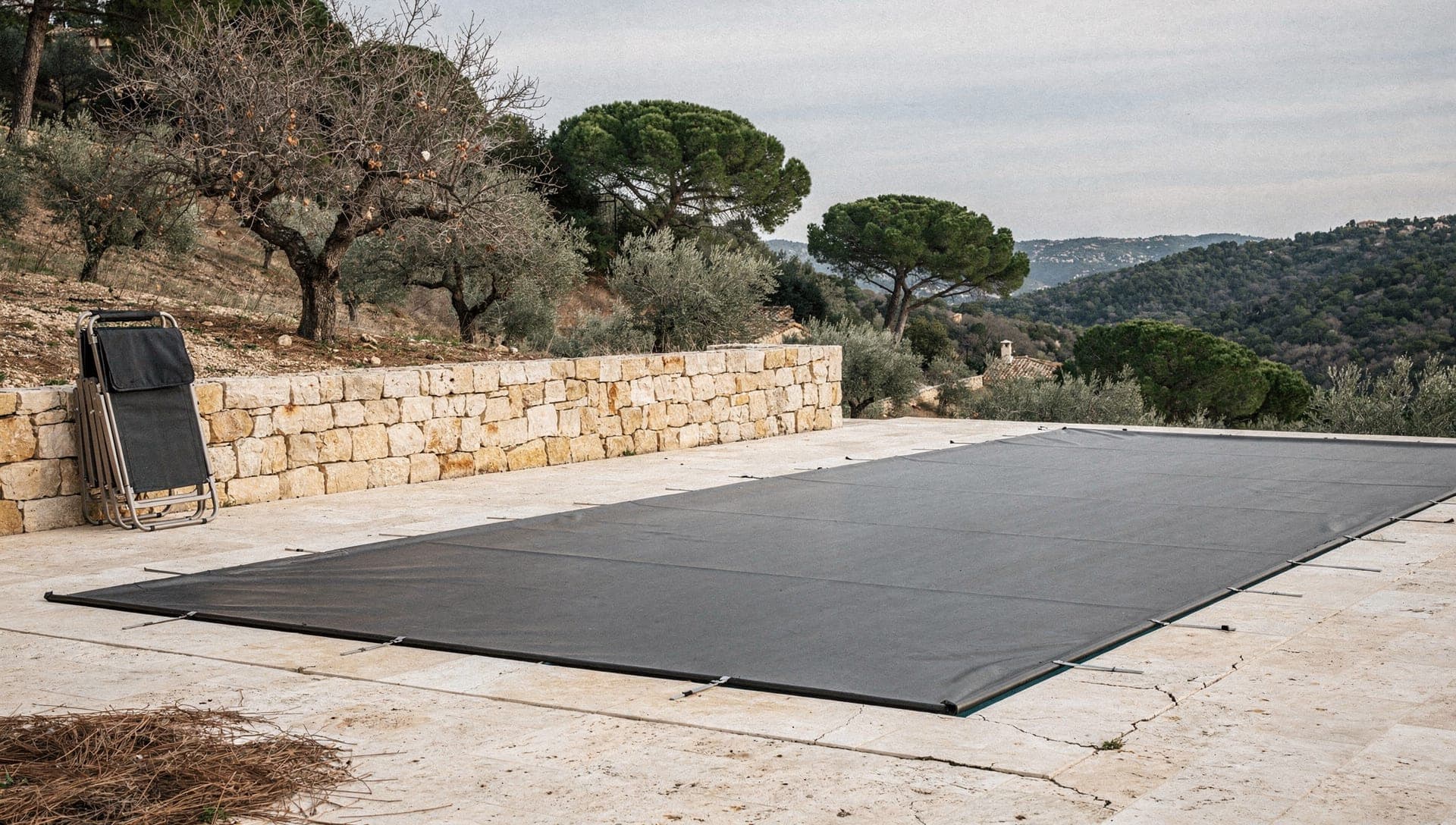
On pools, ignore the calendar and watch the thermometer. The Fédération des Professionnels de la Piscine et du Spa sets one trigger: once water temperature drops below 12 degrees, it is time to winterise. Going too early costs you water quality and going too late costs you frost damage, and the record low at Cannes of minus 12 degrees in January 1985 should settle any argument about whether frost is theoretical here. Passive wintering means stopping filtration, dropping the water below the return inlets, draining or blowing out the pipework, adding a winterising product, fitting floats and a taut cover fixed on all four sides, and isolating the electrical cabinet. Active wintering keeps filtration running about two hours a day so the water never stands still, which is what most owners at this altitude actually do. Swimming here commonly runs to the end of October and sometimes into early November.
Buying Between November and March: How We Would Play It
The off-season is the better time to buy here, and the reasons are practical rather than sentimental.
You see the property working. Damp shows in February and hides in July. A north-facing room that is charming and cool in August is a room you will not use between November and March. Roofs, gutters, terraces and the run-off from the plot above you all declare themselves after a 40 mm night in November. Ask to view in the rain rather than avoiding it.
You see the village honestly. Walk the lanes on a Tuesday in late January, count the shutters that are closed and the shops that are open, and check whether the restaurant you liked in August is serving. The second-home table earlier in this piece gives you the expectation. The walk tells you whether the expectation is right on your particular street, because a lane at the top of Châteauneuf and a lane at the bottom behave very differently.
You see the commute honestly too. The A8 carries close to 150,000 vehicles a day at Nice on the most recent national count and functions as the city's ring road between junctions 49 and 52. It is dense year-round, but the school-term profile is not the August profile. If your working assumption is Sophia Antipolis at 8.30 in term time, test that, not a holiday-week run.
You get a thinner field. The winter air network is roughly half the summer one. Nice Côte d'Azur ran 130 destinations across 47 countries in summer 2026, its largest programme ever, against 71 destinations in each of the two most recent winters for which the airport has published a figure. The tourism observatory explicitly attributes part of the November occupancy fall to the winter closure of several international air routes. Fewer flights means fewer casual viewers.
Some caveats, honestly stated. Notaires, diagnosticians and artisans all take the Christmas fortnight, so a compromis signed in mid-December will not complete on the timetable a September one would. French school holidays for the Nice academy in zone B fall from 19 December 2026 to 4 January 2027, and the winter break from 20 February to 8 March 2027. Build those into any deadline. Mountain and hill roads can close briefly after snow above 500 metres, which affects access to Gréolières rather than to any of the eight villages. And a house viewed only in winter hides its own problems: you will not see how the terrace takes the August sun, where the shade actually falls, or how loud the cicadas and the neighbour's pool pump are.
Our working rule is two viewings in two seasons before an offer on anything above a million. If that is impossible, view in winter and pay someone to walk it for you in summer.
Our Honest Read: Who the Hinterland Winter Suits
The hinterland off-season is not a compromise you tolerate for the sake of July. For a certain buyer it is the point.
It suits families anchored to Sophia Antipolis and the international schools, because their year does not have a season. Valbonne's 34-year median age and 85.6 per cent main-residence share are not statistics about property, they are a description of a village with children in it in February. Le Rouret and Biot sit close behind on the same measure.
It suits anyone who wants a working relationship with the land. If you buy olive terraces at Opio, Châteauneuf-de-Grasse or Le Rouret, your calendar is now built around a harvest that starts in late October and can run to April, and a mill that presses on fixed days. That is a genuine change to how a year feels, and buyers who want it should weight it heavily.
It suits people who like a small permanent community and are willing to join it. Village associations in these communes run on a handful of residents. Turn up to the Saint-Blaise weekend in Valbonne or the Le Rouret market and you will meet more of your commune in a day than in three summers.
It does not suit everyone. If your picture of the Riviera is terraces full at nine in the evening, February at Châteauneuf-de-Grasse will read as desolate rather than peaceful. If you need a wide choice of restaurants within walking distance every week of the year, buy in Grasse, Valbonne or Mougins village, and accept the price or the density that comes with it. If you plan to let the house on a long lease, check the DPE class before you fall in love, because a G rating means you cannot let it at all and an F rating means you cannot raise the rent. And if you cannot heat an uninsulated 200 square metre stone house without wincing at the bill, buy something smaller, better insulated, or newer.
The one thing we would say to every buyer, whatever the budget: come in the last week of January. Not in October, when it is still warm and green and the visitors have not fully gone, and not at Easter, when everything reopens. The last week of January is the honest week. Whatever the village looks like then is what you are actually buying.
Frequently Asked Questions
Frequently Asked Questions
No, but it is cooler than the coast. Météo-France normals for Cannes give a January mean daily maximum of 13.6 C and a minimum of 3.7 C. Grasse and the villages inland run about two to two and a half degrees colder at night than Nice and around two degrees colder by day in January. Light frosts happen inland where they are close to absent at Nice, which records 1.3 frost days a year. Snow settles regularly above 500 metres, and none of the eight villages sits that high, so lying snow in the villages is occasional rather than seasonal.
November, closely followed by October. Météo-France 1991 to 2020 normals for Cannes record 145.4 mm in November and 134.3 mm in October, against an annual total of 881.2 mm across 63.9 rain days. Those two months alone deliver close to a third of the year's rain, in roughly sixteen days. Rain here arrives in short, intense episodes rather than as drizzle, which is why drainage, restanques and run-off from uphill plots are worth checking before you buy.
Châteauneuf-de-Grasse, on the published data. Second homes make up 21.2 per cent of its housing stock, ahead of Opio at 18.1 per cent and Mougins and Roquefort-les-Pins at 17.0 per cent each. At the other end, Valbonne records 8.5 per cent and Grasse 6.9 per cent, which is why both stay busy through January. Grasse's 10.2 per cent vacancy rate is a separate issue and reflects older stock in the historic centre rather than seasonal absence.
Gréolières-les-Neiges is 35 km and about 45 minutes from Grasse, and under an hour from Cannes. It is the closest ski area to the sea in the Alpes-Maritimes, 22 km away as the crow flies, with 30 km of pistes between 1,400 and 1,800 metres and an adult day pass of 24 EUR for the 2025 to 2026 season. L'Audibergue is comparable in distance at 18 EUR a day. The larger domains, Auron at 135 km of pistes and Isola 2000 at 120 km, are 90 km and about an hour and a half from Nice.
From late October. Harvest in the AOP Huile d'olive de Nice zone runs from mid-October and can continue to April, later than other French basins. The Moulin d'Opio opened drop-off on 27 October in 2025 with pressing on Mondays, Wednesdays and Saturdays, and publishes each season's hours about a month before it starts. To get oil from your own olives rather than a pooled batch you need at least 180 kg. In Grasse, the Huilerie Sainte-Anne stops doing mill visits from 10 October to 1 January because that window is its working campaign, and Domaine H takes pooled batches from as little as 5 kg.
The Marché de la Truffe runs across two towns in mid-January, at Grasse at La Bastide Saint-Antoine and at Le Rouret on the Place du Village. The thirtieth edition fell on 10 and 18 January 2026, with quality inspection on the stands and a 2025 average price around 950 EUR a kilo for Tuber melanosporum. The departmental truffle growers' syndicate is registered at Le Rouret. For a weekly market, Aups in the Var sells to the public every Thursday morning from 26 November 2026 to 25 March 2027. The legal marketing window for black truffle runs 15 November to 31 March.
Yes, and generally in your favour. From 1 January 2026 the primary-energy conversion coefficient for electricity fell from 2.3 to 1.9, applied automatically to every DPE issued from that date. No label goes down as a result, and DPEs issued in 2025 or earlier can be updated free of charge on the ADEME observatory without a new site visit. The official SDES simulation estimates around 700,000 additional principal residences leave passoire status. For letting, class G has been banned since 1 January 2025, class F is banned from 2028 and class E from 2034, and F or G properties cannot have their rent raised at all. Seasonal furnished tourist lets are exempt from both the décence rules and the rent freeze.
Need personalised guidance?
Our team knows every street and every sector across the hinterland.
Explore