Town Guide
Biot Real Estate Guide: Prices, Sectors and Village Life in 2026
What buyers actually pay in the Riviera's glassmaking village, sector by sector, with schools, access, taxes and our honest read for 2026.
In This Guide
Biot Real Estate Guide: Prices, Sectors and Village Life in 2026
Quick Read: What Biot Property Costs in 2026
A house in Biot averages 6,951 EUR per square meter as of September 2026, and an apartment averages 4,869 EUR per square meter, according to notarial DVF data aggregated by PAP. Both figures sit above the Alpes-Maritimes department average of roughly 5,000 EUR per square meter for apartments and 5,500 EUR per square meter for houses. Prices in Biot have risen 9.6 percent over the past year and 15.1 percent over five years, a steadier climb than the coastal hotspots and one built on genuine scarcity rather than speculation.
Biot is a working hilltop village of 10,511 residents wedged between Antibes and Sophia Antipolis, still known for the bubble glass its artisans invented seventy years ago. It is not a satellite of Valbonne or Mougins. It has its own secondary school, Collège l'Éganaude, its own glassworks open to visitors, and a housing stock split between the medieval core, mid-century villa sectors like Bois Fleuri-Chèvre d'Or-Saint Philippe, and newer builds closer to the Sophia Antipolis technology park.
- Typical buyer: Sophia Antipolis executives, retirees drawn to the craft heritage, and second-home owners from Northern Europe.
- Best value: renovation projects in the historic village core, where per-square-meter prices undercut finished villas in Bois Fleuri.
- Watch for: the 2026 second-home tax surcharge, which some Alpes-Maritimes communes now apply at up to 60 percent of the residential tax base.
- Access: A8 motorway exit 44 (Antibes), roughly twenty minutes to Nice airport, and 4 km from Biot's own SNCF station.
Why Buyers Are Looking at Biot Now
Biot spent years in the shadow of Valbonne and Mougins, both of which built international reputations around Sophia Antipolis money and, in Mougins's case, golf and gastronomy. That shadow is thinning. Agents in the sector report a rising share of buyers who tried to find a house in Valbonne first, found the historic core already picked over, and moved four kilometers west to Biot instead.
The appeal is specific rather than vague charm. Biot kept its working identity. The Verrerie de Biot still employs glassblowers who shape the bubble glass invented here in the 1950s, and four glassworks in the commune stay open to visitors year round, well beyond September's Biot International Glass Festival. The village earned the "Ville et Métiers d'Art" label in 1997 for that reason, one of a small number of French towns to hold it. Add the Fernand Léger museum, opened in 1960 on a hillside just below the old town, and Biot has a cultural anchor that Valbonne, built around a 16th-century bastide grid, and Mougins, built around golf courses, simply do not.
Practically, Biot sits inside the Sophia Antipolis perimeter, the technology park that hosts roughly 2,500 companies and universities across several communes. Buyers who work there get the commute without paying Valbonne's premium for it. Houses here average 6,951 EUR per square meter against 7,010 EUR in Valbonne and 7,900 EUR in Mougins, based on the same PAP dataset, a gap of several hundred euros per square meter that adds up fast on a 200 square meter villa.
None of this makes Biot cheap. Grasse, twenty minutes north, still undercuts it by a wide margin at 4,979 EUR per square meter for houses. What Biot offers instead is a working village with a real economy underneath the property market, not a bedroom community.
The buyer mix has shifted too. We're seeing more Belgian, Dutch, and Scandinavian buyers arrive specifically for the craft-village identity rather than for beach access, alongside the usual British and French second-home crowd. That mix tends to hold prices steadier through the off-season than in towns that lean on a single nationality or a single summer rental market.
The population numbers back up the shift from sleepy village to a genuinely lived-in commune. Biot counted 2,656 residents in 1968 and 10,511 at the 2023 census, growth driven almost entirely by Sophia Antipolis rather than tourism, which is why the village feels occupied through the winter instead of shuttered until Easter the way some coastal resort towns do. Biot has no golf course of its own, but Opio's course sits about fifteen minutes away and Cannes-Mougins Golf Club around twenty, close enough for buyers who play without needing a fairway view from the terrace.
Property Prices in Biot: The 2026 Numbers
The table below draws on DVF notarial sale records aggregated by PAP for September 2026, cross-checked against MeilleursAgents estimates, which run close but not identical because DVF captures completed sales while agency indices track asking prices. Treat both as a range rather than a fixed number, and always ask a local agent for a comparable-sales pull on the specific sector before making an offer.
| Town | Apartments EUR/m2 | Houses EUR/m2 |
|---|---|---|
| Biot | 4,869 | 6,951 |
| Valbonne | 4,532 | 7,010 |
| Mougins | 4,794 | 7,900 |
| Antibes | 5,246 | 7,503 |
| Grasse | 3,072 | 4,979 |
| Alpes-Maritimes average | 4,873 | 5,496 |
Biot's house price has climbed 1.0 percent in the past month, 2.2 percent over three months, 5.9 percent over six months, and 9.6 percent over the year, a curve that has been consistently positive rather than spiky. Over five years the gain reaches 15.1 percent, below Valbonne's sharper run-up but ahead of the department's broader 16.3 percent five-year figure in raw terms, since Biot started from a lower base and has been catching up rather than leading.
Within the commune, the spread is wide. A renovation project in the historic center, stone walls and a tile roof needing full mechanical and electrical work, can still trade under 5,000 EUR per square meter for the shell alone. A finished villa with a pool in Bois Fleuri-Chèvre d'Or-Saint Philippe, the commune's established residential sector, regularly clears 7,500 to 8,500 EUR per square meter for anything built or renovated in the past decade. Land itself is scarce. Biot covers only 15.54 square kilometers, and a large share sits within Sophia Antipolis's protected green zones, which caps new construction and keeps existing villa plots valuable.
DVF data itself updates twice a year, typically in April and October, and always lags actual signings by six to eighteen months because it tracks notarized acts rather than compromis de vente. The September 2026 figures quoted here reflect that lag, meaning the freshest sales in the dataset closed in mid-2026 even as asking prices on the ground have likely moved again. Treat DVF as the floor of what a property is worth and current agency asking prices as the ceiling, with the real number somewhere between.
Biot's Sectors, From the Old Village to the Technopole Edge
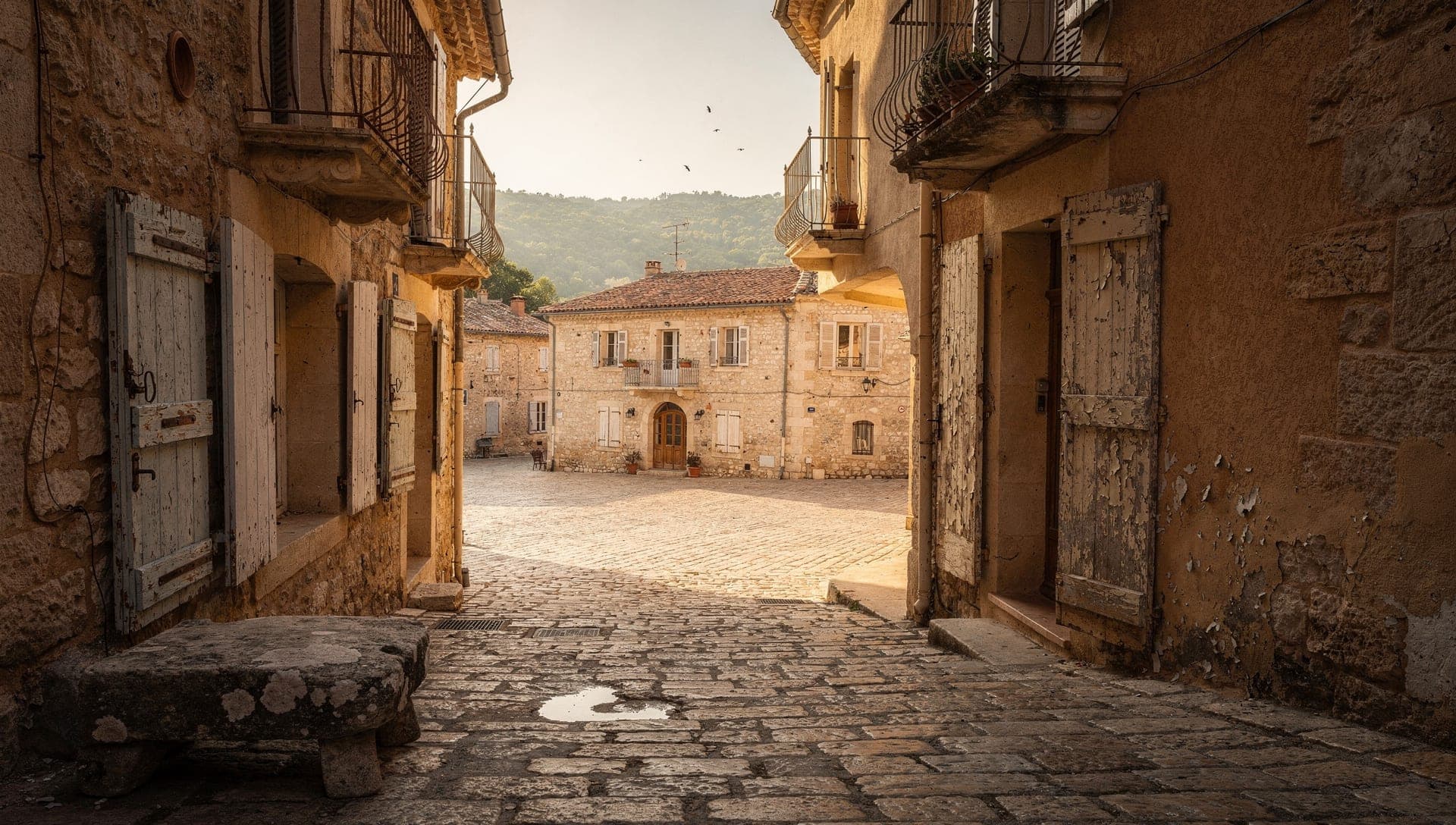
Biot divides into a handful of distinct sectors, and buyers who conflate them tend to overpay for the wrong one. The historic village sits at the top of the hill, a cluster of ochre stone houses along cobbled lanes around the Place des Arcades and the old church. Property here is mostly old, narrow, and vertical, townhouses of three or four floors rather than villas, prized by buyers who want to walk to a boulangerie and a glassworks rather than drive everywhere. Renovation is the norm, and Biot's heritage rules constrain what can change on the exterior.
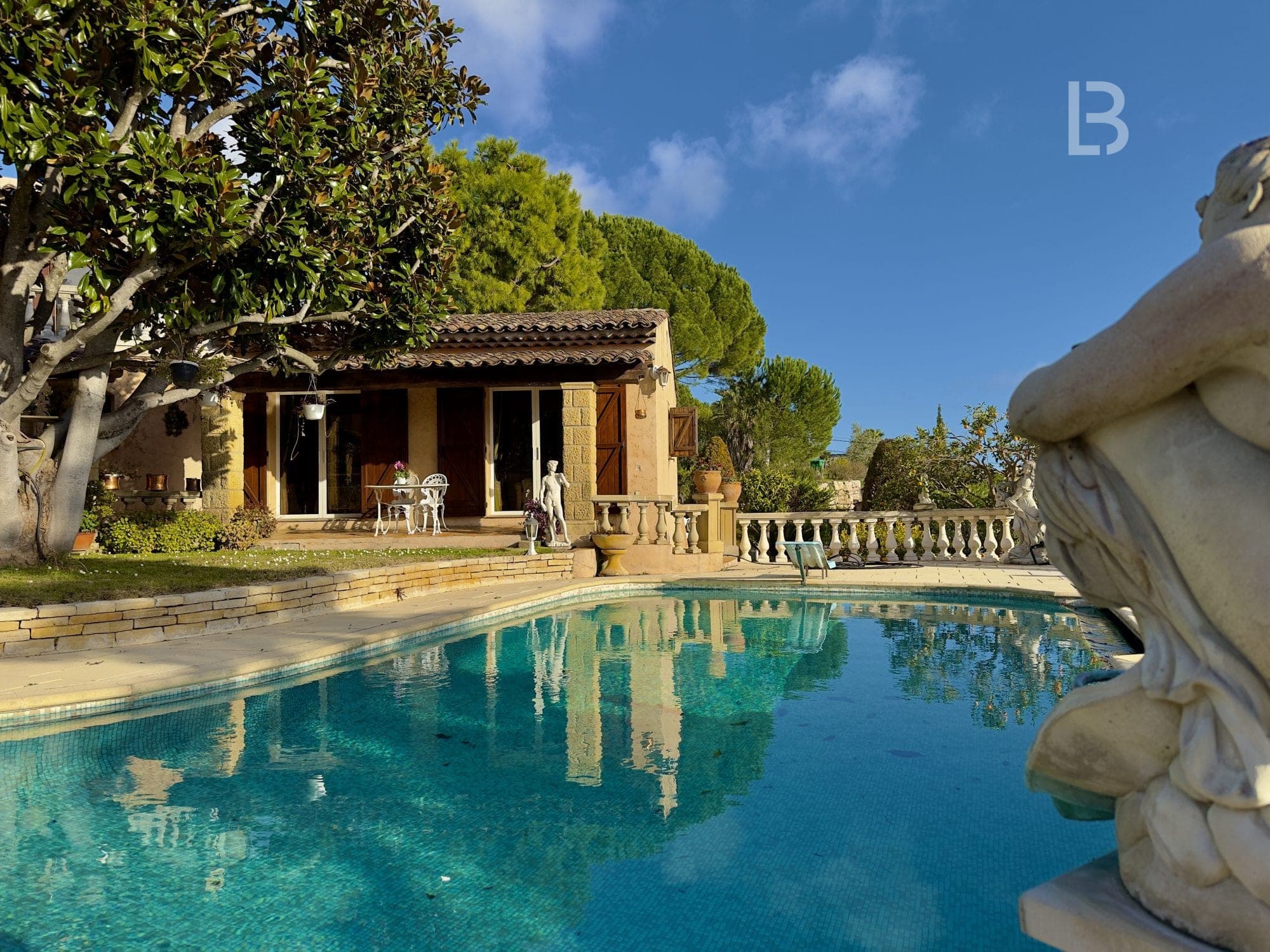
Below and around the hill, Bois Fleuri-Chèvre d'Or-Saint Philippe is the commune's main residential sector, a spread of mid-century and contemporary villas on wooded plots, many with pools, aimed squarely at Sophia Antipolis families who want a garden and a short commute rather than village life. This is where the 7,500 to 8,500 EUR per square meter villas trade, and where most new listings from international agencies concentrate.
Toward the coast, along the La Brague valley that forms the border with Antibes, Biot holds a different, more commercial character: retail parks, Marineland and its neighboring attractions, and a scattering of newer apartment programs aimed at buyers who want beach access at Antibes or Golfe-Juan within ten minutes and don't need the hilltop views. Prices here track closer to Antibes than to the village.
Closer to Sophia Antipolis itself, on Biot's eastern edge, smaller residential pockets sit within walking distance of Collège l'Éganaude and the technopole's office campuses, a practical choice for dual-income households where one or both partners work on-site. This is also where Biot's own SNCF station sits, four kilometers from the old village, giving car-free access to Nice and the coast.
Fiber internet reaches most of Biot, including the older village houses where retrofitting a line can still mean running it along an exterior stone wall rather than through it, a detail worth confirming before assuming a smooth remote-work setup. For buyers whose work depends on it, Sophia Antipolis's fiber backbone makes the eastern sectors the safer bet over the historic core, where a handful of streets still wait on upgrades.
Schools and Family Life in Biot
Families weigh Biot against Valbonne mostly on schooling, and the comparison favors Biot more than reputation suggests. Collège l'Éganaude, the commune's own secondary school, sits inside Biot at the edge of Sophia Antipolis and enrolls more than 800 students across 28 classes, with international sections and dedicated sports and music tracks, a public school with a genuinely international student body drawn from the families working in the technopole around it.
For primary-age children, Biot runs its own communal schools in the village and lower town, and several private and Montessori options operate within a short drive across Sophia Antipolis. Families who want a fully bilingual or international curriculum through the baccalauréat still lean toward the Centre International de Valbonne, roughly fifteen minutes away by car, which many Biot residents use without needing to live inside Valbonne itself.
Beyond the school run, Biot reads as a genuinely child-friendly commune: a walkable historic core with almost no through-traffic, a municipal pool and sports facilities, and outdoor space that ranges from the wooded Bois Fleuri sector to hiking trails toward the Vallon des Combes. It is quieter than Antibes and less manicured than Mougins, which suits families who want their children playing outside rather than in a gated development.
Getting to and from Biot
Biot connects to the motorway network at exit 44 of the A8, the same exit used for Antibes and central Sophia Antipolis, reached from the village along the D4 or, from the coast road, the D6098 and D6007. Drivers from Nice take the A8 west to exit 44 and follow signs to Biot. From Cannes, the same exit works, with the Sophia Antipolis access road continuing on toward the village.
Biot's own SNCF station sits about four kilometers from the historic center and carries TER regional trains and some intercity services, with an Envibus line 10 connection and a free summer shuttle running between the station and the village. For the airport, Lignes d'Azur bus line 620 stops at Biot station and runs to Nice-Côte d'Azur, a trip of roughly twenty to twenty-five minutes depending on traffic on the coast road.
For anyone commuting into Sophia Antipolis itself, Biot's position inside the technopole's edge means the drive can run under ten minutes outside peak hours, a real advantage over Valbonne or Mougins, both of which sit further from the office campuses and see worse congestion on the D35 and D3 during the morning run.
Buyers weighing a hillside villa against a village house should also factor parking. The historic core has limited street parking and several properties come without a dedicated spot, a genuine constraint for a household running two cars, while the villa sectors around Bois Fleuri and toward Sophia Antipolis were built with garages and driveways as standard.
Biot's village layout predates the car by centuries, so anyone renting or buying in the historic core should ask specifically about a taxi or rideshare habit for evenings out, since reaching coastal nightlife means either driving down carefully on the D4 after dinner or budgeting for a taxi back up. Villa sectors around Bois Fleuri and toward Sophia Antipolis don't have this problem, with driveway parking and flatter roads throughout.
Village Life: Glass, Craft and the September Festival
Biot built its modern identity on glass rather than on golf or perfume, and that heritage still shapes daily life. Four glassworks in the commune, led by the original Verrerie de Biot, stay open to visitors year round, and the town earned the "Ville et Métiers d'Art" designation in 1997 for its concentration of working craft studios, one of a small number of French communes to hold it. The Biot International Glass Festival, now in its fifth edition and running September 18 to 20, 2026, brought around 200 glassmakers from five continents to the village and drew more than 18,000 visitors in 2024. This year's guest artists, Danish glassblower Tobias Møhl and French glass-paste artist Juliette Leperlier, have work on show through October 25 in the "Glass is Biotiful V" exhibition.
The Musée Fernand Léger, opened in 1960 on the hillside just below the old town, gives Biot a serious cultural credential beyond the craft studios, housing one of the largest public collections of the artist's cubist work. Between the museum, the glassworks, and the weekly market around the Place des Arcades, Biot draws steady day-trip tourism without the summer gridlock that clogs central Antibes or Cannes, a balance most buyers here actively want.
Restaurants and shops in the village lean toward the artisanal rather than the branded, small kitchens rather than beachfront chains, and residents describe an evening scene that empties out early rather than staying loud into the night. For a buyer choosing between a lively coastal address and something quieter, Biot sits closer to the quiet end, with the coast and its nightlife a fifteen-minute drive away when wanted.
The hospitality side of Biot has grown alongside the property market. A new Moxy hotel opened near the Antibes Sophia Antipolis interchange, aimed at business travelers using the technopole, and several restored village houses now operate as licensed seasonal rentals. Anyone planning to let a Biot property short-term should register with the mairie first, the same requirement that applies across Alpes-Maritimes communes, and budget for the fact that enforcement of unregistered listings has tightened across the department in recent years.
The 2026 Second-Home Tax Landscape
Buyers looking at Biot as a second home should budget for the possibility of a local tax surcharge before signing. A 2023 decree widened France's "zone tendue" classification, the designation that lets a commune apply an extra tax on second homes, from roughly 1,100 communes nationwide to close to 3,700. Coastal resort towns, mountain communes, and large cities all became eligible, and Provence-Alpes-Côte d'Azur now sits among the three regions, alongside Auvergne-Rhône-Alpes and Occitanie, that together account for more than half of all communes that have adopted the surcharge.
Where a commune opts in, the surcharge can reach 60 percent of the standard residential tax base for a property that is not a primary residence. Nationally, 657 communes chose that maximum rate in 2025, up from the year before, and 1,628 communes applied some level of surcharge, against 1,461 the previous year. The trend is moving in one direction only.
We were not able to confirm from public sources whether Biot has adopted the surcharge for 2026 or at what rate, and municipal decisions can change year to year. Any buyer treating a Biot property as a second home should ask their notaire or the Biot mairie directly for the current THRS status before finalizing a purchase, rather than relying on last year's figure. For buyers who plan to make Biot a primary residence, none of this applies.
Buying Old vs New: Renovation Reality in Biot
Roughly half the inquiries agents get on Biot's historic core come from buyers who underestimate what a stone village house actually needs. Walls a meter thick hold heat brilliantly in August and cost a fortune to insulate properly in winter without losing the exterior character that heritage rules protect. Rewiring, replumbing, and adding modern bathrooms into a house with three narrow floors and a single staircase typically run 1,800 to 2,600 EUR per square meter in this market, on top of the purchase price, and a serious project easily takes twelve to eighteen months once permits are in hand.
New construction is the opposite problem: there is very little of it. Biot's 15.54 square kilometers include large tracts inside Sophia Antipolis's protected green zones, kept largely free of building since the technopole's founding decades ago, and the commune's own urban plan limits new development around the historic core to preserve its character. The practical result is that most "new" listings in Biot are recent renovations of older structures in Bois Fleuri and the eastern sectors, not ground-up construction, and genuine new-build opportunities command a real premium when they do appear.
Anyone renovating in a wooded sector should also budget for débroussaillement, the mandatory brush-clearing around structures that Alpes-Maritimes communes enforce strictly given the region's wildfire risk, and factor it into both the purchase decision and the annual maintenance budget rather than treating it as a one-time cost.
The buying timeline itself follows the standard French process regardless of the property's condition: a compromis de vente, a statutory cooling-off period, then typically two to three months before the acte authentique while financing and diagnostic conditions clear. Add a renovation project on top and a buyer should plan on close to two years between the first viewing and moving in, longer if the Architecte des Bâtiments de France asks for revised drawings.
Permitting adds its own timeline. A house inside the historic core, or within 500 meters of the Fernand Léger museum's protected perimeter, usually needs sign-off from the Architecte des Bâtiments de France before any exterior change, which routinely adds two to four months to a declaration préalable and can push a simple permis de construire past six months. Budget the delay into any purchase timed around a specific move-in date.
Our Honest Read on Buying in Biot
Our take, after watching this market for a while: Biot rewards buyers who want a real village over a manicured one, and it punishes buyers who show up expecting Valbonne prices with Grasse convenience. It is neither the cheapest hinterland town nor the most prestigious, and that middle position is exactly its value. You get a working craft economy, a school inside the commune, motorway access in minutes, and a five-year price trend that has been steady rather than spiky.
Where we would push back on a client: do not buy a historic-core house on charm alone without a firm renovation quote in hand, and do not assume a listing agent's square-meter figure matches DVF reality, ask for the notarial comparables yourself. Do not assume the second-home tax situation will stay where it is either. If your plan depends on the numbers we quote here holding for five years, build in a margin.
Where Biot earns its keep is for buyers who will actually use the place, walk to the boulangerie, watch the glassblowers work, send a child to Éganaude, and drive ten minutes to an office in Sophia Antipolis rather than commute from further out. For a pure investment play with no personal use, Antibes or central Valbonne probably move faster. For a home, Biot is one of the stronger arguments in the hinterland right now.
If Biot doesn't fit, our recent coverage of Opio and Châteauneuf-de-Grasse looks at two quieter alternatives at a lower price point, and our Valbonne sector guides cover the more expensive, more polished end of the same market.
Frequently Asked Questions
Frequently Asked Questions
Biot averages 6,951 EUR per square meter for houses and 4,869 EUR per square meter for apartments as of September 2026, according to DVF notarial data aggregated by PAP, both above the Alpes-Maritimes department average.
Yes for houses. Biot houses average 6,951 EUR per square meter against 7,010 EUR in Valbonne and 7,900 EUR in Mougins. Apartments run close across the three towns, with Biot at 4,869 EUR per square meter.
Biot has its own secondary school, Collège l'Éganaude, with over 800 students and international sections, located inside the commune at the edge of Sophia Antipolis. Families seeking a fully international or bilingual curriculum typically use the Centre International de Valbonne, about fifteen minutes away.
Take Lignes d'Azur bus 620 from Biot's SNCF station, about twenty to twenty-five minutes to Nice-Côte d'Azur airport depending on traffic, or drive via the A8 motorway from exit 44.
We could not confirm Biot's current status from public sources. Provence-Alpes-Côte d'Azur is among the regions where communes have widely adopted a surcharge of up to 60 percent on second homes since a 2023 decree expanded eligibility, so buyers should check directly with the Biot mairie or their notaire before purchasing.
It is Biot's main residential sector, a spread of villas on wooded plots below the historic hilltop village, where finished properties typically trade between 7,500 and 8,500 EUR per square meter.
The festival runs September 18 to 20, 2026, its fifth edition, with around 200 glassmakers from five continents and an expected turnout in line with the 18,000 visitors recorded in 2024.
Need personalised guidance?
Our team knows every street and every sector across the hinterland.
Explore