The quick read: living in perfume country
If you buy a home around Grasse, you are buying into a working flower economy, not a museum. The rose de mai comes in from May to early June, the jasmine is picked before mid-morning from August to October, and two town festivals, ExpoRose on 8 to 10 May 2026 and the Fête du Jasmin from 31 July to 2 August 2026, mark the two ends of the season. Grasse itself is the affordable base at about 3,746 euros per square metre in mid-2026, while the villages that share the same flower country, Châteauneuf-de-Grasse near 6,197 and Opio near 6,415, cost roughly two-thirds more. Our view: the perfume heritage is real and it protects the setting, the open fields and the light, but it adds almost nothing measurable to a price per square metre. What you pay for is the same thing buyers always pay for here, which is the view, the plot, the school run and the Sophia Antipolis commute. The flowers are the reason the hills are not built over, and that counts for more than any label.
What perfume country is
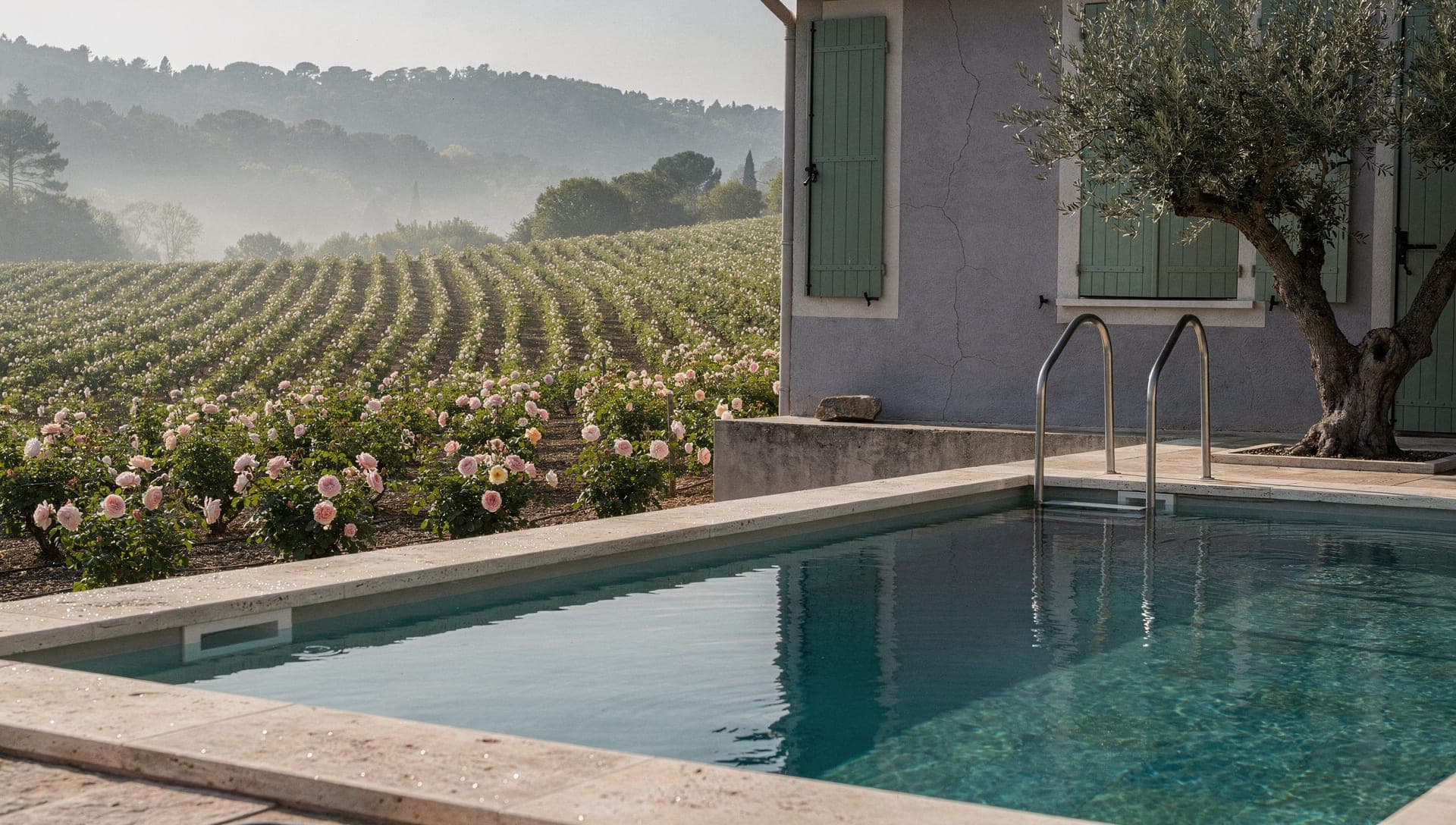
People say Grasse and picture a shop counter. The real thing is a band of terraced hillsides running from Plascassier and Pégomas up to Châteauneuf-de-Grasse and Le Bar-sur-Loup, where flowers have been grown for the perfume trade for roughly three hundred years. Three plants matter most. The rose centifolia, called rose de mai after the month it flowers, gives a honeyed and slightly peppery note. Jasmine grandiflorum opens at night through the warm and humid end of summer. Tuberose and orange blossom fill out the calendar. The soil, the shelter of the Pre-Alps and the day-to-night temperature swing are why these fields sit here and almost nowhere else in France.
In 2018 UNESCO added the perfume know-how of the Pays de Grasse to its list of the Intangible Cultural Heritage of Humanity. The listing covers three linked skills, growing the perfume plants, knowing and processing the natural raw materials, and the art of composing a scent. That recognition matters to a buyer for a practical reason. It ties the town’s identity to keeping real fields in production, which is a brake on the kind of blanket development that has swallowed flower land elsewhere on the coast. When you stand on a terrace in Opio at dusk and the hills are still green to the ridge, the perfume economy is part of why.
The trade nearly disappeared once. Through the late twentieth century, cheap synthetics and cheaper land in Egypt and Morocco pulled the flower fields down to a fraction of their former acreage, and much of the old growing land around Grasse was sold and built. What saved the rest was the big fashion houses deciding, from the 1980s on, that they wanted a guaranteed source of the real French flower for their signature scents. That decision is why a working field still sits below a villa terrace today. For a buyer it is a useful piece of history, because it explains why the surviving fields are protected, contracted and unlikely to move, rather than a pretty accident that might vanish next year.
The flower calendar, month by month
Life in these villages runs on a growing season, and it helps to know it before you buy, because it changes how a spring or late-summer morning feels. From roughly early May the rose de mai harvest runs for four to six weeks depending on the sun, finishing in the first days of June. Pickers are in the rows at dawn, and a full-grown centifolia field gives off a scent you catch from the road. A rose is worth more the faster it reaches the still, which is why so much of this crop now moves on a short local circuit rather than a long supply chain.
Then the fields go quiet through high summer until the jasmine starts. Jasmine grandiflorum blooms every night from August into October, and the flowers are picked from first light until mid-morning while the scent still holds. It is slow, hand-done work, and the numbers are humbling. It takes several thousand flowers to make a small amount of absolute. Orange blossom in spring and tuberose in late summer fill the gaps. For a resident this rhythm is the real reward. You get two long stretches, May and late summer, when the surrounding land is at its most alive, and the festivals are timed to catch both ends.
There is a practical side worth knowing before you fall for a field view. A working flower farm is a farm, with the dawn activity, the occasional tractor and the seasonal labour that come with it. Most buyers like the sight of the picking crews at first light, and they are gone by the time you take a late breakfast, but if you want silence at seven in the morning in May, a plot directly above an active parcel is not it. The same fields also mean the land around you is managed and cut back, which keeps fire risk lower than an abandoned scrub hillside, a real consideration in this part of the Alpes-Maritimes. Ask the agent which parcels nearby are under cultivation contract and which are only zoned agricultural, because the first kind is far more likely to stay green.
Two festivals that frame the year
The town marks its flowers twice. ExpoRose runs from 8 to 10 May 2026, the theme this year is Envie d’évasion, and the old centre fills with roses. The route links the Villa Fragonard, the Jardin des Plantes, the Place aux Aires and the Médiathèque Charles Nègre, and the Cours Honoré Cresp holds the rose market with growers, workshops and demonstrations. It lands right in the middle of the rose de mai harvest, so the flowers on the stalls are the flowers coming out of the fields that same week.
The bigger event is the Fête du Jasmin, and the 2026 edition runs from 31 July to 2 August. The centrepiece is the corso fleuri, a decorated flower parade through the town on the Saturday evening, where floats throw jasmine and other blooms into the crowd. Friday opens with dancing and a firework at quarter past ten. Sunday brings a mass in Provençal and the Mondial Parfumé de Boules Carrées, a square-boules tournament. If you live in a village like Châteauneuf or Opio, these two weekends are the ones you plan the summer around, and they are a real draw for buyers who want the culture without living inside the busy old town.
A word on the practical side, because the festivals do touch daily life. On the Fête du Jasmin weekend the old centre of Grasse closes to traffic for the parade, parking goes early, and the roads down towards the Pénétrante slow in the evening. Residents of the outer villages treat it as a night to walk in or to arrive well before the corso. None of this is a reason to buy or not buy, but it is the kind of local rhythm that a summer visitor never sees and a resident plans around. The upside is that both festivals are free, family-run and rooted in the town rather than staged for tourists, which is exactly the texture buyers say they are looking for when they choose the hinterland over the coast. Our guide to spring in Grasse covers the May rose season.
The perfume houses and the museum
Three historic houses keep their doors open in Grasse and give the town its daily working texture. Fragonard, Molinard and Galimard all run factories and boutiques open to visitors, with tours that walk you through extraction and blending and let you compose your own scent. They are tourist-facing, and that is the point. They keep the trade in the town centre and put visitors, and their spending, in the old streets rather than out at a coastal resort.
The reference point for anyone serious about the subject is the Musée International de la Parfumerie in the town centre, which holds one of the largest perfume collections in the world, from ancient flasks to modern industry. Its gardens, the Jardins du MIP, sit down the hill at Mouans-Sartoux and grow the raw plants across a conservatory field open to walkers. For a resident this is quiet, useful culture, the kind of place you take visiting family in the morning and then drive fifteen minutes home. It also feeds the schools and the town’s calendar, and it is one reason Grasse keeps a real year-round life while some coastal towns empty out of season.
Beyond the three big names, a layer of smaller creators has grown up in and around Grasse over the last decade, independent perfumers, natural raw-material houses and training schools that draw people who want to learn the trade properly. That matters to the property market in a small but real way. It brings a stream of professionals who want to live near the town rather than commute from the coast, and it supports the cafés, the schools and the year-round trade that make a village feel lived in. When buyers ask us why Grasse holds a working population when prettier coastal spots hollow out, the perfume economy, old and new, is a large part of the answer.
The working fields behind the great perfumes
What surprises new buyers is how much of the world’s finest perfume flower still comes from a handful of small local farms, some of them a short drive from a house you might buy. The Domaine de Manon at Plascassier, run by Carole Biancalana, grows perfume plants and sends its entire harvest to Christian Dior for its absolutes. Visitors are welcome in season to watch the picking. It is the clearest picture you will get of the short circuit that now defines high-end Grasse flower, field to still in a single morning.
The bigger operator is the Mul family, whose fields at Pégomas and Plascassier have supplied Chanel since a 1987 partnership. The family grows rose, jasmine and iris, and a large share of the Grasse jasmine that goes into Chanel No 5 is grown here. For a buyer the lesson is about planning more than romance. These are protected agricultural parcels. A green field below your terrace that belongs to Chanel or Dior is far less likely to become a building site than an ordinary plot, and that permanence is a quiet part of what makes the best view lots here hold their value.
If the subject pulls you in, there are ways to touch it as a resident rather than a tourist. Some farms take on seasonal pickers in May and again for the jasmine, a few offer harvest mornings and workshops, and the local associations that carried the UNESCO file run events through the year. We have had buyers choose Plascassier or the Grasse side specifically so an early riser in the family was able to join a rose picking, and others who liked knowing the field below them fed a bottle they recognised. It is a soft factor, not a spreadsheet one, but it is the kind of thing that makes owners here stay put, and low turnover in a village is itself a sign of a market worth buying into.
Where to live, and what it costs in 2026
Perfume country is not one price. Grasse itself is the value base, and the villages ringing the flower hills carry a large premium for space, quiet and a sea horizon. The figures below are mid-2026 estimates from MeilleursAgents and comparable trackers, all types combined unless noted. Treat them as a starting map, not a valuation, because a renovated bastide with a view and a poor apartment on the ring road sit a long way apart inside the same commune.
| Town or sector | Avg €/m² (all types) | Houses €/m² | What your money buys |
|---|---|---|---|
| Grasse (commune) | ~3,746 | ~4,247 | The affordable base, old-town flats and family houses on the plain |
| Plascassier / Plan de Grasse | - | Plascassier: €5,939/m² (DVF, houses sold for €1M or more, 2021–2025, 21 sales). Plan de Grasse: no DVF figure | Flower-field edge, villas within reach of Sophia |
| Mouans-Sartoux | ~5,416 | - | Museum gardens, schools, TER station, family town |
| Châteauneuf-de-Grasse | ~6,197 | ~6,553 | Hilltop views, quiet plots, the plateau premium |
| Opio | ~6,415 | ~6,464 | Golf and olive terraces, minutes from Valbonne |
The pattern is plain. A real house in Grasse costs what a two-bedroom apartment costs in Opio, and the flower country wraps around all of it. Our view is that the smart buy in perfume country is a view plot on the Grasse or Plascassier side, where the setting is identical to the pricier villages and, on recorded sales of houses at €1M or more, the price per square metre is 22 to 26 per cent below Opio and Châteauneuf-de-Grasse, as long as you accept a slightly longer run to Sophia and a town centre that works for a living rather than for a postcard. Sector prices are in our article on Grasse prices by sector.
Daily life, roads and schools
The practical frame around perfume country is the same one that governs the whole hinterland. The RD2085 is the spine, running from Grasse through Châteauneuf and Le Rouret towards Roquefort-les-Pins, with the roads through Opio leading to the Valbonne roundabouts, and it carries the morning traffic. The A8 motorway is reached at the Antibes or Cannes junctions, with the Pénétrante linking Grasse down to it. Sophia Antipolis, the tech park that drives local demand, is about twenty to thirty minutes from most of these villages outside peak, longer at eight-thirty on a school day, so test your own commute on a Tuesday morning before you sign.
Schools shape the map as much as anything. The Campus International de Valbonne, the CIV, with its international sections, pulls relocating families towards the Valbonne and Opio side, and the Mougins British International School serves the English-speaking market from the other direction. Grasse and Mouans-Sartoux run strong state schools and a TER rail station that reaches Cannes and Nice without the motorway. Markets keep the week honest, with Grasse trading most mornings on the Place aux Aires and the Cours Honoré Cresp, and the smaller village markets filling the rest. This is a place to live year round, not a summer address, and the perfume calendar is part of why the town never fully closes.
One more piece of ground truth on access. Grasse itself sits high, and the roads up to it wind, so a home in the town or on the plateau villages above trades a few minutes of driving for the light and the view. Families weigh this differently than couples or retirees. If your day is two school runs and a Sophia office, a Plascassier or Plan de Grasse address on the lower, flatter ground often works better than a hilltop in Châteauneuf, even though the hilltop photographs better. Our standard advice is to map your real week, the school gates, the office, the supermarket and the airport at Nice, and drive it once before you narrow the search. The flower country is lovely from every angle, but the daily minutes are what you live with.
Does the perfume heritage add to value?
Here is the question buyers ask, and the answer is more useful than the marketing. The perfume label does not put a measurable premium on a price per square metre the way a sea view or a Sophia commute does. Nobody pays five per cent more for a house because a jasmine field is famous. What the heritage does is protect the setting, and that protection is where the money sits. Agricultural zoning around the flower farms, the UNESCO identity that keeps the town invested in its fields, and the general reluctance to build over productive land all keep the open green frame that view buyers pay a large premium for.
So the value runs through the setting, not the story. A plot that looks over the Mul or Manon fields is worth more because it will still look over fields in twenty years, not because the flowers smell good in May. In our view, buyers should love the perfume culture for what it is, a genuine and pleasant part of daily life, and price the property on the ordinary things, the plot, the light, the build quality and the access. If a listing leans hard on perfume romance to justify a number the square metres do not support, that is a reason to slow down, not to pay up.
There is one exception worth naming. A genuine old flower farm, a bastide with its own terraced parcels that once grew rose or jasmine, is rare. It carries a real premium because so few exist and nobody is able to recreate them. Scarcity and land create that value, the same forces that price any rare property. The perfume label does not. If you are ever offered one, treat it as the serious purchase it is, check the water rights, the access and the state of the restanques, and value it as agricultural land with a house rather than as a story. Everything else in perfume country prices on the ordinary rules, and that is good news, because a careful buyer finds fair value here without paying for the myth.
Our view on buying here
Perfume country is one of the few parts of the Riviera where the postcard and the daily reality mostly agree. The fields are real, the festivals are real, and the protected land keeps the hills green in a way the coast lost decades ago. For a buyer who wants a working village with culture, schools and a short Sophia run, the Grasse side offers the best value in the whole hinterland, and Châteauneuf and Opio offer the same setting at a plateau premium if the view and the quiet are worth the extra to you.
The caveats are ordinary and count for more than the romance. Grasse town has patchy sectors, so buy the street, not the name. The RD2085 clogs at rush hour, so drive your commute before you commit. And treat any perfume-scented sales pitch with a cool eye, because the flowers add to your life, not to your resale. Buy the plot, the view and the light. The jasmine is a bonus that comes free with the address, and in our experience it is the part owners here never tire of.
If you want a single rule to carry into a viewing, use this one. Stand on the terrace, look at the view, and ask what it will be in twenty years. In perfume country the honest answer is more often green than it is anywhere else on this coast, and that is the real prize. Book the trip for May or for the first days of August if possible, walk one market and one field, and you will know within an afternoon whether this is your part of the hinterland. Start with our Grasse property guide.